Why does a knot hold?
Follow a cord’s path and discover how contact, friction and the chosen shape work together.
The short answer
Pull a knotted cord and parts of it press together. Their surfaces resist sliding against each other: this is friction. The exact path of the cord matters too. Practice knots are for learning at a table, never for safety or climbing.
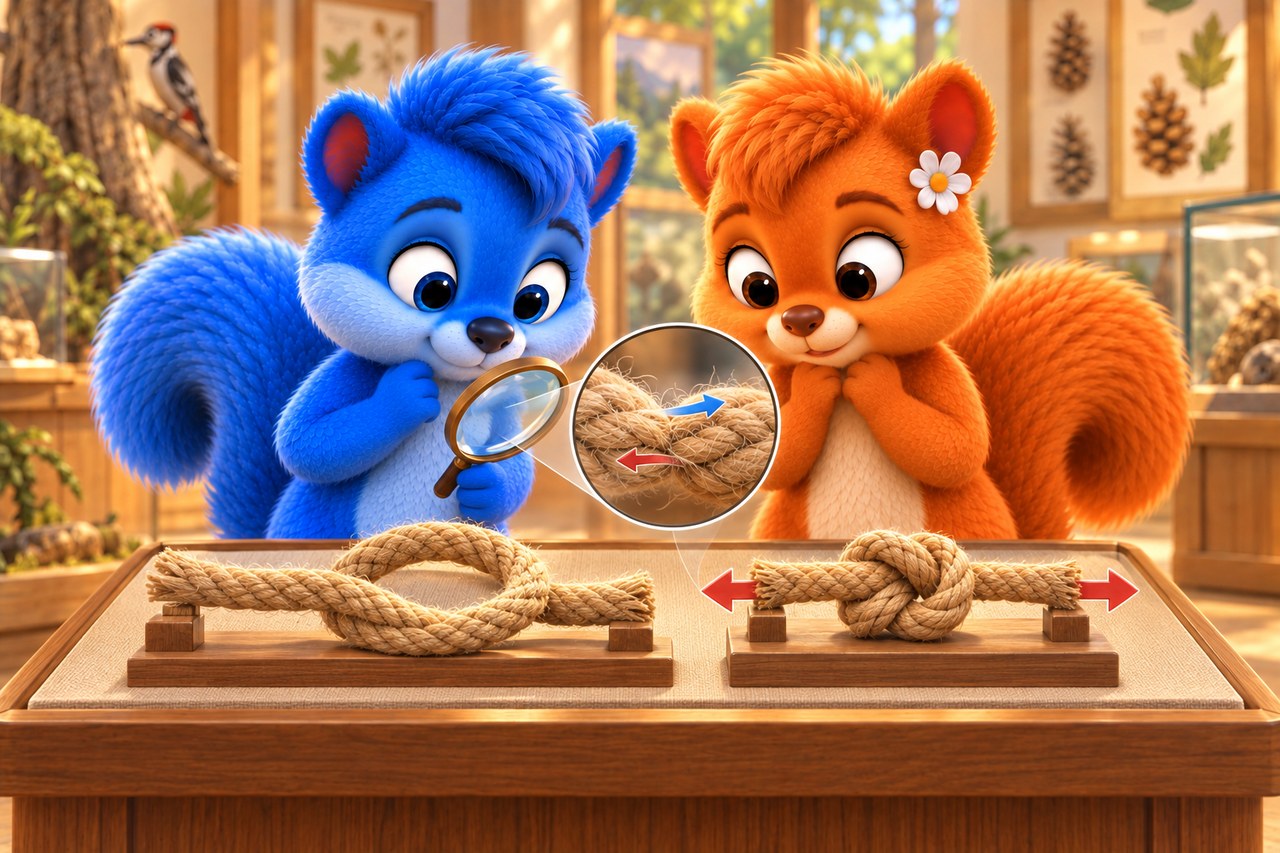
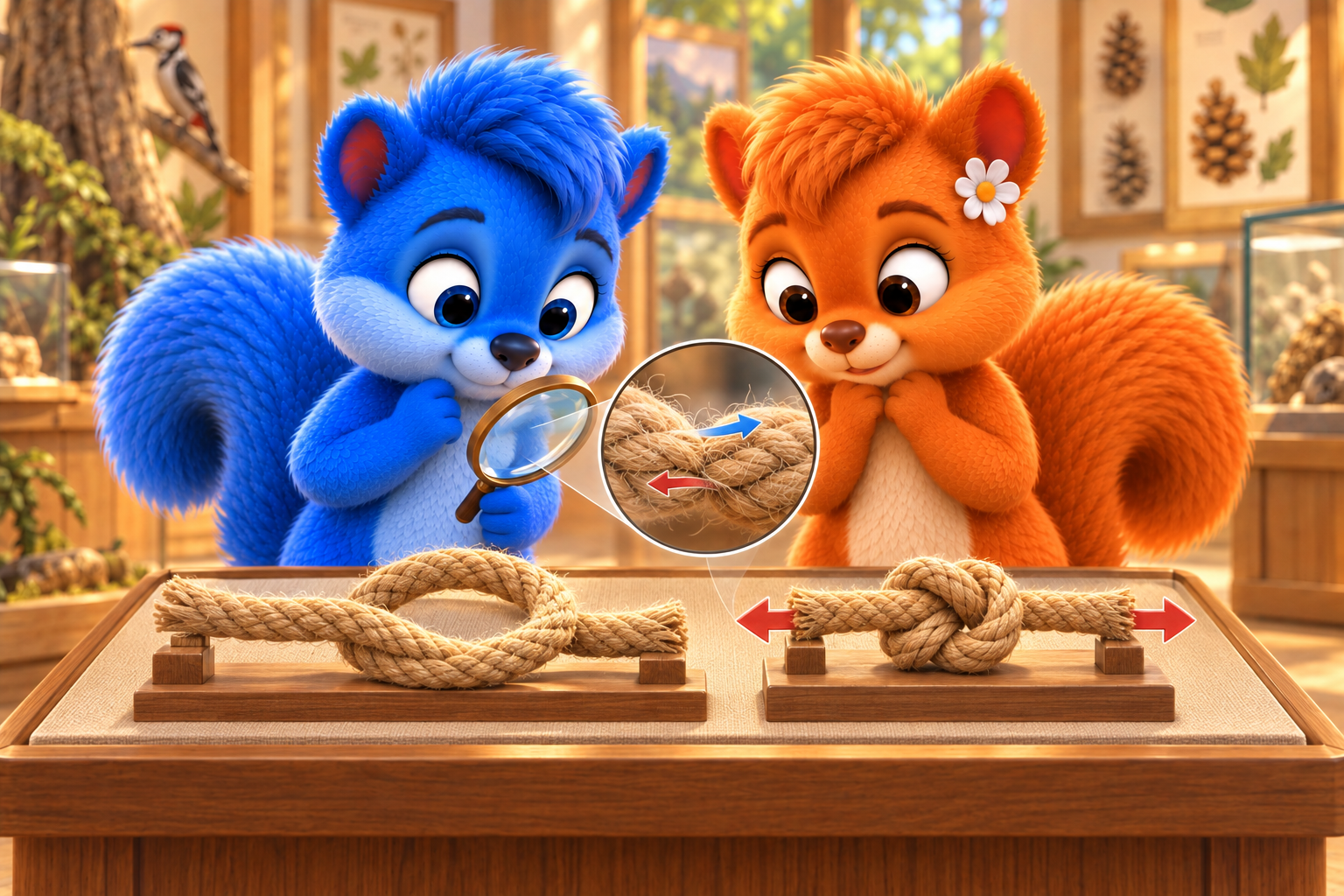
Puschel and Flauschi in the museum. Loose and tensioned cord with enlarged contact surfaces inside the knot. Simplified inanimate museum model; arrows and colours help explain it. AI-created illustration, not a photograph of nature.
Explained in three pictures
1 Cord meets cord
Parts of the cord pass over and under other parts.
2 Contact under tension
Pulling can press the parts more strongly together.
3 Friction resists sliding
Friction at contact surfaces resists sliding. Shape and material matter.
More about the picture
Contact, friction and the cord’s path explain why a knot can hold. Shape and material affect the result. The enlarged contact view is not a particular load-bearing knot or a tying sequence; more turns do not guarantee safety.
An imagined Wusel scene
Puschel and Flauschi investigate
Using a short practice cord on the table, Puschel copies the shown path. A gentle pull makes it slip. Flauschi checks the crossing: one part went over instead of under. He corrects it and tests again, keeping the cord away from bodies.
Look closely
Compare the museum model with the three picture steps. Pulling can press the parts more strongly together.
An example to help you understand
Draw two short crossing lines. At a crossing, leave a small gap in the lower line: this shows which line is on top. Swap the upper and lower lines in a second drawing. If an adult demonstrates a short soft cord, follow its path with your eyes only. Compare the drawing and cord: where do sections touch, and where is there a gap? Do not pull hard or add a weight. The comparison shows path and contact, not load capacity.
Try explaining it
What can stop cord sections slipping in a knot?
Choose a), b) or c), then explain your choice.
- a)Contact, pressure and friction between them.
- b)The length of the free ends alone, regardless of the cord's path.
- c)The cord sections having as little contact as possible inside the knot.
Show the explanation
Correct: a): Contact, pressure and friction between them.
Pull a knotted cord and parts of it press together. Their surfaces resist sliding against each other: this is friction. The exact path of the cord matters too. Practice knots are for learning at a table, never for safety or climbing.
Word help
- friction
- An effect between touching surfaces that resists sliding between them.
Explore in more detail
Here you will find longer explanations and further details. You can explore them together.
1. The cord’s path matters
A knot comes from a particular path: sections pass over, under or through other sections. A crossing alone is not a completed knot. A drawing therefore needs to show which section is on top. In a simple overhand knot, a loop is formed and a free end passes through it. A free end is the cord’s tip that you can move. A name alone is not enough: leading an end incorrectly can produce a different arrangement.
2. Contact and friction help it hold
Sections of cord touch inside a knot. As it tightens, its shape can press sections against one another. Friction is the force that opposes sliding at these contacts. It helps stop sections simply sliding past each other. It is not glue: a knot may still loosen or slip. The cord’s resistance to bending, thickness and material also affect its behaviour. A drawing of its path alone therefore cannot tell us what load a real knot can withstand.
3. Different tasks need different knots
A stopper knot makes a thickened part of a cord. This can stop an end sliding through a suitably small opening. The overhand knot is a simple example. A binding knot instead holds cord around something such as a light gift. The square, or reef, knot belongs to this group. It is not a safe general way to join two ropes: it may change shape unfavourably and come undone. A familiar knot is therefore not automatically suitable for every task.
4. Observe slowly instead of pulling hard
To learn, an adult can demonstrate a simple, loosely arranged knot. Together, follow the cord from one end to the other and identify its contacts. Understand first, then repeat slowly and go back if needed. Many turns do not prove that a knot is good. A shape that is difficult to undo is not automatically safe either. Specialists choose suitable ropes, knots and checks for real tasks. Our tabletop example helps understanding; it does not replace that choice.
An optional question for further exploration
You can use the longer explanation above. This is extra, not needed for the first quiz.
An extra question
What helps a knot resist slipping: glue, or contact and friction between sections of cord?
Discover the answer
Sections of cord press against each other inside a knot. Friction opposes sliding; shape and material affect the result. No glue is needed. A particular arrangement still does not automatically suit every load.
Pictures and sources for adults
Sources for further reading
Facts checked against the specialist sources below on 12 October 2026. The Wusel scene is fictional; comparisons and simplified models are explicitly explained. Sources are in English.