Why does Jupiter have stripes and a red spot?
These striking patterns belong to moving clouds. Jupiter has no solid ground like Earth.
The short answer
Jupiter's light and dark stripes are cloud bands in its atmosphere. Strong winds move them in different directions. The Great Red Spot is a huge long-lived storm, not a fixed mark on solid ground.
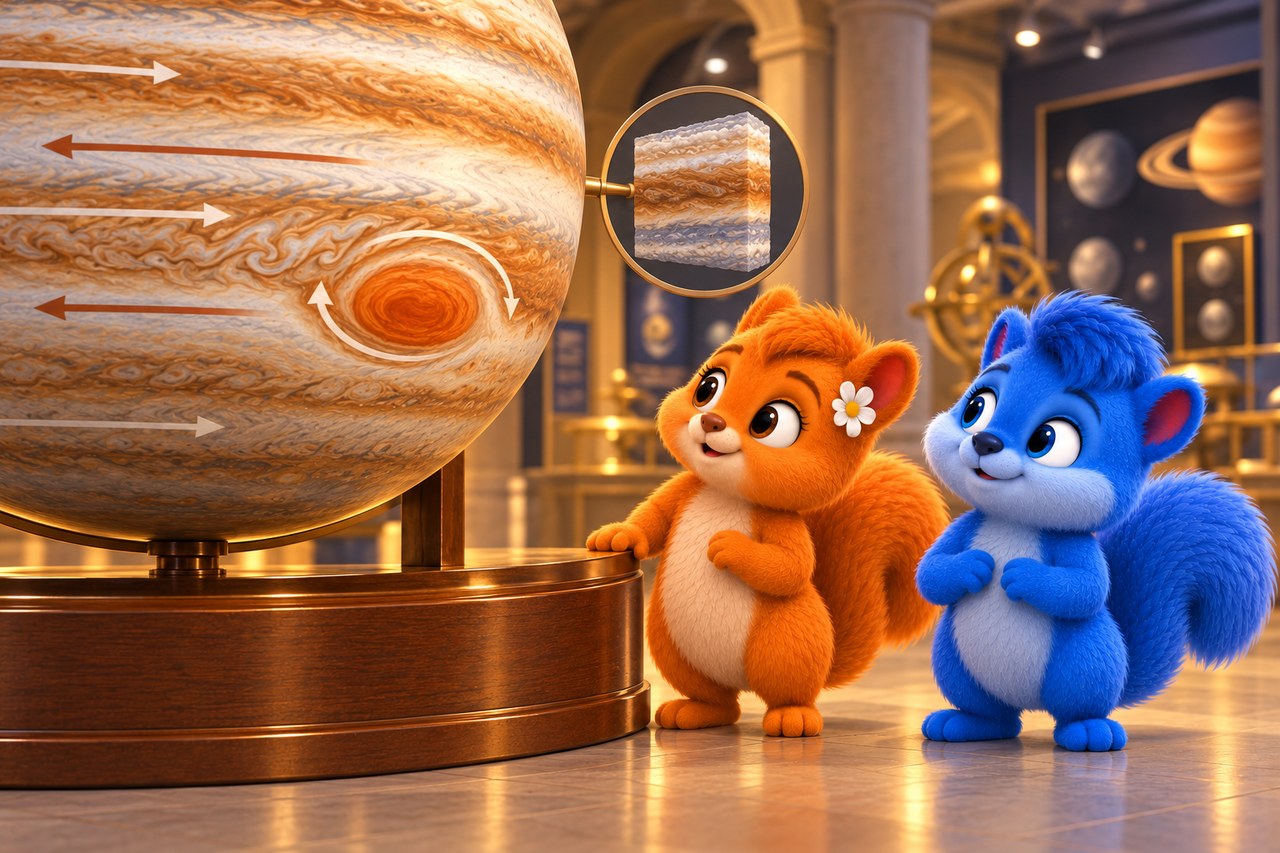
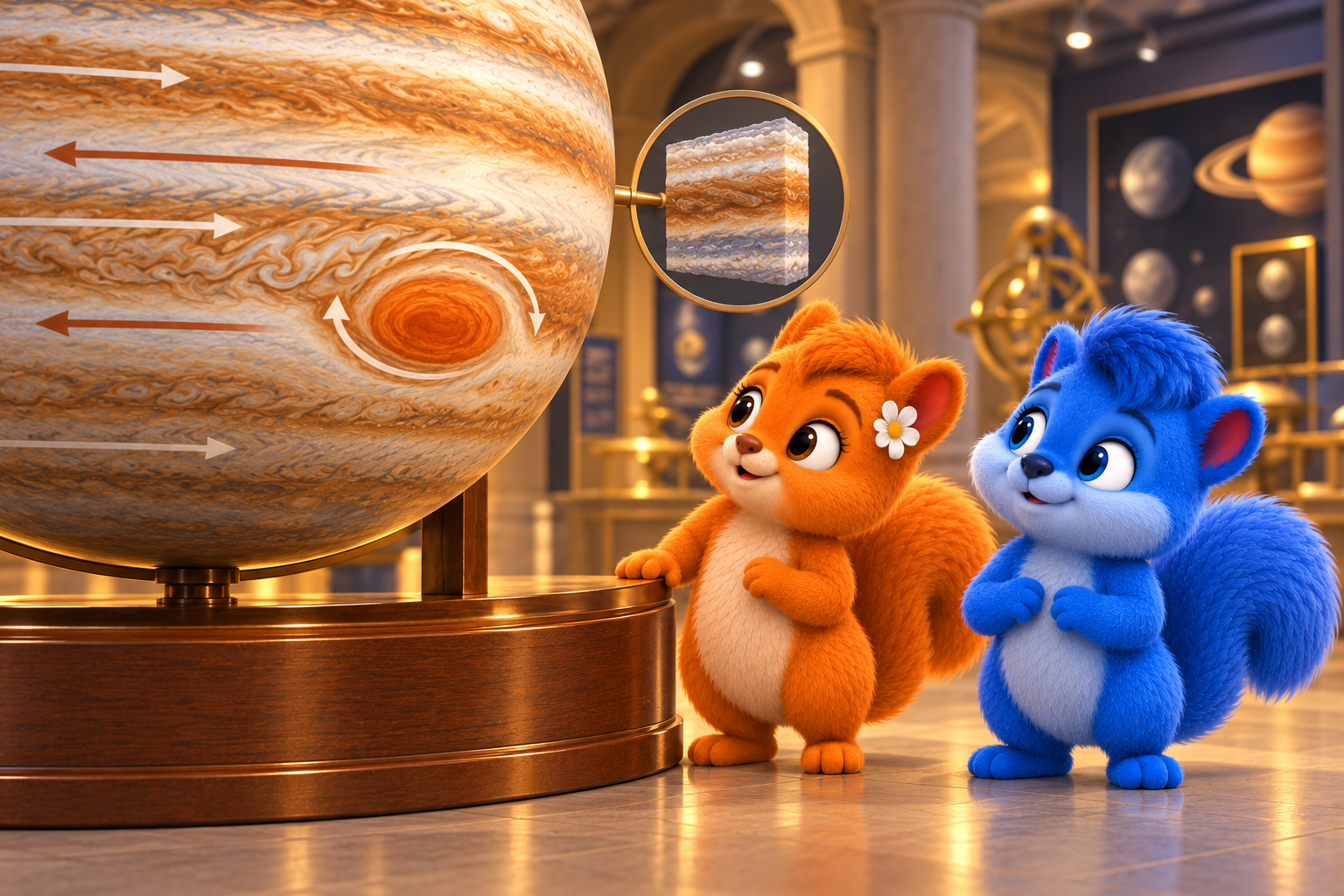
Puschel and Flauschi in the museum. Jupiter model with cloud bands, wind arrows and an enlarged vortex. Simplified inanimate museum model; arrows and colours help explain it. AI-created illustration, not a photograph of nature.
Explained in three pictures
1 Cloud bands
Light and dark cloud regions form bands.
2 Wind in two directions
Strong neighbouring winds blow in different directions.
3 A swirling storm
The Great Red Spot is a huge swirling storm.
More about the picture
Jupiter’s rapid rotation and atmospheric flows help explain its bands. The arrows show different wind directions. The Red Spot is a huge swirling storm; its shape and size change.
An imagined Wusel scene
Puschel and Flauschi investigate
Puschel draws Jupiter's Red Spot as a hole in a solid ball. Flauschi follows the moving clouds in the museum film. They place arrows around the spot. He redraws it as a storm in moving air rather than a hole.
Look closely
Compare the museum model with the three picture steps. Strong neighbouring winds blow in different directions.
An example to help you understand
Draw a circle with light and dark stripes and an oval spot. Add arrows around the spot for motion. Your drawing shows the arrangement of cloud patterns, not a real storm. Compare Earth and Jupiter circles: a 1-centimetre Earth diameter would mean roughly 11 centimetres for Jupiter. This does not model distances in space.
Try explaining it
What is Jupiter's Great Red Spot?
Choose a), b) or c), then explain your choice.
- a)A moon casting a red shadow on Jupiter.
- b)A huge storm in the atmosphere.
- c)A large crater in solid ground.
Show the explanation
Correct: b): A huge storm in the atmosphere.
Jupiter's light and dark stripes are cloud bands in its atmosphere. Strong winds move them in different directions. The Great Red Spot is a huge long-lived storm, not a fixed mark on solid ground.
Word help
- atmosphere
- The gas layer around a world; on Earth it is the air above us.
- rotation
- Turning around one's own axis.
- axis
- An imaginary line around which something turns; in machines it may also be a physical part.
Explore in more detail
Here you will find longer explanations and further details. You can explore them together.
1. An enormous planet
Jupiter is the fifth planet from the Sun and the largest in our solar system. Its diameter is roughly eleven times Earth’s. Diameter means the distance through a sphere’s centre from side to side; it does not mean eleven times the volume. Jupiter is mostly hydrogen and helium and is called a gas giant. Conditions deep inside are very different from those in an ordinary balloon.
2. The stripes are clouds
From outside we see clouds in its atmosphere, the surrounding gas envelope. Light and darker bands lie beside each other. Strong winds move them in different directions. Jupiter rotates once in about ten hours around an axis: an imaginary line through its poles. Its rapid rotation and atmospheric movements help explain the bands. They are not painted roads on rocky ground. Strong wind streams separate the bands. Neighbouring streams can flow eastward and westward. Researchers infer that the upper clouds contain ammonia ice among other substances: a different substance from ordinary water ice. The stripes show distinct moving cloud regions.
Checked against: [1]
3. A spot of moving air
The Great Red Spot is an enormous atmospheric storm. Its winds and clouds move; it is not a hole or volcano. Researchers observe changes in its shape and size, so photographs from different years can differ. Image processing can also intensify colours and contrasts. Our museum model shows a characteristic appearance, not a precise current weather report.
4. Why cannot a vehicle stand there?
Below the clouds there is no solid surface like Earth’s ground. Pressure and temperature increase with depth; substances are compressed and change state. A Moon-style landing is impossible. Jupiter also has faint rings and many moons. Moons are separate bodies orbiting it, not spots on the planet.
An optional question for further exploration
You can use the longer explanation above. This is extra, not needed for the first quiz.
An extra question
Are Jupiter’s stripes landscapes a vehicle could drive on?
Discover the answer
No. They are cloud and wind patterns in a deep atmosphere. The solid museum globe is only a model.
Pictures and sources for adults
Sources for further reading
Facts checked against the specialist sources below on 12 October 2026. The Wusel scene is fictional; comparisons and simplified models are explicitly explained. Sources are in English.