Why do dragons look so different?
Dragons appear in stories and art. Compare imagined features and discover what an old picture actually shows as evidence.
The short answer
Dragons are imagined beings from different storytelling traditions. People give them different shapes, abilities and roles. There is no single correct dragon. A story is not an animal description.
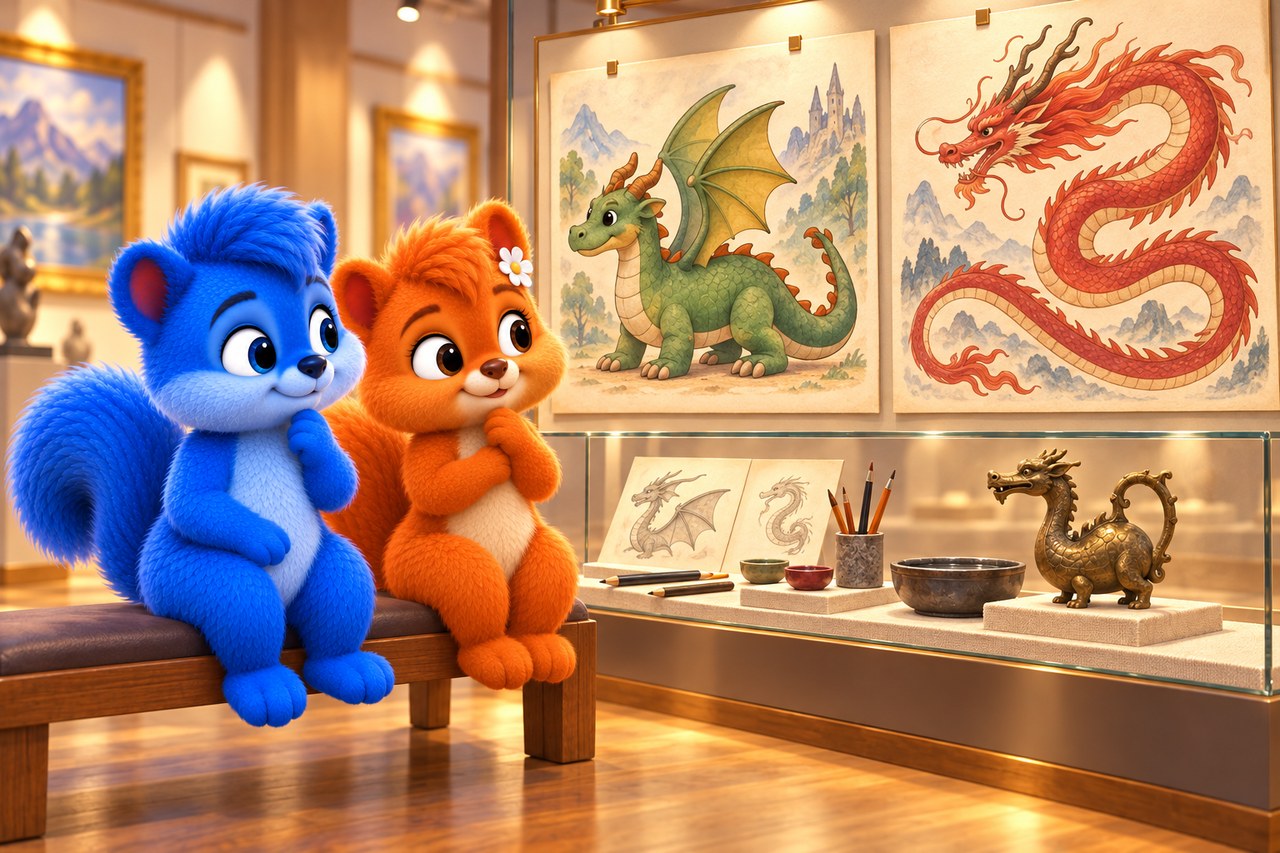
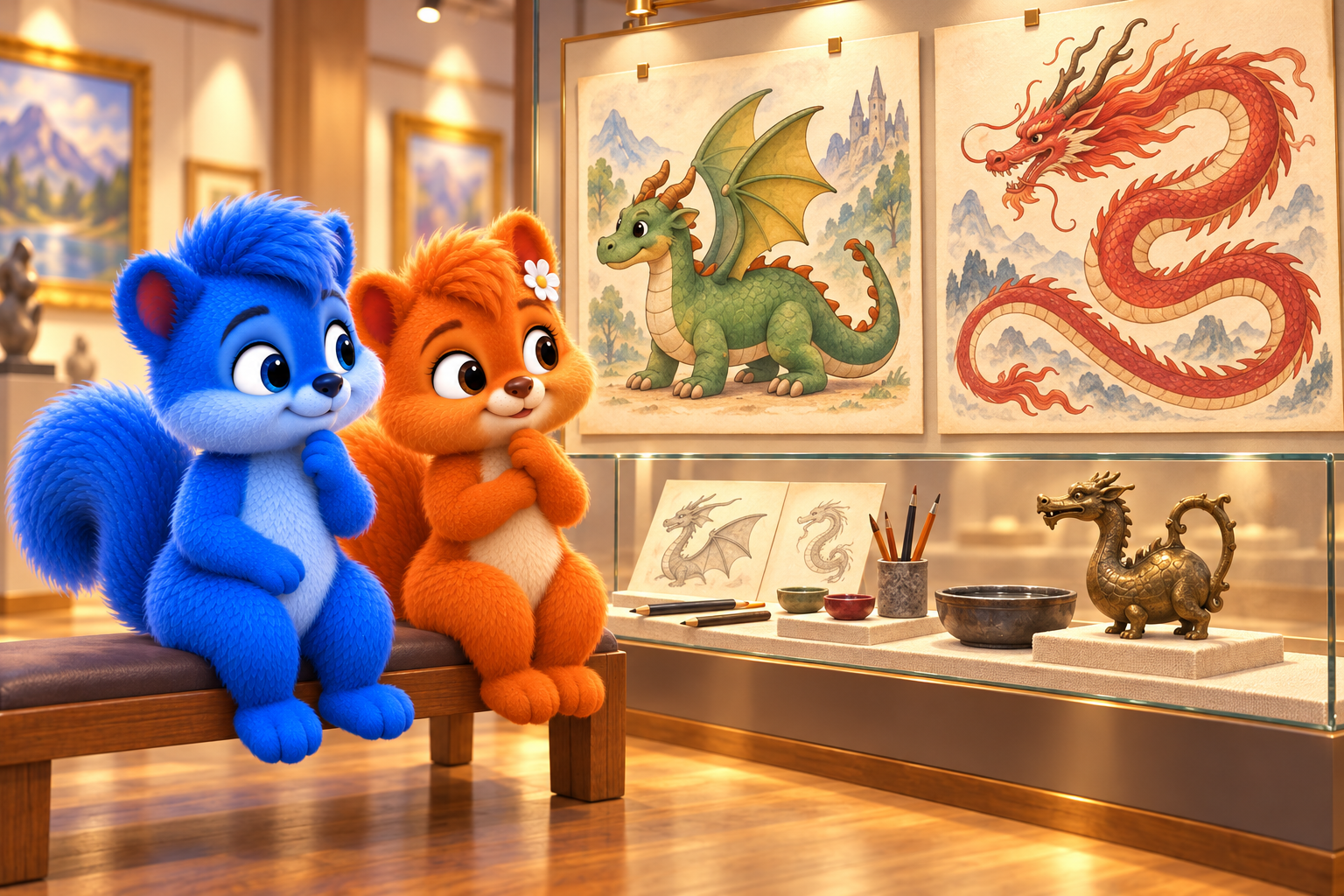
Puschel and Flauschi in the museum. Two invented dragon pictures with different body shapes and a dragon-shaped vessel. Art and invented designs, not living dragons. AI-created illustration, not a photograph of nature.
Explained in three pictures
1 A design with wings
Our first imaginary dragon has wings and four legs.
2 A design without wings
Our second has a long body and no wings.
3 People invent
People design dragons to suit stories and traditions.
More about the picture
Dragons belong to stories and art. People design them differently to suit a story, period and tradition. These two designs are explicitly our own inventions and do not stand for a particular culture.
An imagined Wusel scene
Puschel and Flauschi investigate
Puschel wants to sort all dragon pictures by one rule. Flauschi finds one without wings and another with a different role. They read the origin labels. Now they sort by story and depiction instead of declaring one picture wrong.
Look closely
Compare the museum model with the three picture steps. Our second has a long body and no wings.
An example to help you understand
Draw two friendly dragons of your own. Give one wings, for example, and the other none. With adults, write “Invented by us” beneath them. Describe two visible features of each. Then ask separately: what does our drawing show, and what does it provide evidence for? It shows your idea and provides evidence that you drew it. It provides no evidence for an animal like this living in nature. Your designs do not represent any particular cultural tradition.
Try explaining it
Why can dragons look different in stories?
Choose a), b) or c), then explain your choice.
- a)Because every picture shows the body of the same real species.
- b)Because all stories follow one binding description of a dragon.
- c)They are imagined beings from different traditions.
Show the explanation
Correct: c): They are imagined beings from different traditions.
Dragons are imagined beings from different storytelling traditions. People give them different shapes, abilities and roles. There is no single correct dragon. A story is not an animal description.
Explore in more detail
Here you will find longer explanations and further details. You can explore them together.
1. A name for many imagined forms
Dragons are imaginary creatures in narratives and art. People depicted them differently at different times and places. A dragon may appear threatening in one artwork and carry a protective meaning in another. It helps to ask about the particular work and its history rather than assign every dragon the same meaning.
Checked against: [1]
2. Features are combined in new ways
Artists combine features such as snake-like bodies, wings or claws into imagined creatures. Depictions do not all share the same body parts. Medieval manuscripts can even contain different dragon forms within one book. A bestiary is a historical book about animals and also fantastic creatures; such books often connected descriptions with religious or moral interpretations. They are not modern zoological species catalogues.
3. A real picture with imagined content
A surviving dragon picture can show that people created such a depiction. The work is a real historical object. Its pictured content does not thereby prove that such an animal lived. To understand a work, specialists ask about its material, origin, date and meaning in its particular context. A dragon object could even be useful: The Met holds a roughly 800-year-old dragon-shaped vessel used to pour water for handwashing. Such a vessel is called an aquamanile. Its body held water and a small opening served as the spout. Here an imaginary shape connects art with an everyday task.
4. A real animal with a similar name
The Komodo dragon is a real large lizard. Its name does not make it a fire-breathing imaginary dragon. We distinguish the studied lizard from an imagined creature and look carefully at which case a picture represents.
Checked against: [3]
An optional question for further exploration
You can use the longer explanation above. This is extra, not needed for the first quiz.
An extra question
What could a medieval dragon-shaped vessel be used for?
Discover the answer
To pour water for handwashing. Such an aquamanile combined an imaginary shape with a practical task. Its dragon shape is art, not evidence of a living dragon.
Pictures and sources for adults
Sources for further reading
Facts checked against the specialist sources below on 12 October 2026. The Wusel scene is fictional; comparisons and simplified models are explicitly explained. Sources are in English.