What is DNA?
Tiny chemical building blocks store information living cells can use.
The short answer
Inside your cells is DNA: a tiny, very long strand. The order of its building blocks carries information cells use for their work. Think of letters: the same letters in a different order can mean something different.
DNA has chemical building blocks, not printed words.
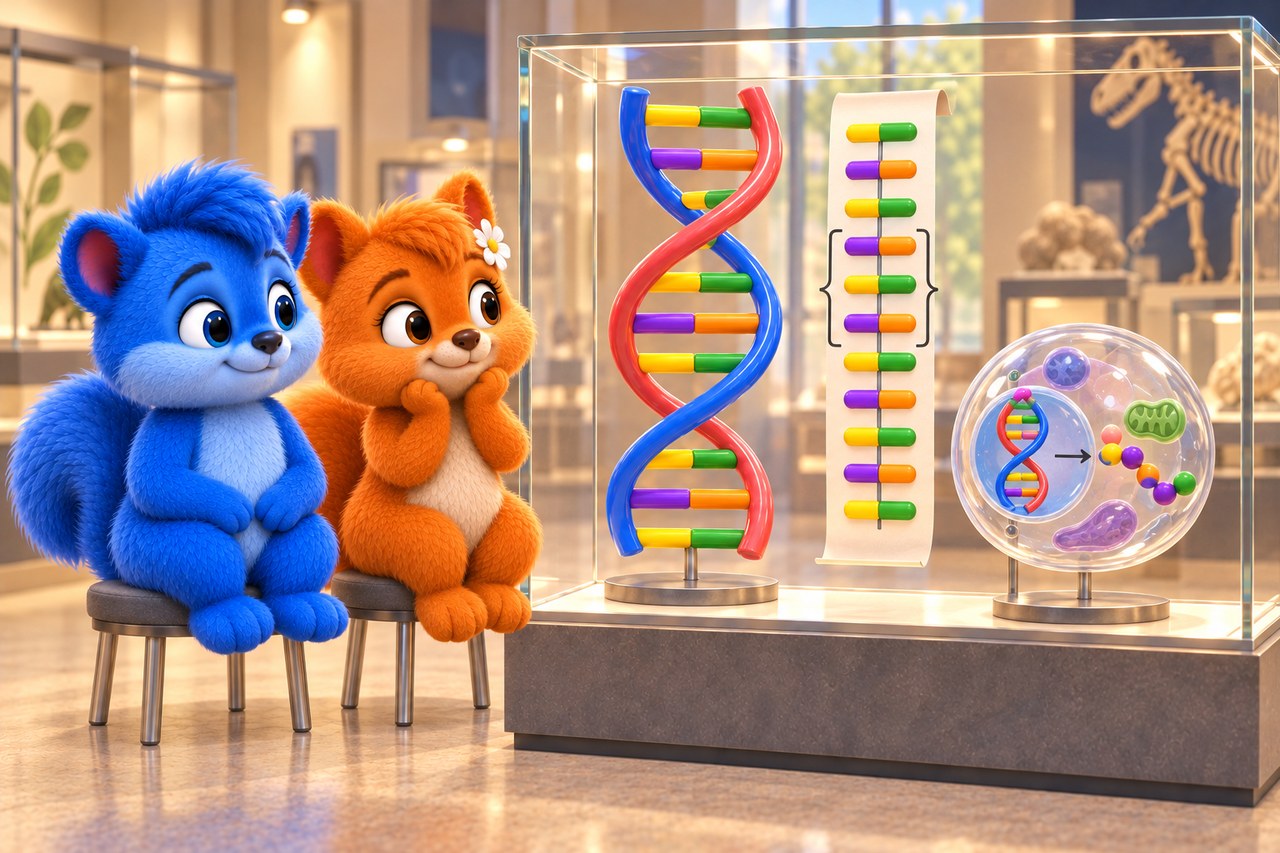
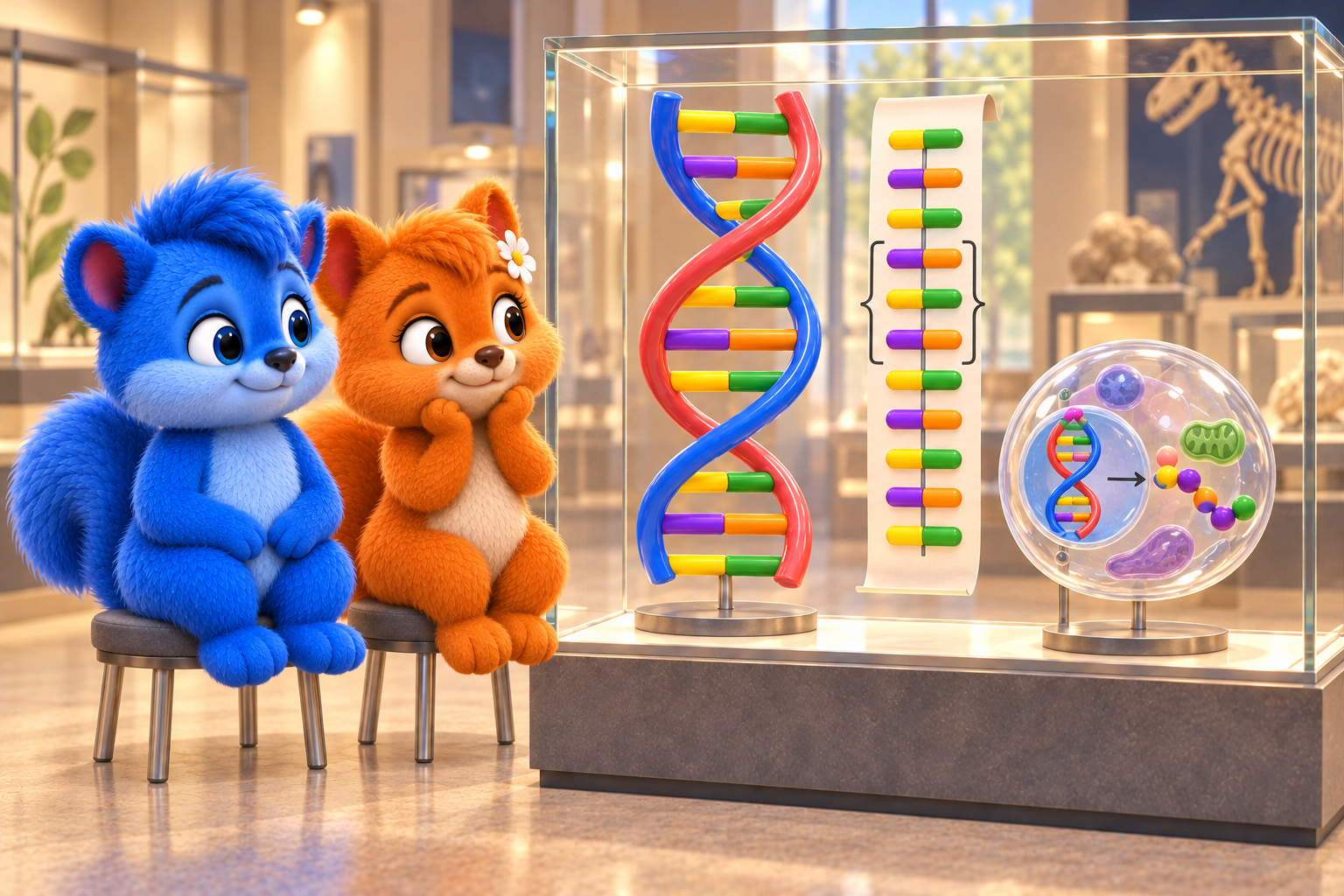
Puschel and Flauschi in the museum. DNA model with two building-block pairs, a sequence and a marked section. Colours stand for building blocks, not real DNA colours. AI-created illustration, not a photograph of nature.
From cells to information
1. Where is DNA?
The large green shape stands for a body cell. The blue circle is its nucleus. The purple lines inside stand for DNA. Everything is greatly enlarged and simplified.
2. Pairs and order
A piece of DNA is drawn as a flat ladder. Read down the left side: A–G–T–C. Their partners are T–C–A–G. The order along the ladder carries information.
3. A working copy is made
For many proteins, the cell uses information from a section of DNA. First it makes a working copy: messenger RNA. This is the single turquoise wavy line. The DNA stays in the nucleus.
4. The cell builds proteins
Outside the nucleus, the copy is used to join protein building blocks in the right order. The pink bead chain stands for a protein. Proteins can act as building parts or tools in the cell.
A gene is a section of DNA with a biological function. Here we show the pathway for a gene that contains information for a protein.
A real gene is much longer than our four ladder rungs. Letters, colours and shapes are learning symbols; real DNA is twisted in three dimensions.
DNA does not itself become a protein. Some DNA is also found outside the nucleus in small cell structures called mitochondria.
What is DNA, and why does a cell need it?
DNA is a substance that stores biological information in the order of its building blocks. Cells use this information to make proteins, among other things. The information is passed on through a working copy; DNA is not turned into protein.
An imagined Wusel scene
Puschel and Flauschi investigate
Puschel arranges model pieces by favourite colours. Flauschi places the pairing guide beside them. They correct the pairs and compare two sequences. He notices that order carries the information, not how pretty his colours look.
Look closely
Compare the museum model with the picture steps. The order of DNA building blocks carries information. A section can be a gene.
An example to help you understand
Draw two ladder sides on paper and four rungs between them. Write one letter pair on each rung: A–T, G–C, T–A, C–G. Draw another ladder with a different order but matching pairs. What changed? The order. This shows how the same kinds of building blocks can form different sequences. Four rungs are not a real gene or a recipe for a body color. Diagram colors only help match pairs; DNA building blocks do not carry these museum colors.
Try explaining it
What carries information in DNA?
Choose a), b) or c), then explain your choice.
- a)The number of its building blocks.
- b)The thickness of the DNA strand.
- c)The order of its building blocks.
Show the explanation
Correct: c): The order of its building blocks.
Inside your cells is DNA: a tiny, very long strand. The order of its building blocks carries information cells use for their work. Think of letters: the same letters in a different order can mean something different.
DNA has chemical building blocks, not printed words. Amount alone does not tell us what information is present: order matters too. Colours are only a model aid.
Word help
- cell
- A tiny living unit. Living things are made of cells.
- DNA
- A very long strand whose sequence of building blocks carries information for living things.
- double helix
- Two strands wound around one another, somewhat like a twisted ladder.
- gene
- A section of DNA carrying particular information.
- chromosome
- A long DNA strand organised and packaged with other components.
- molecule
- A small group of connected atoms, tiny building blocks of matter.
Explore in more detail
Here you will find longer explanations and further details. You can explore them together.
1. Information in a tiny structure
Your body has very many cells. Cells are small living building blocks. Many contain a nucleus: a separated region inside the cell. Much DNA is located there. Some human DNA is also outside the nucleus. DNA is a short name for a substance carrying biological information. Cells can use this information to make substances needed for building and working. It is not a tiny paper scroll with written sentences. The DNA outside the nucleus is in mitochondria. These small cell structures help supply energy and have their own DNA.
2. A twisted ladder as a comparison
Imagine a ladder twisted like a spiral staircase. Two strands form the sides and matching building-block pairs form the rungs. This double-twisted shape is called a double helix.
The building blocks are abbreviated A, T, G and C. A pairs with T, and G with C. These letters stand for chemical substances. There is no printed writing on real DNA.
The order of blocks along a strand is especially important for its information. Our picture shows a flat ladder so you can compare the pairs. Real DNA is twisted in three dimensions. Such a structure of chemically connected building blocks is called a molecule.
Checked against: [1]
3. Genes are sections, chromosomes the packaging
A gene is a section of DNA with a particular job. Many genes carry information for proteins. These substances work in cells as components or tiny tools. Not every section of DNA is such a gene.
Long DNA strands are packaged with other substances. These organised packages are chromosomes. Packaging fits long strands into the nucleus, a region inside many cells.
A chromosome does not always look like an X. The familiar X picture shows a particular stage before cell division. Cell division is the process in which new cells form from a cell.
An extra detail you do not need to memorise for the first quiz: most human body cells have 23 chromosome pairs in the nucleus, or 46 chromosomes. Egg and sperm cells usually have only 23. A chromosome count must therefore say which cells it describes.
4. Inherited does not mean everything is decided
Humans usually receive two chromosome sets for their body cells: one from the biological mother and one from the biological father. A set here means a group of chromosomes belonging together. This describes biological origin, not who lovingly raises a child. Many traits are influenced by several genes. Environment and experiences matter too. Here, environment includes living conditions and nutrition. A person is therefore not simply a copy of their parents, and DNA alone does not determine what someone will learn or experience.
An optional question for further exploration
You can use the longer explanation above. This is extra, not needed for the first quiz.
An extra question
Our DNA paper model has A on the left of a rung. What belongs on its right according to our pairing rule?
Discover the answer
T. A pairs with T; G pairs with C. The order along the ladder can vary. Our paper model shows these matches, not a person’s entire information.
Pictures and sources for adults
Sources for further reading
Facts checked against the specialist sources below on 12 October 2026. The Wusel scene is fictional; comparisons and simplified models are explicitly explained. Sources are in English.