Body & Senses
Why do we have bones?
Puschel finds more than a coat stand in a teaching model.
The short answer
Bones form the skeleton. It supports the body, protects important organs and works with muscles and joints for movement. Bone is living tissue, not unchanging stone.
An imagined Wusel scene
Puschel and Flauschi investigate
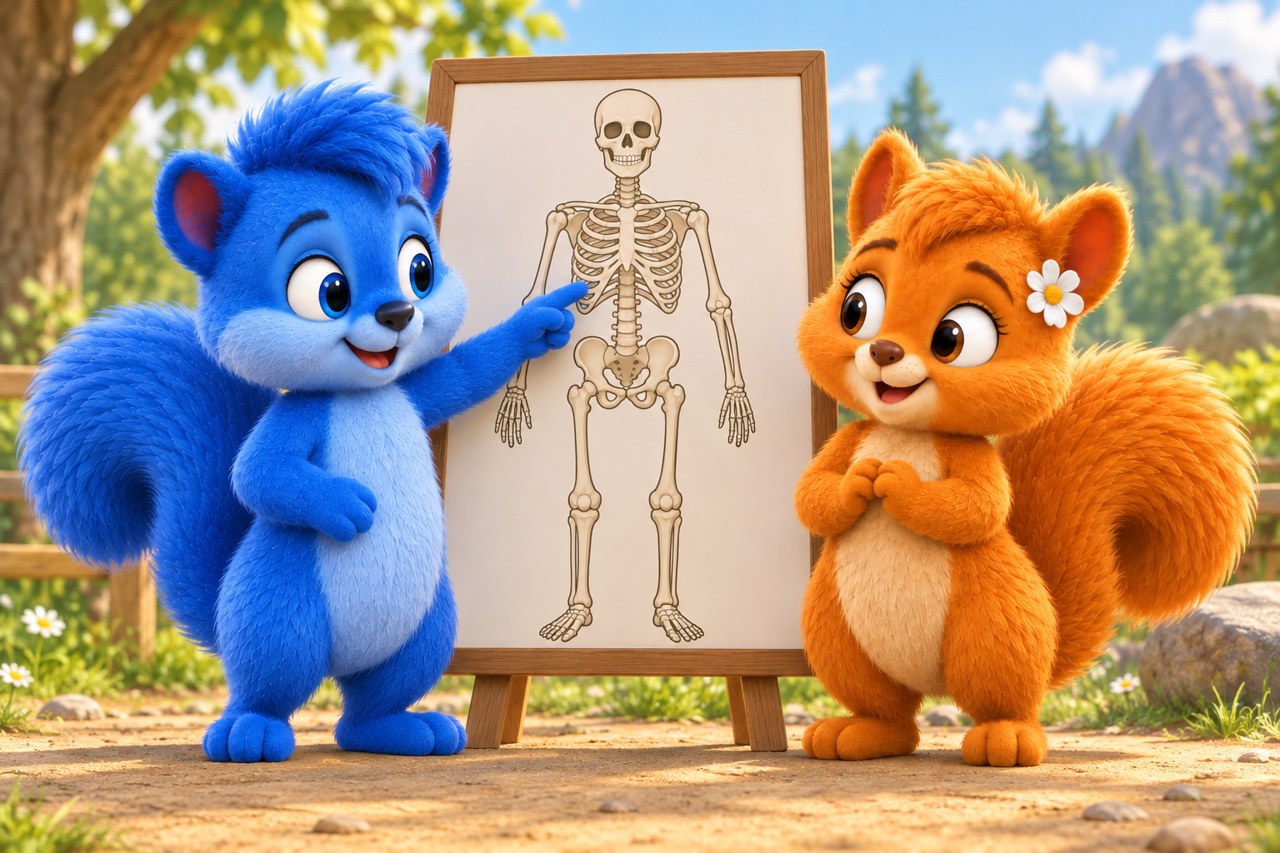
The two see a human skeleton on a teaching board. Puschel“That looks like a coat stand with lots of separate parts.”
Flauschi“It shows a person’s bones. They support the body and protect important parts.”
Puschel studies the ribs. Puschel“One protective curve after another.” Flauschi“The ribcage helps protect the heart and lungs.”
They gently move their own arms. Flauschi“In people, bones, joints and muscles work together. The picture cannot show everything.”
Puschel“So a model helps us think, but is not a whole person.” They also look at the skull and leave the board in place.
Little Wusel quiz
What does the skull protect?
Choose one answer: a), b).
- a)The lungs.
- b)The brain.
Show answer
Correct answer: b): The brain. The skull protects the brain.
Are bones just dead solid rods?
Choose one answer: a), b).
- a)No, they are living tissue.
- b)Yes, they never change.
Show answer
Correct answer: a): No, they are living tissue. Bones are living tissue and change.
Word help
- cell
- A tiny living unit. Living things are made of cells.
- tendon
- A strong connection that transfers a muscle's pull to a bone.
- joint
- A connection between bones. Many joints allow movement.
Explore in more detail
Here you will find longer explanations and further details. You can explore them together.
Understand step by step
How it works – simply explained
An internal framework
Bones form the skeleton, supporting the body rather than leaving it made only of soft parts. Bones are alive and continually renewed.
Protection for delicate parts
The skull surrounds the brain. Ribs form a protective chest around heart and lungs. Bones cannot prevent every injury, however.
Movement, not a rigid frame
Many bones meet at movable joints. Muscles pull them through tendons. The framework can support the body while allowing movements such as waving.
A framework that grows
A building frame stays still, but your skeleton can move and grows during childhood. Bone is not dead chalk. Living cells work inside it; bone changes and can heal after injury. Many joints allow movement, so waving does not move the whole skeleton as one rigid block.
The key points again
Discovery 1
A person’s bones together form the skeleton. It supports the body.
Source: [1]
Discovery 2
Bones also protect delicate body parts. The skull protects the brain; the ribcage helps protect the heart and lungs.
Source: [1]
Discovery 3
Bones are living tissue, made of many tiny cells and material between them: they grow and change. Together with joints and muscles they make movement possible. Joints are movable connections between many bones.