Body & Senses
Why do baby teeth fall out?
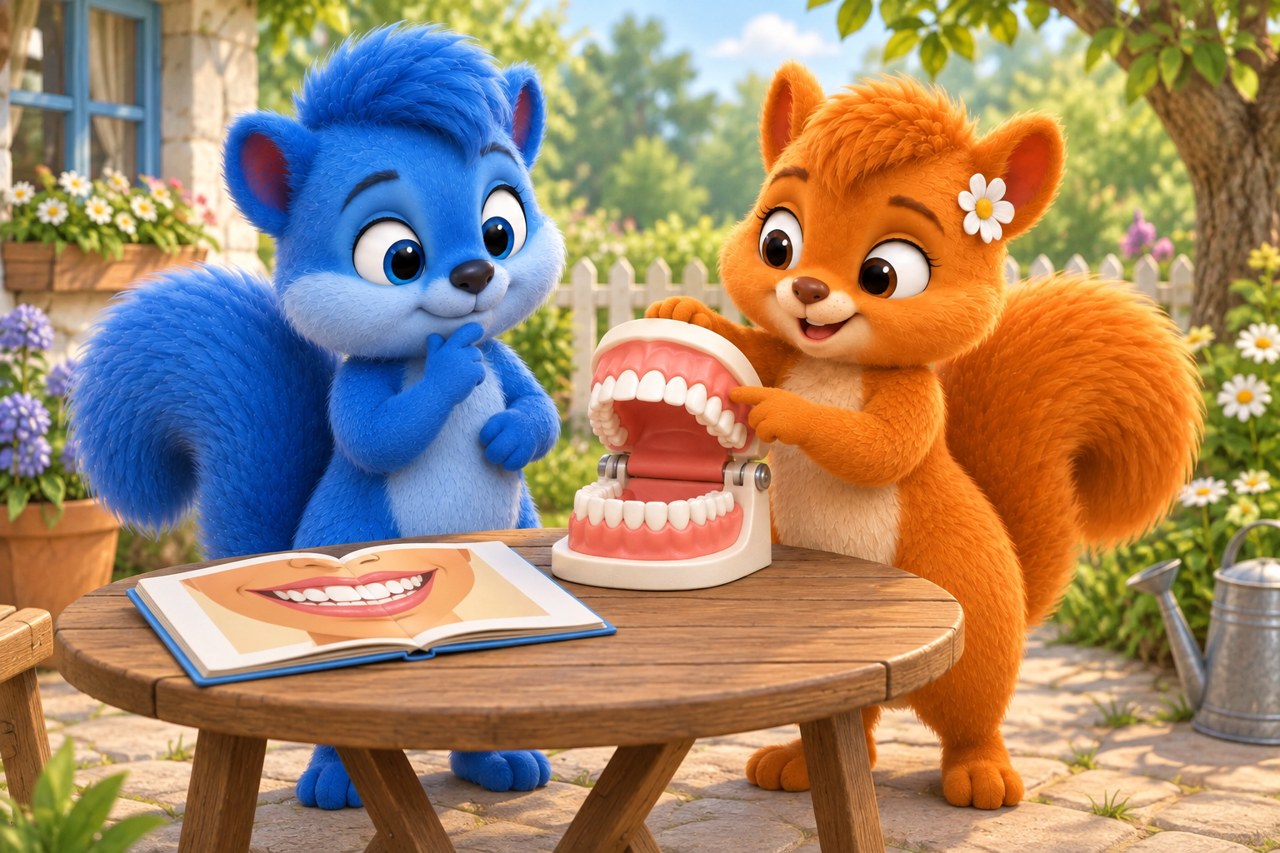
A tooth model raises a question about human children.
The short answer
Baby teeth make way for permanent teeth. Before a baby tooth normally falls out, its root gradually breaks down and the tooth loosens. The timing differs between children.
An imagined Wusel scene
Puschel and Flauschi investigate
A tooth model stands on the garden table. Puschel“When a child loses a tooth, is that a mishap?”
Flauschi“For human children, changing from baby teeth to permanent teeth is usually part of growing.”
Puschel studies the model without pulling it. Puschel“Do baby teeth stay tiny forever?” Flauschi“They are the first set of teeth, and most are replaced as children grow.”
Flauschi“Not all children change teeth at the same time. New molars also grow at the back.”
Puschel“So every mouth has its own timetable.” The model stays on the table. Nobody needs to wobble a real tooth to explore their question.
Little Wusel quiz
What are baby teeth?
Choose one answer: a), b).
- a)The first set of human children’s teeth.
- b)Teeth that stay the same throughout life.
Show answer
Correct answer: a): The first set of human children’s teeth. They are the first set of human children’s teeth.
Does every new permanent tooth replace a baby tooth?
Choose one answer: a), b).
- a)Yes.
- b)No, first permanent molars usually grow at the back.
Show answer
Correct answer: b): No, first permanent molars usually grow at the back. No. First permanent molars usually grow behind the baby teeth.
Explore in more detail
Here you will find longer explanations and further details. You can explore them together.
Understand step by step
How it works – simply explained
Teeth have an anchor
A baby tooth is held in the jaw by its root, below the visible part. This anchor keeps it firmly in place.
The anchor changes
During normal tooth replacement, the baby tooth root is gradually absorbed. The tooth loosens and may fall out. A permanent tooth can emerge in its place.
Not every new tooth replaces one
First permanent molars grow further back without a baby tooth falling out first. Timing varies. Never pull loose teeth out by force.
Why a new tooth can appear at the back
First permanent molars grow behind the baby molars, where there was no baby tooth to lose. A new tooth can therefore appear without one falling out. Replacing a baby tooth is different: its root breaks down, it loosens, and a permanent tooth can take its place. Both are normal parts of tooth development.
References for this explanation: [1], [2], [3]
Additional specialist reference: KZBV: Das natürliche Gebiss
The key points again
Discovery 1
Human children first get baby teeth. Later these are gradually replaced by permanent teeth.
Discovery 2
Before a baby tooth normally falls out, its root is gradually broken down. The root is the part that holds the tooth in the jaw. The tooth becomes loose and the permanent tooth can take its place.
Source: [3]
Discovery 3
Tooth replacement often starts around age six, but not at the same time for everyone. First permanent molars usually grow behind the baby teeth without replacing a baby tooth.