Nature & Garden
Why do bees visit flowers?
A little flower visit leaves a big question.
The short answer
Bees find food in flowers: sweet nectar and pollen. During visits they can carry pollen to another flower. This helps many plants reproduce and is called pollination.
See the connection
Simplified drawings, not to scale. Not a guide for identifying species.
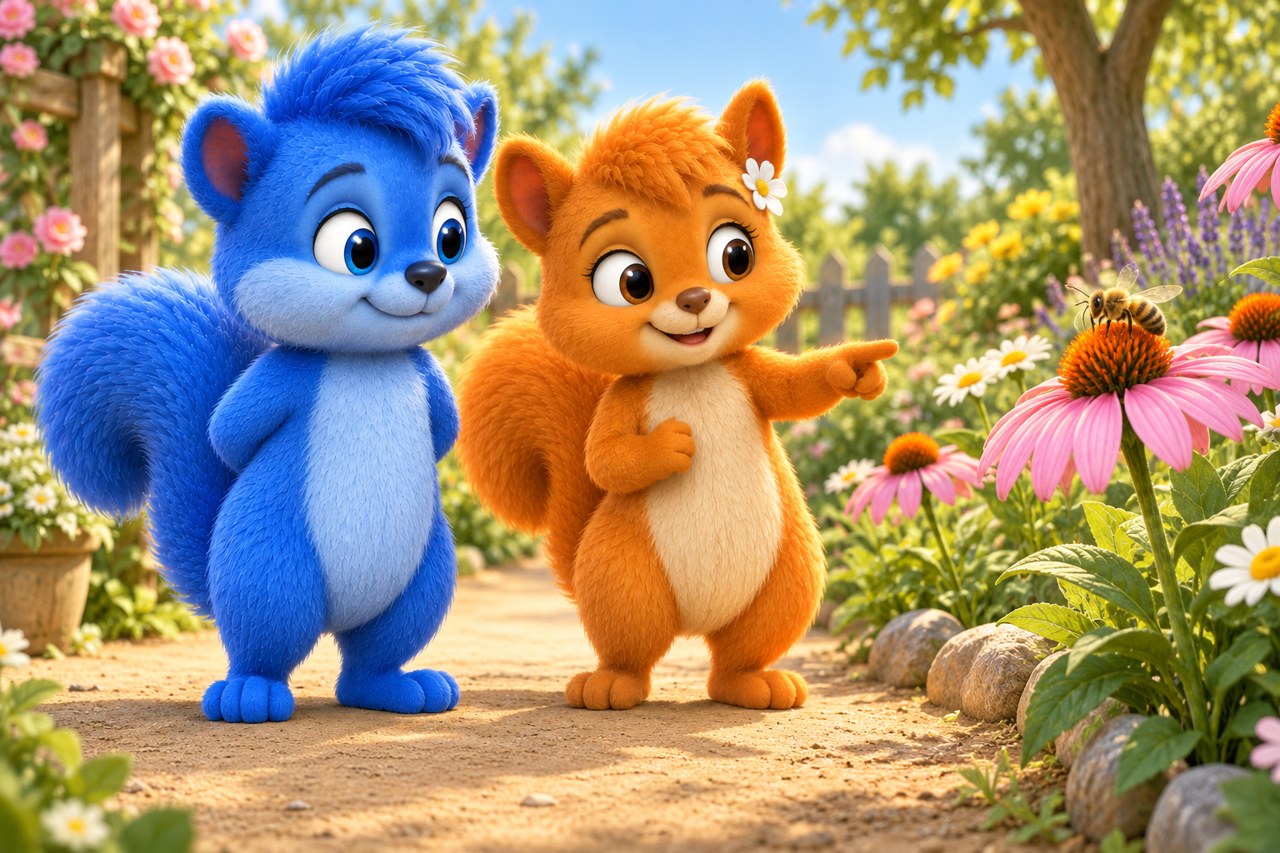
An imagined Wusel scene
Puschel and Flauschi investigate
A bee lands on a pink flower. Puschel stays on the path. Puschel“Did it book a visit to the flower shop?”
Flauschi“It is looking for food. We will watch from a distance.” They see the bee visit the next flower.
Puschel“Does it take anything along?” Flauschi“Pollen can stick to its body and reach another suitable flower.”
Puschel checks his own paws. Puschel“Mine have no pollen. Today I am just watching.”
The bee flies on. The two keep their questions and let the flower visit finish undisturbed.
Discovery 1
Bees find nectar and pollen as food at many flowers. Nectar is a sugary liquid; pollen is the fine powder produced by flowers.
Source: [1]
Discovery 2
Pollen can stick to a visiting bee. The bee may carry it to the stigma of another flower of the same plant species. The stigma receives pollen. This transfer is called pollination.
Source: [1]
Discovery 3
Pollination can lead to seeds forming. Other animals or wind also pollinate plants. Bees do not visit every kind of flower.
Source: [1]
Little Wusel quiz
What is nectar?
Choose one answer: a), b).
- a)Dry pollen powder.
- b)A sugary liquid.
Show answer
Correct answer: b): A sugary liquid. Nectar is a sugary liquid. Pollen is the fine powder from flowers.
Are bees the only pollinators?
Choose one answer: a), b).
- a)No, other animals or wind can pollinate too.
- b)Yes, only bees.
Show answer
Correct answer: a): No, other animals or wind can pollinate too. Other animals and wind can also pollinate plants.
Word help
- pollen
- Fine powder from flowers. Pollination carries it to a suitable flower’s receiving surface. It is not a plant seed.
- nectar
- A sugary liquid offered by many flowers and eaten by some animals.
- pollination
- Pollen reaches a flower’s receiving surface, the stigma. Further processes can then lead to seeds.
- stigma
- The part of a flower where pollen can land.
Explore in more detail
Here you will find longer explanations and further details. You can explore them together.
Understand step by step
How it works – simply explained
Flowers offer food
A bee visits suitable flowers to collect nectar or pollen. Nectar is sugary liquid; pollen is fine powder.
Pollen travels along
It may stick to the bee and reach another same-species flower’s stigma, the receiving surface. This transfer is pollination.
Seeds may follow
Suitable pollination may lead to further processes forming seeds. Not every visit guarantees this. Other animals or wind pollinate some plants.