What can animal tracks tell us?
A print is a clue. Compare visible features and learn to distinguish observations from guesses.
The short answer
An animal walks across mud and leaves footprints. A nibbled cone can also reveal that an animal was here. Compare several traces, their sizes and shapes. One smudged print is often not enough to tell which animal made it.
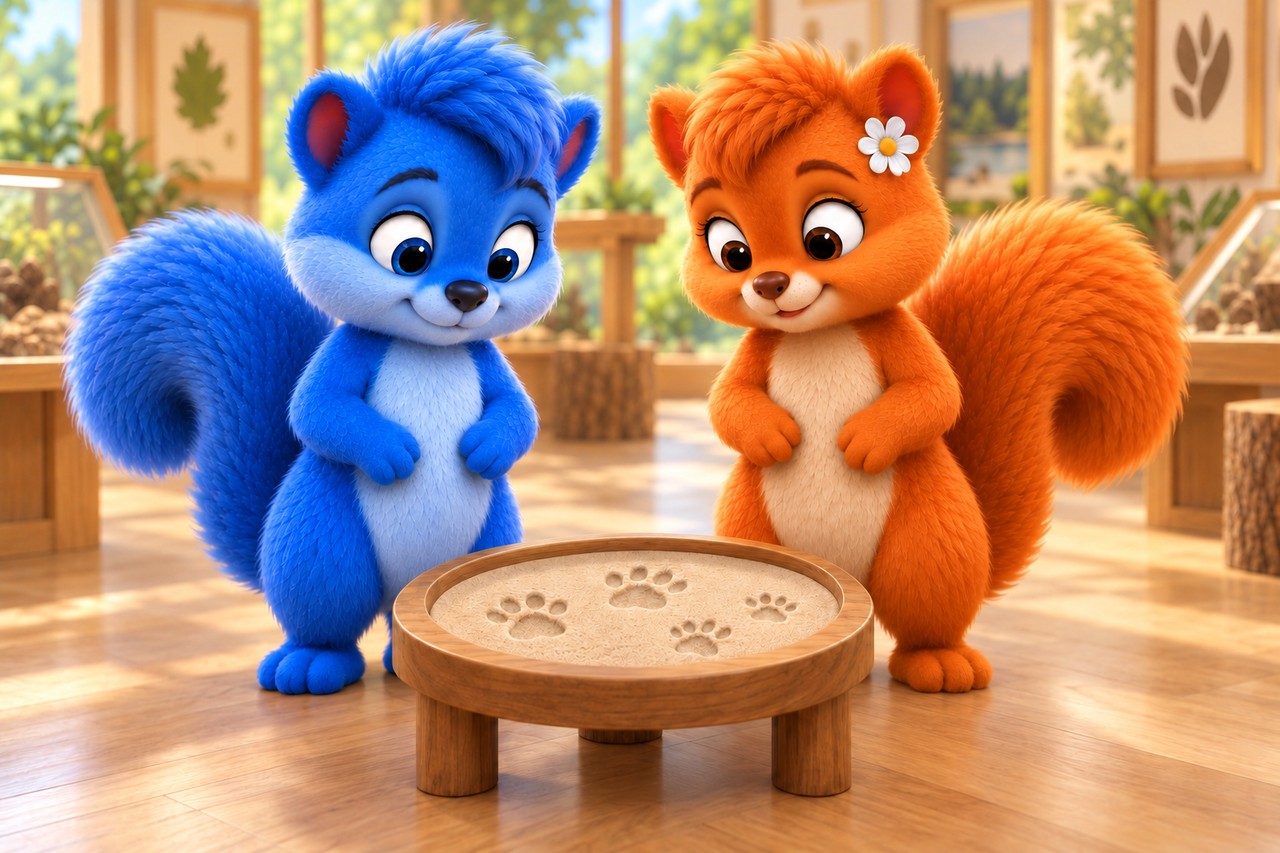
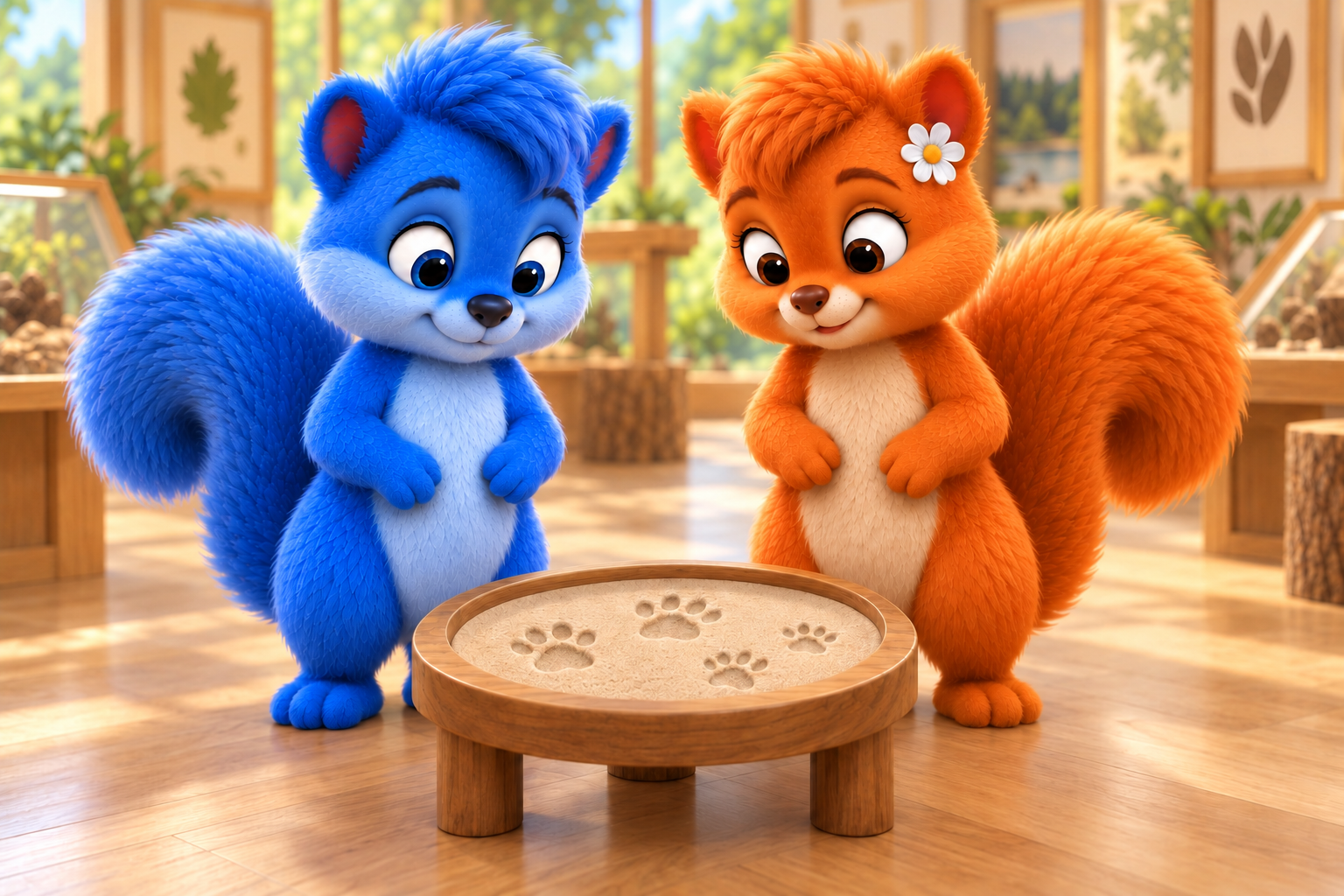
Equal-sized adult Puschel and Flauschi with rounded muzzles examine replica paw prints in a small sand tray. Invented museum scene with schematic prints; not a photograph of nature or a reliable species identification. AI-created illustration, not a photograph of nature.
What the diagram shows
The diagram simplifies the process. First compare its shapes and arrows. You can read its labels in larger text below.
Read the picture labels
These are the words and sentences from the diagram above. The full explanation follows below.
- Describe first — then compare carefully
- Clearer shape
- Incomplete shape
- Observation: Two long sections.
- Observation: One part clear, a remainder unclear.
- Interpretation: could fit a split hoof.
- No confident species name from these schematic shapes!
- Ground, weather and track age can change what remains visible.
- Further features and specialist knowledge help interpretation. Invented examples at the same display size; not species dimensions or foot anatomy. Look or draw only; leave animals, burrows and nests undisturbed.
An imagined Wusel scene
Puschel and Flauschi investigate
Puschel immediately names an animal from one unclear print. Flauschi looks for further tracks and a scale in the picture. Some clues fit; others are missing. They record a reasoned guess rather than a certain name.
Look closely
Puschel and Flauschi examine replica prints in a sand tray at an invented nature museum. The scene is not an identification guide. The factual learning picture schematically compares a clearer shape and an incomplete one; shapes and sizes are not species-specific measurements.
An example to help you understand
Draw an invented print with two long sections. Beside it, draw a second print with one section only half visible. First write only what you actually drew: “two long shapes” or “one shape and an unclear remainder”. Then add a guess: “could fit a split hoof”. Do not invent an exact animal name. This demonstrates why a description differs from a confident identification. Outdoors, an adult may photograph a suitable find from the path without changing it.
Try explaining it
What helps with an unclear footprint?
Choose a), b) or c), then explain your choice.
- a)Compare several tracks, size and shape.
- b)Infer the species from one matching part alone.
- c)Identify the species from depth alone, ignoring the ground.
Show the explanation
Correct: a): Compare several tracks, size and shape.
An animal walks across mud and leaves footprints. A nibbled cone can also reveal that an animal was here. Compare several traces, their sizes and shapes. One smudged print is often not enough to tell which animal made it.
Explore in more detail
Here you will find longer explanations and further details. You can explore them together.
1. An animal leaves clues
When a foot presses into yielding ground, an imprint may remain. This individual footprint is a track. A series of prints shows part of a route. Sand or snow can preserve these signs after the animal has gone. Other clues include chewed twigs or a resting place. Look at them only. A clue suggests possible presence; it does not automatically tell us which individual animal was there or exactly when.
2. Describe the shape first
First examine features: visible characteristics. How many separate impressions can you see? Are they narrow or broad? Are there pads or claw marks? A pad is a soft cushion on a paw. A clear deer-family hoof print often shows two long main sections. A paw print looks different. These distinctions help comparisons. They are not a fixed template for every surface and species; missing small details can change the interpretation. A clear dog print usually shows four toe pads ahead of the larger foot pad, often with claw marks.
A deer’s split hoof instead has two conspicuous main parts. “Four small pads plus a large one” therefore describes something different from “two long hoof halves.” These are comparison features; unclear prints may still leave the species uncertain.
3. Similarity does not identify a species
Different animals can leave similar tracks. At White Sands National Park, for example, kit fox and dog prints are hard to distinguish. Several features must therefore be considered together, with specialist knowledge of animals that occur in the area. Snow type, track age and later temperatures also affect how clearly a print remains visible. A blurred shape may therefore show less than a fresh, clear print. We write “could fit” when clues do not support a confident identification.
4. Observe, record and leave animals undisturbed
A good observation includes a description: where was the track seen from a permitted path, what surface is it in, and what is visible or unclear? A drawing can mark missing sections instead of inventing them. With adults, you can later consult suitable specialist books. You do not need to find or frighten the animal to learn. Burrows and nests are not search targets. If an animal appears, give it space; adults follow the rules of the place.
An optional question for further exploration
You can use the longer explanation above. This is extra, not needed for the first quiz.
An extra question
You see an unclear footprint. Can you confidently identify a particular species from it?
Discover the answer
No. Similar prints may come from different species, and the surface or later changes can hide details. Describe visible features first and mark uncertainty. One unclear print alone is not enough for a confident species name.
Pictures and sources for adults
Sources for further reading
Facts checked against the specialist sources below on 12 October 2026. The Wusel scene is fictional; comparisons and simplified models are explicitly explained. Sources are in English.
- National Park Service: Huf- und Pfotenmerkmale
- National Park Service / White Sands: Ähnliche Spuren verschiedener Arten
- National Park Service / Glacier: Schnee, Veränderungen und weitere Tierzeichen
- Scouts: Tierbeobachtung planen und Spuren entdecken
- National Park Service: Tiere in Ruhe lassen und örtliche Regeln beachten
- National Park Service: Vergleich von Zehen, Ballen und Krallen bei Tierspuren