Designing board games: test the rules
An original game begins with an idea. A trial round shows whether everyone understands permitted actions and when the game ends.
The short answer
A board game needs a goal, clear rules and meaningful choices. A simple model can be tested early. Tests reveal missing rules or long waits, helping improve the game.
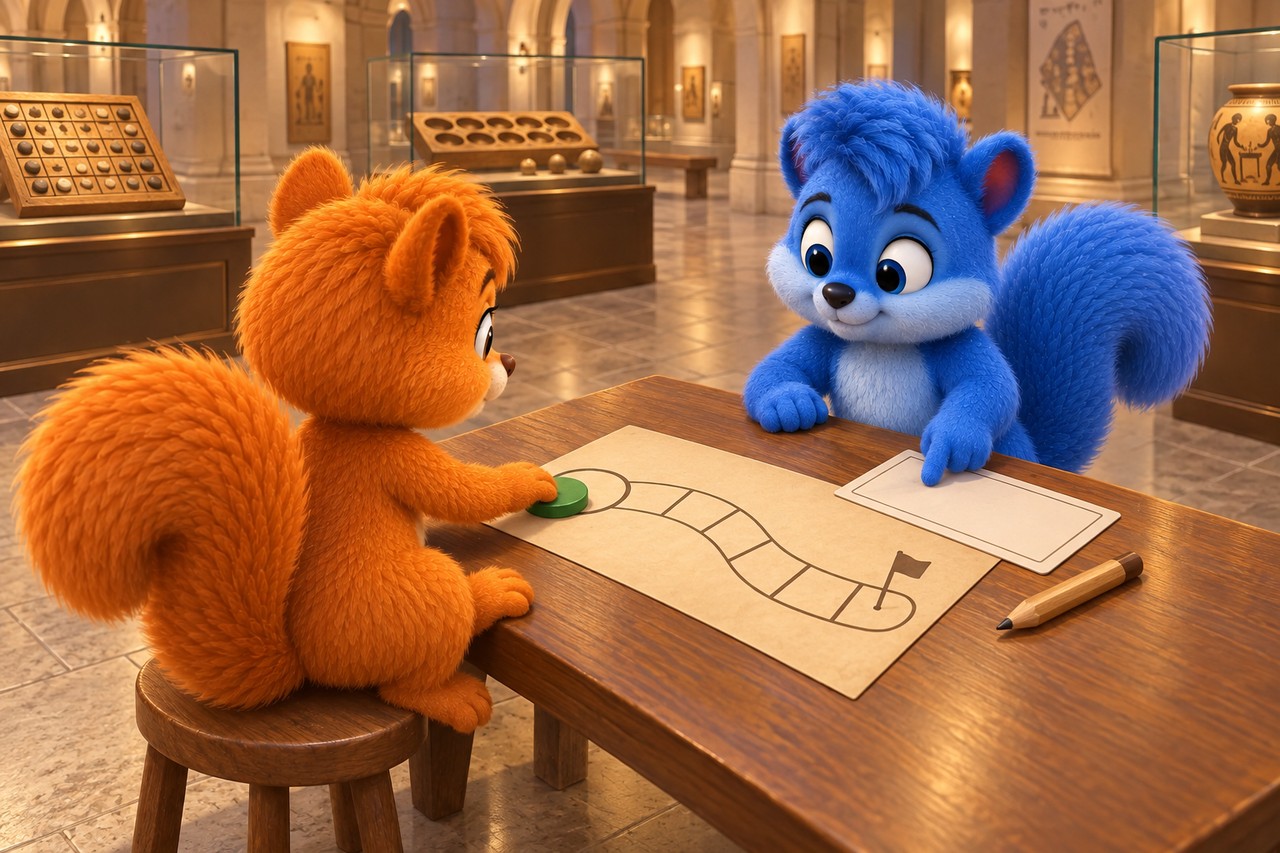
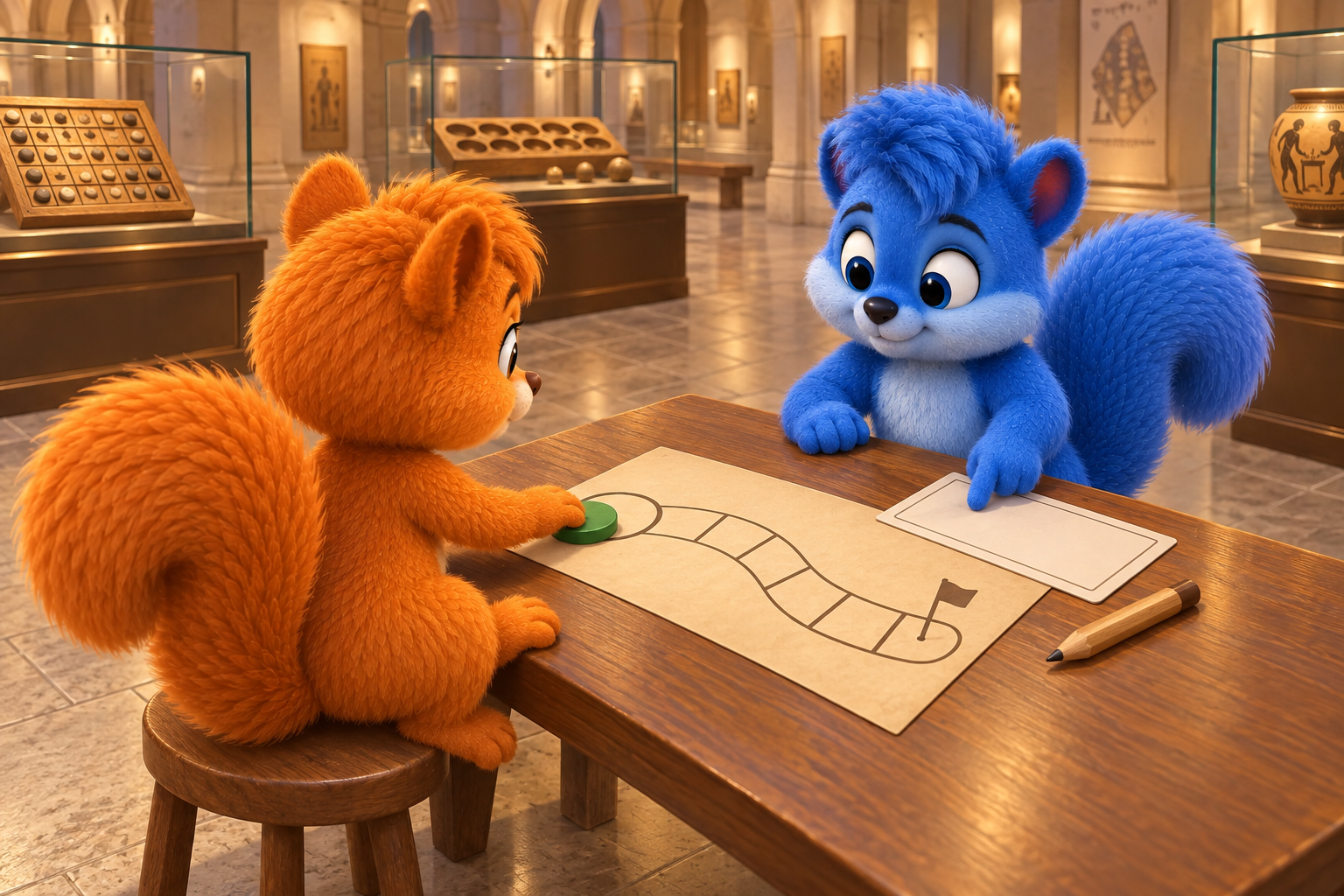
Flauschi and Puschel test an original paper board game at a museum station. Original learning scene with a game prototype; the text and model give the practice rules. AI-created illustration, not a photograph of nature.
What the diagram shows
The diagram simplifies the process. First compare its shapes and arrows. You can read its labels in larger text below.
Read the picture labels
These are the words and sentences from the diagram above. The full explanation follows below.
- One shared counter, two people taking turns
- 1
- 2
- 3
- 4
- 5
- 6
- Start
- Target
- Each turn: one or two spaces forward, stopping at 6 at most.
- Younger starts; same age: choose the starter by lot once.
- At space 6 the round ends: the shared goal is achieved.
- No backward moves, dice or extra cards.
- Play the whole trial round; record unanswered questions.
- Original simple game prototype; no copy of a finished game.
An imagined Wusel scene
Puschel and Flauschi investigate
During a test game, Puschel lands on a square with no rule. Flauschi asks what should happen. They write down a clear option and test that point again. They continue once both understand the rule.
Look closely
In the museum games gallery, Puschel and Flauschi try an original paper path at a visitor station. Flauschi moves a large green counter; Puschel points at the rule card. Old boards are protected behind glass.
An example to help you understand
Our original cooperative mini-game: draw six spaces forming a path, with a start circle on the first and a target flag on the sixth. One shared large counter starts on space 1. Two people take turns; the younger starts, or choose the starter by lot once if both are the same age. On each turn, move forward one or two spaces, stopping at the target at most. When the counter reaches space 6, the round ends and both players have achieved the shared goal. No backward moves, dice or extra cards. Test whether someone can start and finish using this rule card alone.
Try explaining it
Why play a simple game prototype?
Choose a), b) or c), then explain your choice.
- a)To find unclear rules and difficulties.
- b)To fix the rules before playing and not check them afterwards.
- c)To judge whether the game is understandable from its appearance alone.
Show the explanation
Correct: a): To find unclear rules and difficulties.
A board game needs a goal, clear rules and meaningful choices. A simple model can be tested early. Tests reveal missing rules or long waits, helping improve the game.
Word help
- prototype
- An early model or device for testing an idea.
Explore in more detail
Here you will find longer explanations and further details. You can explore them together.
1. Choose an original game idea
Designing a board game involves developing an idea and considering its parts. Paper and a drawing tool are enough for an initial draft. Existing games can help us understand components; our practice design should solve an original small task.
Checked against: [1]
2. Write down the turn sequence
Before playing, agree who starts, who acts next and which actions are permitted. Help and impossible tasks need agreements too. A rule card records these decisions so players need not guess important rules.
Checked against: [2]
3. Specify a clear ending
For our trial round, decide an end condition. A path game might end when a piece reaches the target. That is only one possibility: an original design can also involve working towards a shared goal. Write down exactly when the round ends.
Checked against: [2]
4. Test and revise the prototype
Our paper board is a prototype: an early testable version. Play it through completely and record questions or unexpected events. Then change one point and test again. An unclear rule during testing is useful information for the next draft.
Checked against: [3]
An optional question for further exploration
You can use the longer explanation above. This is extra, not needed for the first quiz.
An extra question
Why play a paper prototype all the way to its specified ending?
Discover the answer
Because a trial round shows whether the sequence and end condition are understandable. Questions or unexpected situations may arise. Record them and revise the rules before another round.
Pictures and sources for adults
Sources for further reading
Facts checked against the specialist sources below on 12 October 2026. The Wusel scene is fictional; comparisons and simplified models are explicitly explained. Sources are in English.