How do specialists compare wild herbs?
Explore leaf shape, edges and arrangement — and why a similar leaf does not mean a reliable identification.
The short answer
Experts compare several plant features, such as leaves, stems, flowers and habitat. One similar leaf or photograph is not enough for safe identification. Wild does not mean edible. We do not taste unknown plants.
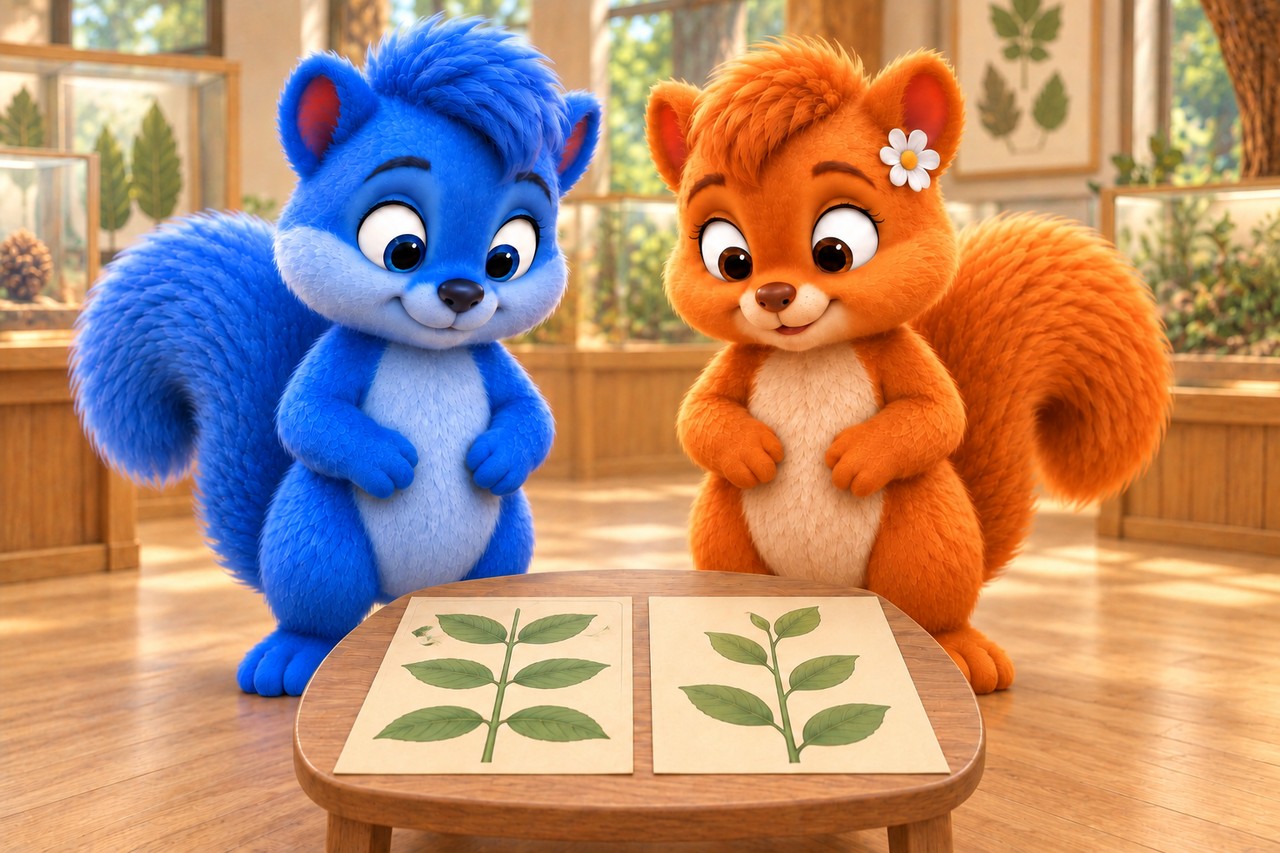
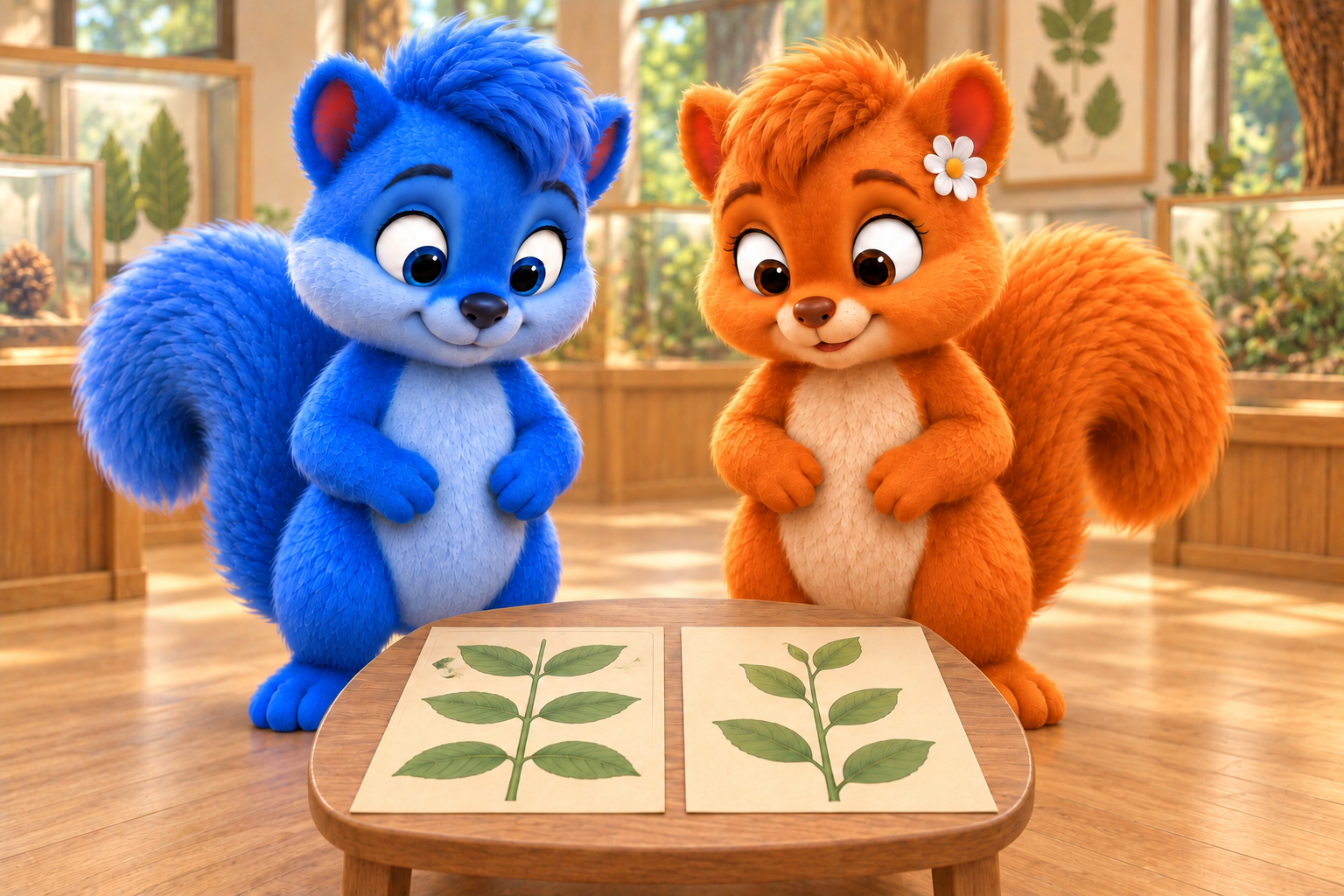
Puschel and Flauschi examine two schematic leaf drawings on teaching cards at a nature museum. Invented teaching cards; not identified plant species or a guide to deciding whether a plant is edible. AI-created illustration, not a photograph of nature.
What the diagram shows
The diagram simplifies the process. First compare its shapes and arrows. You can read its labels in larger text below.
Read the picture labels
These are the words and sentences from the diagram above. The full explanation follows below.
- Vocabulary cards — not identification of edible plants
- Opposite
- Alternate
- Leaf margin
- Pairs at the same point
- Single leaves at different points
- Smooth
- Toothed
- These features occur in many different plants.
- Specialists consider relevant features of the whole plant together.
- A resemblance alone identifies no species and does not mean “edible”.
- Invented shapes, no species dimensions; no complete plants shown. Draw and observe only. Leave unknown plants untouched.
An imagined Wusel scene
Puschel and Flauschi investigate
Puschel groups two cards with similar leaves. Flauschi compares flowers and stems too. The cards show different plants. They leave unknown plants growing and record why one leaf is not enough.
Look closely
At an invented nature museum, Puschel and Flauschi examine two teaching cards with schematic leaf drawings. No collected herbs are laid out. The drawings explain feature vocabulary, not identified species or edible plants.
An example to help you understand
Draw two invented stems. On the first, place a pair of opposite leaves at each of two points. On the second, place single leaves at different heights. Label the drawings “opposite” and “alternate”. Draw two leaf edges beside them: one smooth and one toothed. Which features can you now describe more precisely? Do not add a real plant name or the word “edible”. These feature drawings are a vocabulary and observation example, not identification keys or a basis for collecting.
Try explaining it
Is one similar leaf permission to eat a wild plant?
Choose a), b) or c), then explain your choice.
- a)Yes, if an animal eats a similar-looking plant.
- b)No, we do not taste unknown plants.
- c)Yes, if leaf shape and colour match a photo.
Show the explanation
Correct: b): No, we do not taste unknown plants.
Experts compare several plant features, such as leaves, stems, flowers and habitat. One similar leaf or photograph is not enough for safe identification. Wild does not mean edible. We do not taste unknown plants.
Explore in more detail
Here you will find longer explanations and further details. You can explore them together.
1. Describe before naming
Wild herbs grow at their location without deliberate planting. The term does not tell us whether a plant is edible. Botanists are plant specialists. They describe features: characteristics that can be compared. For leaves these include shape, edges and arrangement along a stem. They also examine other parts, such as flowers when present. “A long green leaf” is a starting description, but often far too general for a reliable name.
2. Leaves show more than colour
A leaf margin is its outer edge. It may be smooth or have small teeth, for example. Leaf arrangement describes how leaves are positioned along a stem. Opposite leaves form a pair at the same point on opposite sides. Alternate leaves have one leaf at each attachment point; further leaves occur at different points. Our learning picture explains only these terms. This does not reliably identify a species: many plants share individual features.
3. Similar plants may have very different effects
Germany’s Federal Institute for Risk Assessment particularly warns about confusing wild garlic with lily-of-the-valley or autumn crocus. Their young leaves may look similar, but confusion can cause severe poisoning. Smell alone is also insufficient: a garlic smell from a previously touched plant may remain on hands and mislead the next test. We therefore perform no smell test. Knowledgeable people must reliably know the plant and its poisonous lookalikes through their features.
4. A suggestion is not approval to eat
An illustration or a similar photograph can prompt questions. It does not check the actual plant in front of you. Specialist identification means reliably classifying that plant using appropriate features. Deciding whether it is suitable as food additionally requires certainty. Being an adult does not automatically mean having plant expertise. If uncertain, leave the plant growing and do not eat it. Purchased culinary herbs from controlled cultivation are an alternative for cooking. You can discover without collecting.
An optional question for further exploration
You can use the longer explanation above. This is extra, not needed for the first quiz.
An extra question
Is a green leaf with a similar shape enough reason to eat an unknown plant?
Discover the answer
No. Individual features may look similar across different species, including poisonous lookalikes. Our drawings explain words and approve nothing for eating. Leave unknown plants untouched; when uncertain, collect and eat nothing.
Pictures and sources for adults
Sources for further reading
Facts checked against the specialist sources below on 12 October 2026. The Wusel scene is fictional; comparisons and simplified models are explicitly explained. Sources are in German and English.