How can cheetahs sprint so skilfully?
Their bodies suit short fast runs. Hunting also involves how they accelerate, brake and turn.
The short answer
Long legs, a flexible spine and other adaptations help cheetahs make fast short runs. The tail helps with changes of direction. Sprinting takes a lot of effort; top speed cannot be maintained continuously.
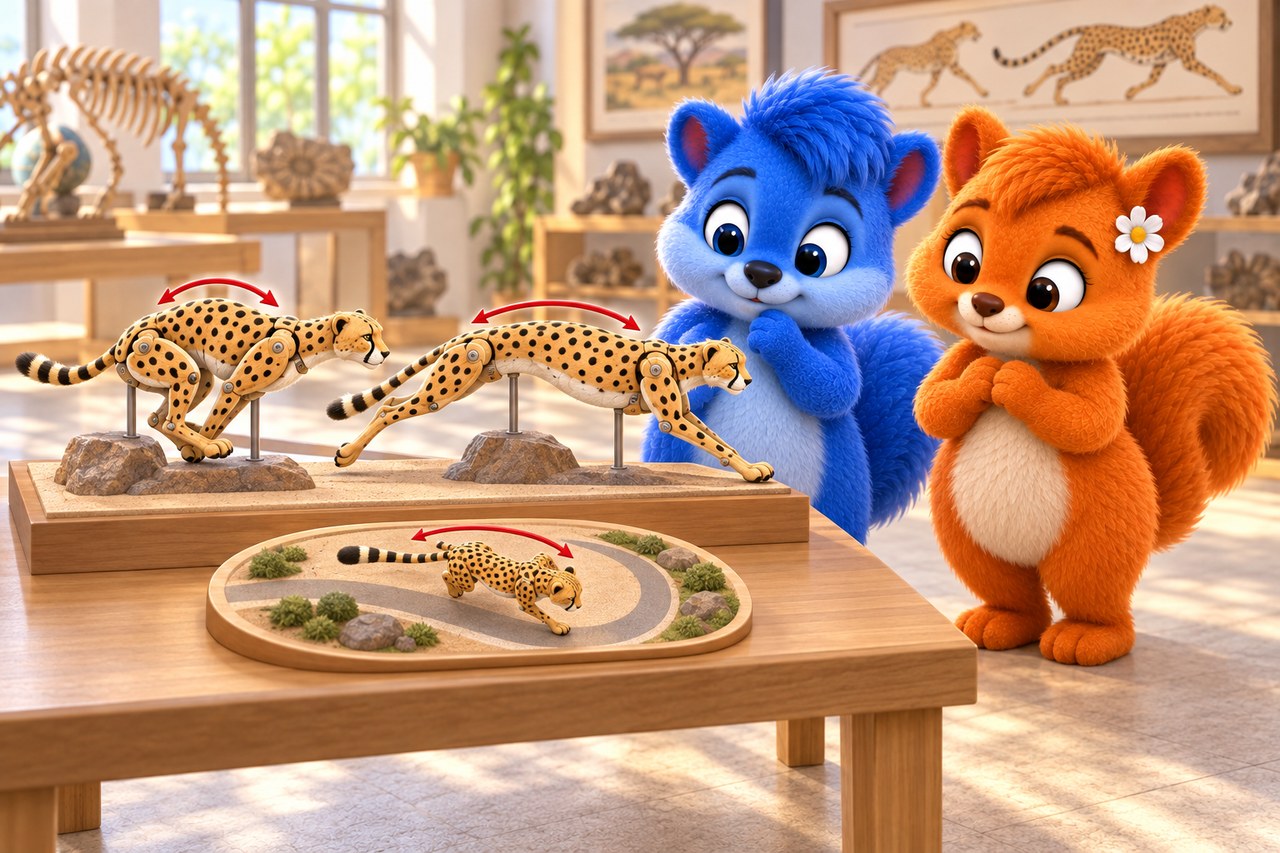
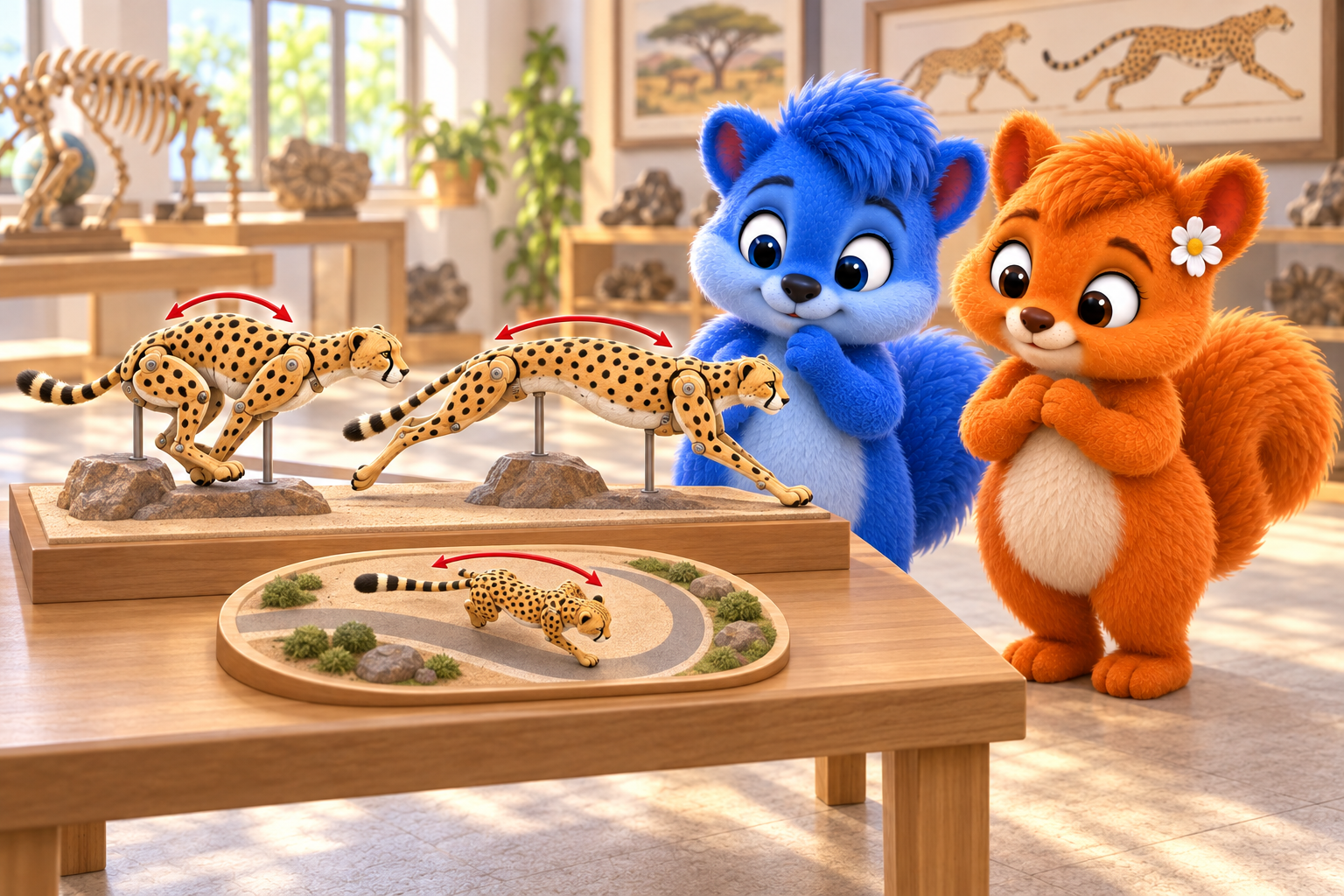
Puschel and Flauschi in the museum. Movement models with flexed and extended backs and a long tail during turns. Simplified inanimate museum model; arrows and colours help explain it. AI-created illustration, not a photograph of nature.
Explained in three pictures
1 The back flexes
The flexible spine bends and straightens during galloping.
2 Legs stretched out
Long legs and an extended back allow long strides.
3 Tail during turns
The long tail helps with balance, especially during turns.
More about the picture
Spine, legs, muscles, paws and tail work together. A cheetah can accelerate, brake and turn, not just run fast in a straight line. These postures are greatly simplified phases, not an exact measured gallop sequence or speed reading.
An imagined Wusel scene
Puschel and Flauschi investigate
Puschel gives his cheetah an endless speed arrow. Flauschi points to the sequence of sprint and rest. They add the beginning and end of its short run. His picture now shows a fast effort followed by rest, not unlimited speed.
Look closely
Compare the museum model with the three picture steps. Long legs and an extended back allow long strides.
An example to help you understand
With permission at a museum activity station, place a broad paper curve on the table. Move a small model slowly along it. Where does it change direction? Then compare with a straight paper strip. This merely traces a route. Your hand movement measures neither cheetah speed nor braking force; the model also shows no actual running gait.
Try explaining it
Why are rest periods part of a cheetah's fast running?
Choose a), b) or c), then explain your choice.
- a)A longer sprint automatically becomes less and less tiring.
- b)Sprints take effort and cannot last indefinitely.
- c)Their bodies recover more energy during a sprint than they use.
Show the explanation
Correct: b): Sprints take effort and cannot last indefinitely.
Long legs, a flexible spine and other adaptations help cheetahs make fast short runs. The tail helps with changes of direction. Sprinting takes a lot of effort; top speed cannot be maintained continuously.
Word help
- rosette
- Leaves arranged closely around one centre rather than spread along a long stem.
Explore in more detail
Here you will find longer explanations and further details. You can explore them together.
1. A body for fast movement
Cheetahs have long legs, slender bodies and flexible spines. A spine is the row of connected bones running along the back. During a gallop the back can bend and extend. The long tail helps balance, especially during changes of direction. These features work together with muscles and paws. No single feature alone therefore explains why a cheetah can run fast.
Checked against: [1]
2. Spots are not tiger stripes
A cheetah’s coat usually bears separate dark spots. Prominent dark facial lines extend from the eyes towards the mouth. Leopards, by contrast, usually have rosette-shaped markings; tigers have stripes. We compare these features when examining our model. The colour of one simplified toy animal alone cannot reliably identify a real animal.
3. A measurement is not the speed of every run
In 2013 a research team studied five wild cheetahs in Botswana using measuring collars. Among 367 predominantly hunting-related runs, the highest recorded speed was about 93 kilometres per hour. Most hunting runs, however, involved only moderate speeds. Acceleration, braking and sideways movement also mattered. The figure describes this study, not a fixed speed for all cheetahs.
Checked against: [3]
4. A sprint is not a distance run
Cheetahs maintain very high speeds only briefly. They also need suitable prey, water, cover and sufficient space. Fragmenting habitats can reduce these opportunities. At the museum station we examine only the difference between a straight and a curved route. The wooden model moves neither muscles nor spine like a real cheetah.
Checked against: [1]
An optional question for further exploration
You can use the longer explanation above. This is extra, not needed for the first quiz.
An extra question
Does a cheetah run at its highest possible speed during every hunt?
Discover the answer
No. Most recorded hunting runs in the 2013 study involved only moderate speeds. Acceleration, braking and turning also play a part. A recorded maximum is no speed for every run.
Pictures and sources for adults
Sources for further reading
Facts checked against the specialist sources below on 12 October 2026. The Wusel scene is fictional; comparisons and simplified models are explicitly explained. Sources are in English.