How do you check whether a banknote is genuine?
A similar picture is not enough. Several appropriate features need checking together.
The short answer
One feature is not enough to check a banknote. Adults compare several security features by feeling, looking and tilting. Suspect notes need expert examination. Children should not handle a real suspected case alone.
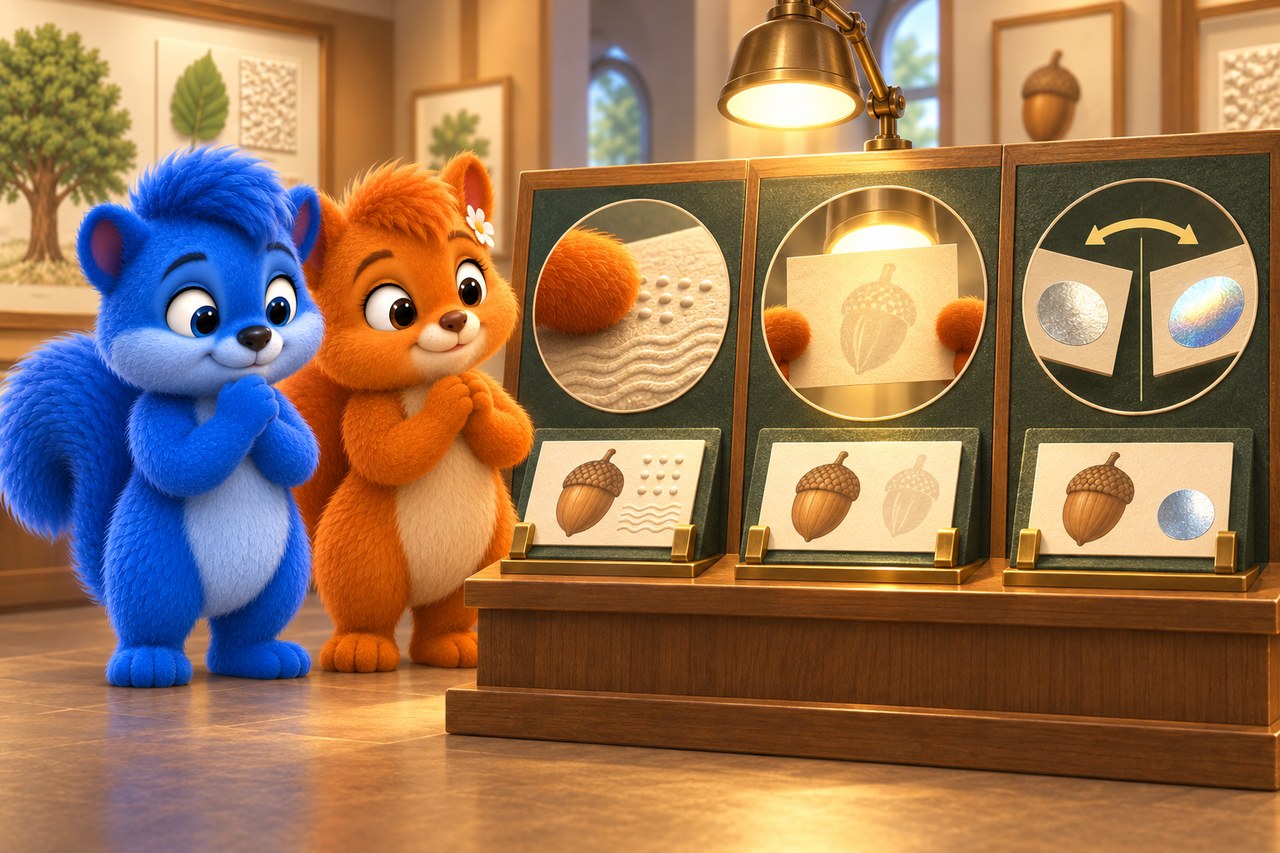
Puschel and Flauschi in the museum. Invented play notes demonstrate touch, checking against light and tilting. The play notes are not banknotes; one feature alone is not enough. AI-created illustration, not a photograph of nature.
Explained in three pictures
1 Feel
Raised print feels different from smooth paper.
2 Look against light
A watermark becomes visible against light.
3 Tilt
Tilting changes some features’ appearance. Check several features together.
More about the picture
Check several appropriate security features together. These drawings are symbols, not a banknote or a guarantee of authenticity. Real features depend on the banknote series; the invented acorn cards in the museum picture are only play cards.
An imagined Wusel scene
Puschel and Flauschi investigate
In the museum, Puschel recognises one pattern on an enlarged banknote picture and calls it genuine. Flauschi adds cards for feel, look and tilt. They find several model features. He changes his claim: one matching pattern is not enough.
Look closely
Compare the museum model with the three picture steps. A watermark becomes visible against light.
An example to help you understand
Use two invented acorn picture cards that do not imitate money. Compare paper, drawing and appearance when tilted. Puschel records which property he checked. Flauschi adds that a beautiful card still is not real money. This practises several observations, not authentication. An adult can then show the appropriate official Bundesbank description for a real euro note.
Try explaining it
Is one shiny patch enough to prove a banknote genuine?
Choose a), b) or c), then explain your choice.
- a)Yes, if the printed value and the size match.
- b)No, several features need checking.
- c)Yes, if the shine and paper colour look like those of a real note.
Show the explanation
Correct: b): No, several features need checking.
One feature is not enough to check a banknote. Adults compare several security features by feeling, looking and tilting. Suspect notes need expert examination. Children should not handle a real suspected case alone.
Explore in more detail
Here you will find longer explanations and further details. You can explore them together.
1. Looking similar is not enough
Counterfeit money is intended to be mistaken for genuine money. A colourful note may look convincing at first glance. Comparing only its colour or size is insufficient. Security features are particular properties that help checking. You need to know which features belong to the kind of note you are studying.
Checked against: [2]
2. Feel
Euro banknotes use special cotton paper. Parts of the printing feel raised. An adult can gently examine known areas and compare with a confirmed genuine note of the same kind. A worn or crumpled note feels different from a new one, so touch alone does not decide.
3. Look and tilt
Holding a note against light can reveal a watermark: differences in the paper that become clear with light shining through. Tilting changes the appearance of certain shiny security features. The exact features depend on the value and series. A series is a related banknote design. The official description identifies the appropriate features. A specific example is the Europa-series 20-euro note. Its front has a shiny emerald number. When tilted, a bright band appears to move up and down inside the number, whose colour changes between emerald green and deep blue. This is a particular changing feature, rather than just any shiny patch.
4. Combine several clues
The Bundesbank recommends feeling, looking and tilting together, with a confirmed genuine comparison note. One shiny patch does not prove authenticity. If uncertain, seek a specialist check. Children should neither make counterfeit money nor accuse anyone. An honest person might unknowingly have received a false note.
Checked against: [2]
An optional question for further exploration
You can use the longer explanation above. This is extra, not needed for the first quiz.
An extra question
Does one shiny feature prove that a note is genuine?
Discover the answer
No. Check several appropriate features on real banknotes. Children ask adults if unsure; a bank can help examine the note.
Pictures and sources for adults
Sources for further reading
Facts checked against the specialist sources below on 12 October 2026. The Wusel scene is fictional; comparisons and simplified models are explicitly explained. Sources are in German.