How does a counterweight move a long throwing arm?
A historical throwing machine helps explain movement. It was a dangerous weapon, not a toy.
The short answer
In our model of a throwing machine, a heavy counterweight is lifted. When it drops, it turns a long arm. The other end throws the model load. The energy came from lifting the weight. This explains this model, not every historical catapult.
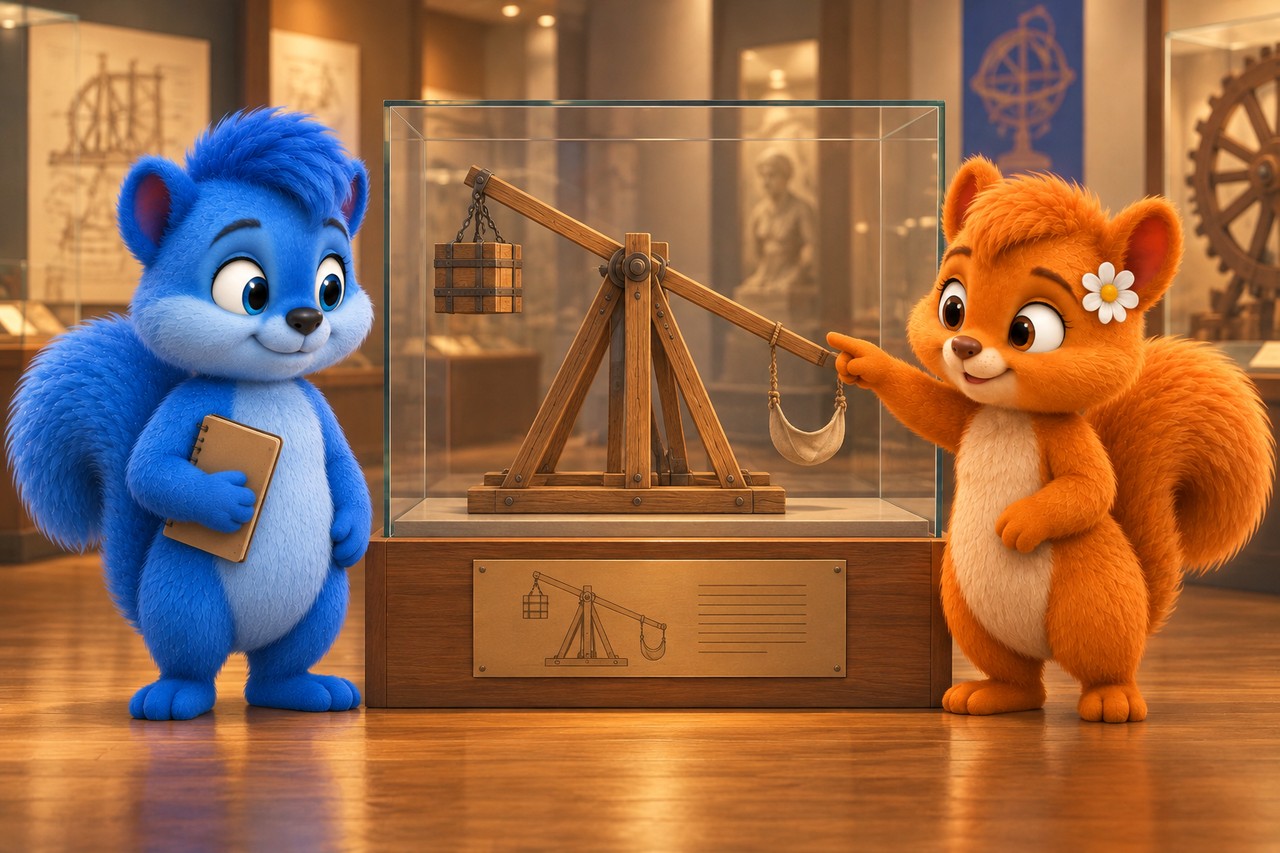
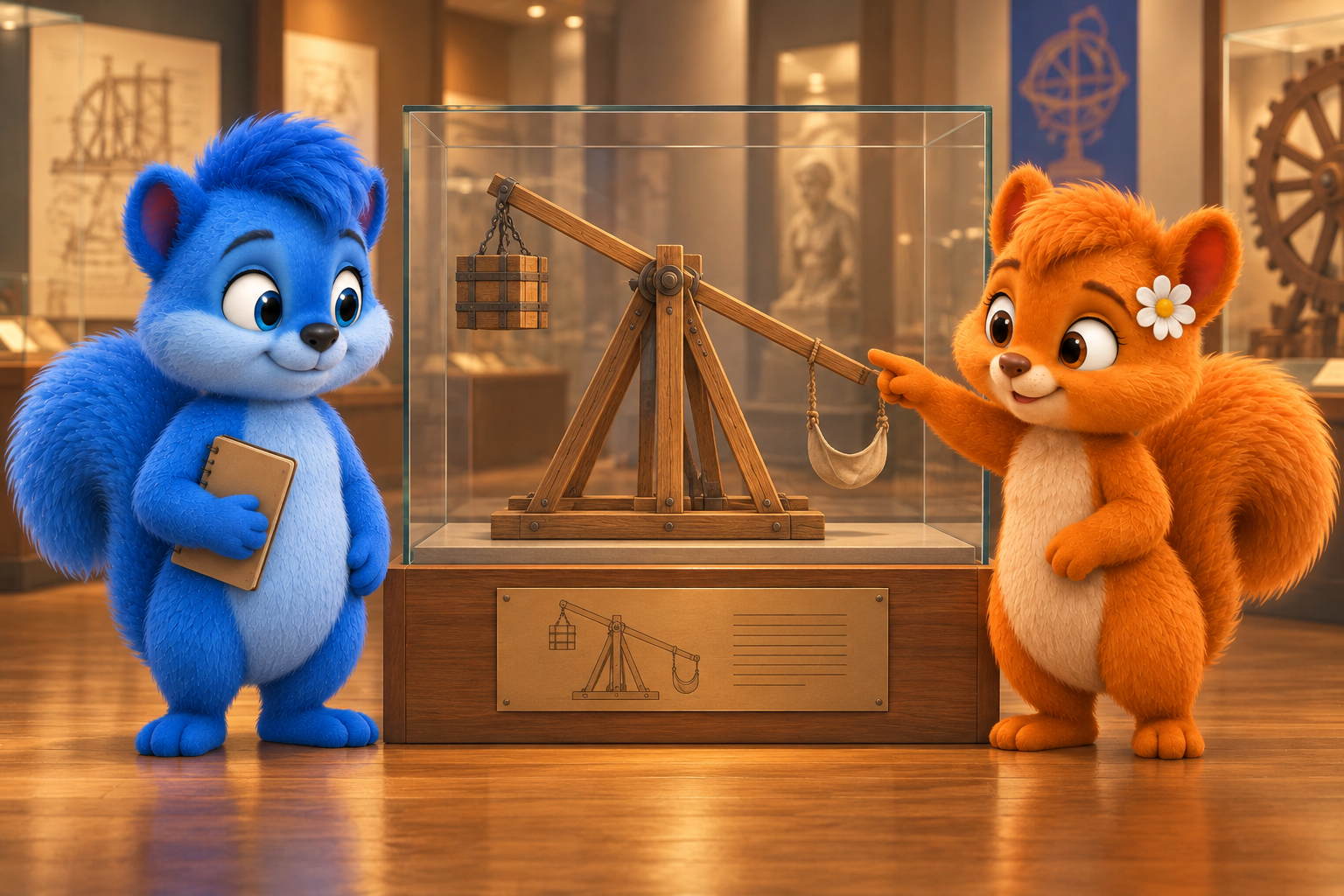
Equal-sized adult Wusels examine an immobile trebuchet behind glass, with a weight box and empty sling. Artistic counterweight model, not an exact reconstruction of a particular machine. Proportions and sling simplified; no ammunition or operation. AI-created illustration, not a photograph of nature.
What the diagram shows
The diagram simplifies the process. First compare its shapes and arrows. You can read its labels in larger text below.
Read the picture labels
These are the words and sentences from the diagram above. The full explanation follows below.
- One end descends; the other rises.
- Position 1
- red dot: fixed pivot
- long end
- Position 2
- red dot: fixed pivot
- long end
- Beam motion only: sling and release omitted. Not to scale, not a building guide, no speeds specified.
An imagined Wusel scene
Puschel and Flauschi investigate
At the secured museum model, Puschel watches only the long arm's end. Flauschi shows him the falling counterweight. They replay the slow demonstration. This time he places the first arrow where the weight begins to fall.
Look closely
A wooden weight box hangs from the shorter left end; the cloth sling on the right is empty. Flauschi indicates the long beam and Puschel examines the model behind glass. Find the round pivot between the ends.
An example to help you understand
Draw a beam with its pivot slightly left of centre. Mark a short left end and a long right one. In another drawing keep the pivot in place, with the left end lower and right end higher. Add arrows and explain the opposite movements. This is a paper comparison, not an experiment with weights or projectiles. A taller arrow does not automatically mean greater speed. Such claims require measurements of dimensions, masses and motion. Mass describes how much matter an object contains; a paper sketch provides none of those measurements.
Try explaining it
What moves the long arm in the model shown?
Choose a), b) or c), then explain your choice.
- a)The raised counterweight stays up while the arm swings by itself.
- b)The counterweight must be pulled upward so it slows the arm as it falls.
- c)The falling counterweight.
Show the explanation
Correct: c): The falling counterweight.
In our model of a throwing machine, a heavy counterweight is lifted. When it drops, it turns a long arm. The other end throws the model load. The energy came from lifting the weight. This explains this model, not every historical catapult.
Word help
- friction
- An effect between touching surfaces that resists sliding between them.
Explore in more detail
Here you will find longer explanations and further details. You can explore them together.
1. Different machines share a name
Catapult is used for different throwing machines. This model illustrates one type: a counterweight trebuchet. Such machines were used in medieval sieges: surrounding and attacking a place. People could be hurt; technological history is not automatically a heroic tale.
Checked against: [1]
2. A beam turns around one place
A beam turns around an axle, the fixed turning point in its frame. One end is shorter and the other longer. It acts as a lever: a force at one end can turn it and move the other. The long section is the throwing arm. Both ends turn through the same angle, but the longer end travels a longer distance. For the same turning rate, the end farther from the pivot therefore moves faster. Two marked points on a drawn beam make this difference clear.
Checked against: [1]
3. The weight descends; the other end rises
A heavy counterweight hangs at the short end. When a raised weight is released, gravity, Earth’s pulling force, draws it down. Its connection to the turning beam makes the other end rise. Our diagram shows directions, not speeds or calculated forces. The energy comes from the raised weight: gravitational potential energy is energy stored because the weight is raised. As it descends, energy is transferred to the moving parts. Energy due to movement is called kinetic energy. The machine creates no energy from nothing; friction and other moving components take a share too.
4. A picture omits parts of the mechanism
Real trebuchets had a sling at the long end to carry and release a projectile. Several movements had to work together. Our museum picture shows an empty, immobile sling. An incomplete illustration proves neither a historical machine’s range nor a homemade device’s safety.
Checked against: [1]
An optional question for further exploration
You can use the longer explanation above. This is extra, not needed for the first quiz.
An extra question
Why does the longer end of the beam travel farther during the same turn?
Discover the answer
Both ends turn around the same pivot through the same angle. The longer end lies farther from the pivot and traces a larger arc. At the same turning rate its speed is therefore greater. The descending counterweight supplies energy.
Pictures and sources for adults
Sources for further reading
Facts checked against the specialist sources below on 12 October 2026. The Wusel scene is fictional; comparisons and simplified models are explicitly explained. Sources are in English.