Card tricks: order behind the surprise
Find a remembered card without reading minds: our small sorting trick can be explained step by step.
The short answer
Some card tricks use a carefully planned sequence to create surprise. Mathematical patterns can help. Checking slowly can reveal the method. A surprising result does not prove real magic.
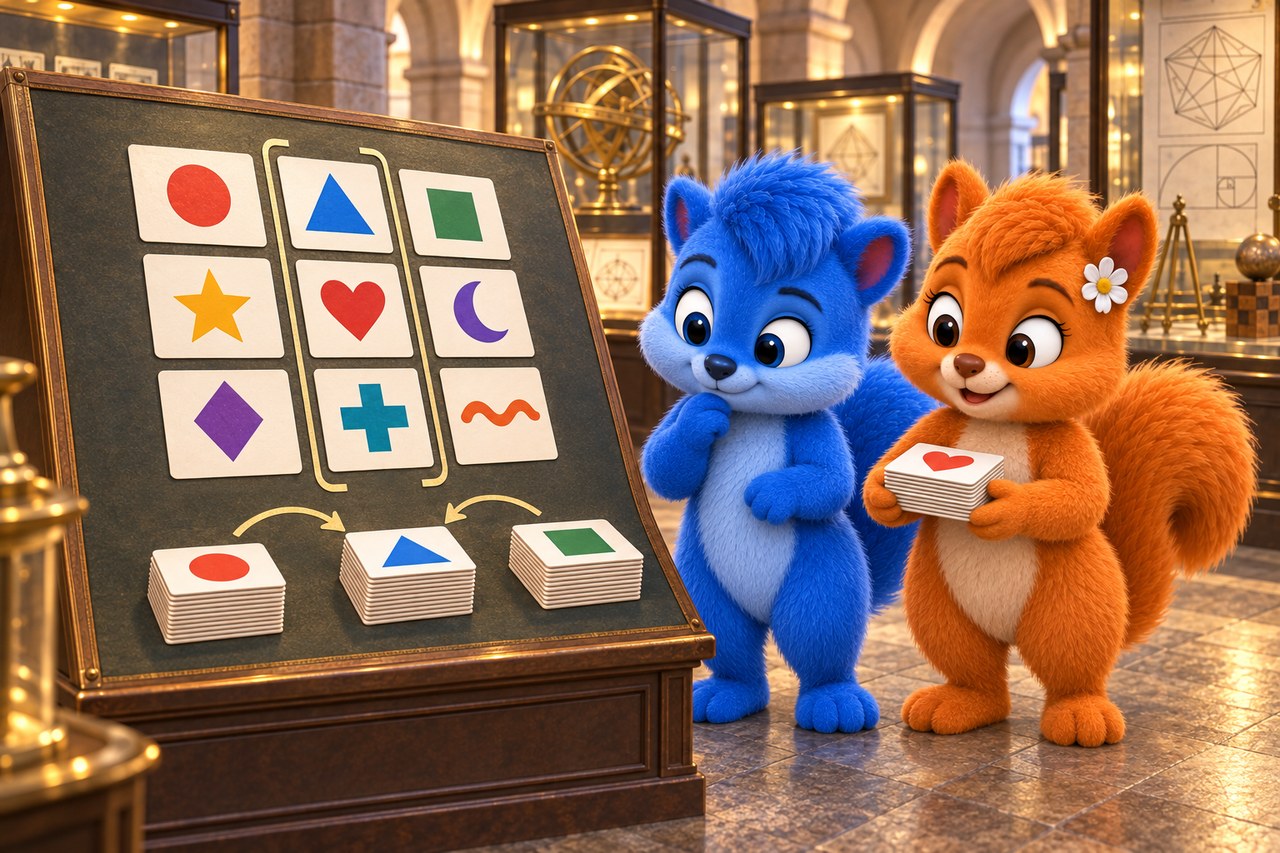
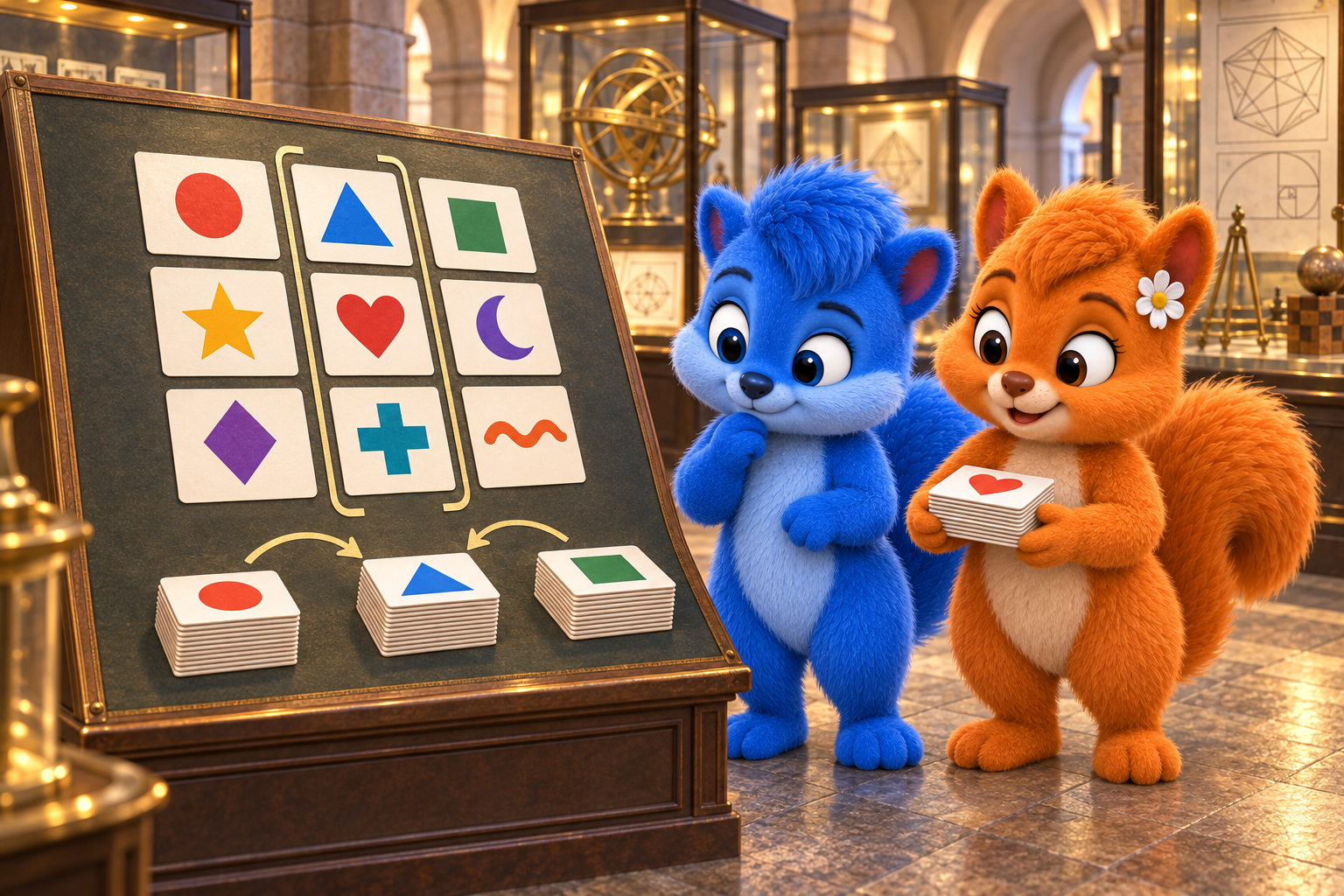
Puschel and Flauschi in the museum. Nine cards are dealt in columns and deliberately reordered as groups. The museum picture shows the ordering idea; the three picture steps explain our exact sequence. AI-created illustration, not a photograph of nature.
Explained in three pictures
1 Name the column
Example card 8: name the middle column after the first deal.
2 Put group in the middle
Gather that column between the others. Card 8 reaches position 6.
3 Order once more
Deal row by row and gather again: card 8 reaches position 5.
More about the picture
The left shows the first deal. Centre and right show stack orders, read row by row. Each named column is gathered top to bottom and placed between the other groups. Repeat row-by-row dealing and gathering exactly once; do not shuffle. This example shows order, not mind-reading.
An imagined Wusel scene
Puschel and Flauschi investigate
Puschel skips a sorting step in the practice trick and gets a different result. Flauschi puts the sequence cards beside him. They compare each step, find the omission and try slowly again. Now they understand why order matters.
Look closely
Compare the museum model with the three picture steps. Gather that column between the others. Card 8 reaches position 6.
An example to help you understand
Original procedure: use nine cards with different symbols, faces visible. Someone remembers a symbol. Deal from the top of the stack by rows into three columns: top left, top middle, top right, then the second and third rows. Ask only which column contains the chosen card. Collect each column as a three-card group, preserving top-to-bottom order as top-to-bottom stack order. Put one unnamed group on top, the named group underneath and the other group at the bottom. Repeat the row-by-row dealing and the same collecting rule exactly once. Do not shuffle. Count from the stack’s top to the fifth card: it holds the remembered symbol. Practise face up first to make the order checkable.
Try explaining it
What can explain a surprising card trick?
Choose a), b) or c), then explain your choice.
- a)A carefully planned sequence.
- b)A chance event guaranteed to repeat every time through the same steps.
- c)Mind-reading proven by the audience's surprise.
Show the explanation
Correct: a): A carefully planned sequence.
Some card tricks use a carefully planned sequence to create surprise. Mathematical patterns can help. Checking slowly can reveal the method. A surprising result does not prove real magic.
Explore in more detail
Here you will find longer explanations and further details. You can explore them together.
1. A performance does not prove magic
Some tricks use mathematical patterns and carefully planned procedures. A surprising result alone does not show supernatural ability. In our activity, openly explain how the card sequence brings the chosen card to a known position. Other tricks may use other methods.
Checked against: [1]
2. Arrangement provides information
In the three-pile principle, a viewer identifies the group containing their remembered card. The performer collects groups in a specified order. This deliberately changes the card’s possible position. Naming the group provides real information; no thoughts need to be guessed.
Checked against: [2]
3. Narrow down our nine-card model
In our original small variant, each of three columns has three cards. Collecting the named column between the other two places the chosen card at position 4, 5 or 6. Dealing by rows again puts exactly these positions in the middle row. Collect the named column in the middle again: the chosen card now occupies position 5.
Checked against: [2]
4. Explain as well as demonstrate
Mathematical card tricks can be investigated and explained. Track possible positions and test different starting cards. Do not shuffle between our two rounds. Different card counts or collecting rules need a new check.
An optional question for further exploration
You can use the longer explanation above. This is extra, not needed for the first quiz.
An extra question
Why can our trick find a remembered card without reading minds?
Discover the answer
Because the person names its column and the groups are deliberately collected. In our nine-card procedure, the first collection puts it at position 4, 5 or 6; the second puts it at 5. This is explainable order rather than mind reading.
Pictures and sources for adults
Sources for further reading
Facts checked against the specialist sources below on 12 October 2026. The Wusel scene is fictional; comparisons and simplified models are explicitly explained. Sources are in English.