Soil & nature cycles · Feeding relationships
Who eats what in the woodland?
Puschel imagines a straight line. Flauschi finds many connections.
The short answer
Plants use light to make energy-rich substances. Plant-eaters eat them; other animals eat animals. Many organisms use several food sources, creating connected paths: a food web.
Arrows from food to eater
1. Plants start many routes
Green plants use light energy to make energy-rich substances.
↓ is eaten by ↓
2. Other animals join
Another animal may eat a herbivore.
↓ is eaten by ↓
3. Many routes make a web
Animals often have several food sources.
Read the sequence this way: a caterpillar eats the leaf; a bird may eat the caterpillar. Arrows track food and energy.
This is one example pathway, not a whole web. The Sun supplies energy to plants; it is not a prey animal.
See the connection
Simplified drawings, not to scale. Not a guide for identifying species.
An imagined Wusel scene
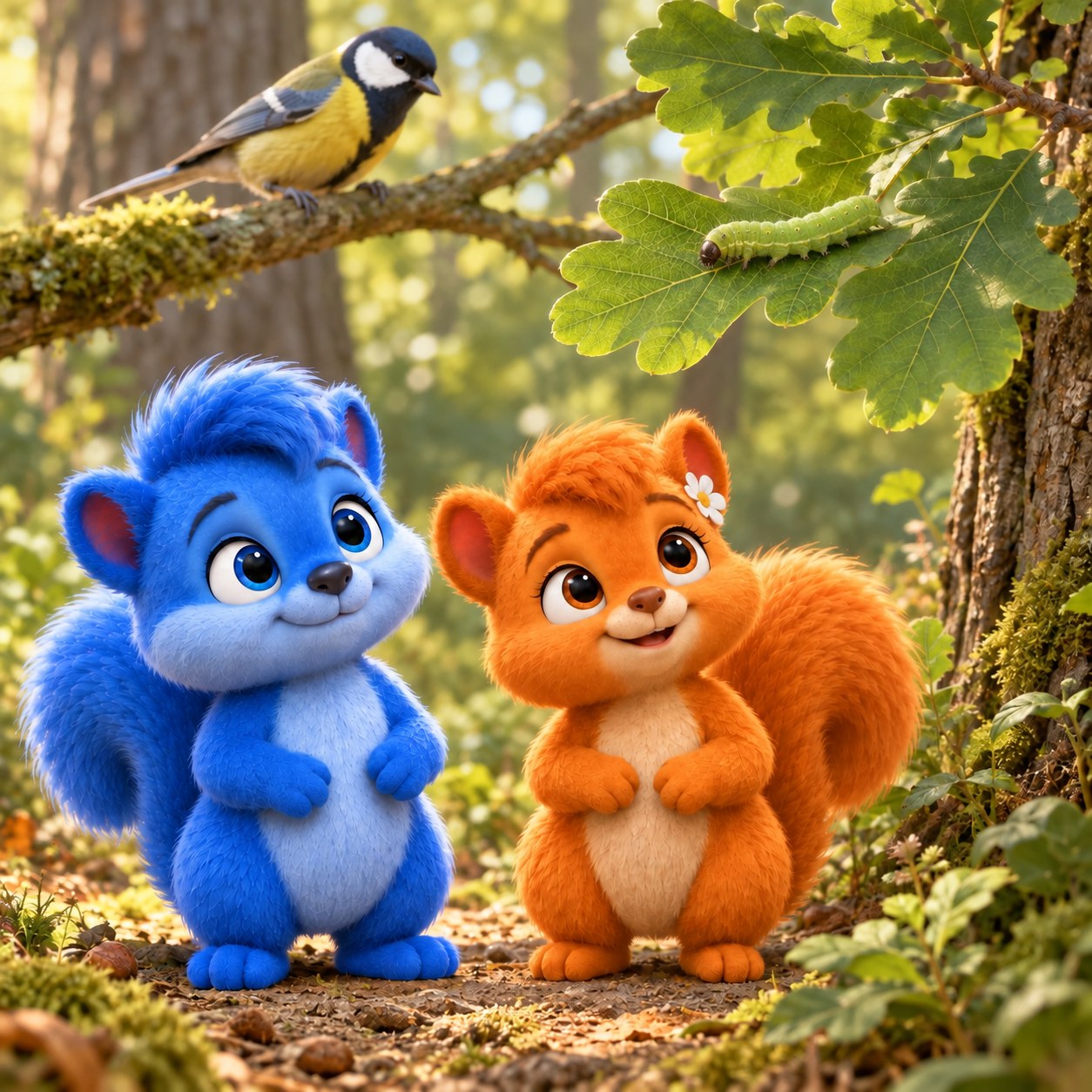
Puschel and Flauschi investigate
Puschel counts a leaf, a caterpillar and a bird. Puschel“A line of three!” Flauschi looks at more leaves and little animals. Flauschi“Nature often has more than one path.”
They imagine the connections in words without making any animal eat. Puschel quickly sees that his first line does not explain everything.
Puschel“I will draw a web in my head,” he says. Flauschi nods. It needs no string and traps nobody.
Little Wusel quiz
Why is a food web often more useful than one food chain?
Show answer
Many animals eat several foods, connecting multiple food chains.
Word help
- nutrient
- A substance a living thing needs to grow and live.
Explore in more detail
Here you will find longer explanations and further details. You can explore them together.
Understand step by step
How it works – simply explained
Plants start many routes
Green plants use light energy to make energy-rich substances. Eating transfers some to herbivores.
Other animals join
Another animal may eat a herbivore. Food-web arrows point from food to eater, showing substance and energy transfer.
Many routes make a web
Animals often have several food sources. A web is therefore more useful than one chain. Energy is used and released as heat, not repeatedly recycled like some nutrients.
Why arrows point from leaf to animal
A caterpillar eats a leaf and a bird eats a caterpillar. Arrows go from food to its eater, showing the transfer of substances and energy. Arrows depicting hunting would run the other way. This explanation explicitly uses the food-transfer direction. Real diets are more varied than this single example chain.
References for this explanation: [1]
The key points again
Discover
Green plants use light to build energy-rich substances. They form the basis of many feeding relationships.
Understand
Energy passes to plant-eaters and other animals when organisms are eaten. Many animals eat several kinds of food.
Connections
A food chain shows one path; connected paths form a food web. Energy flows through it rather than being recycled like nutrients.