How does artificial intelligence learn from examples?
Computers can look for patterns in data. A matching pattern is not always a correct answer.
The short answer
While learning, an AI receives many examples, such as pictures of cats and dogs. It finds patterns and uses them for new pictures. It can still mix things up.
A smoothly written answer can be wrong too: we check important claims with reliable sources.
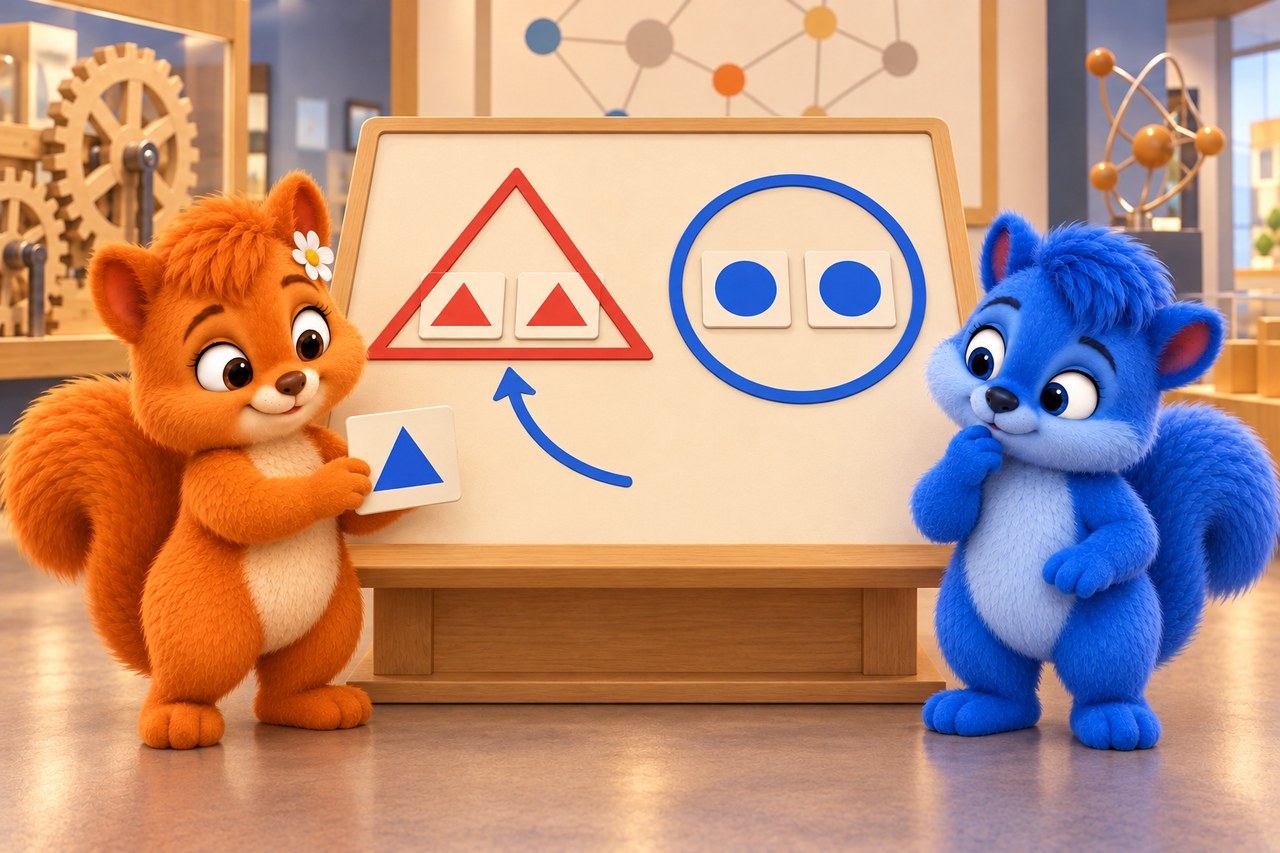
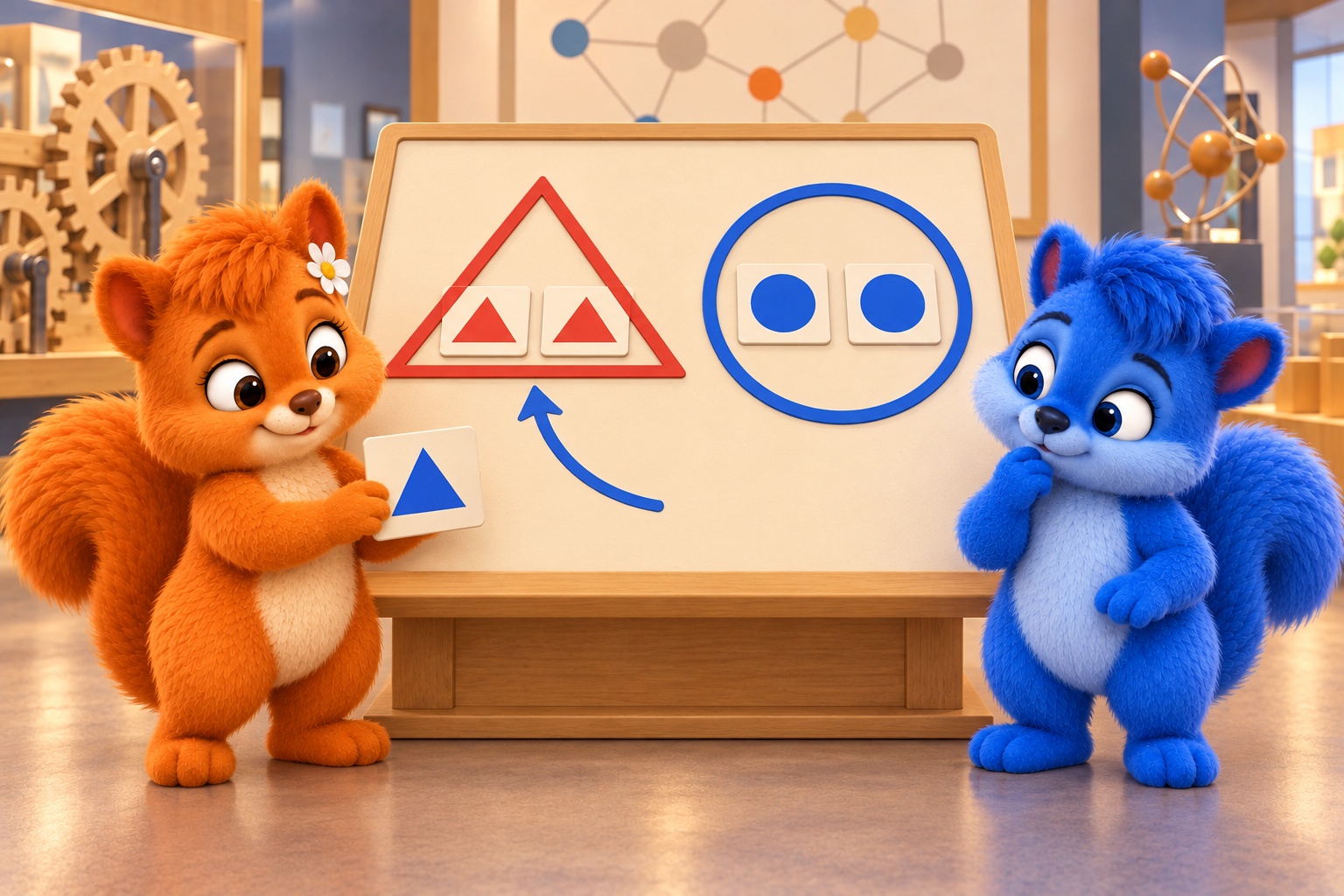
Puschel and Flauschi in the museum. Sorting board: a blue triangle joins the triangles according to shape. The sorting game illustrates a rule, not the whole operation of AI. AI-created illustration, not a photograph of nature.
What exactly improves?
1. These examples are not enough
Above: red triangles. Below: blue circles. Two rules fit so far: sorting by shape or sorting by colour.
2. A new example
The blue triangle reveals the difference. By shape, it belongs with triangles. By colour, it would go with the blue circles.
3. Feedback and new examples
The task is to sort by shape. So the blue triangle belongs with triangles and the red circle with circles. Both colours now occur in both shapes.
The pictures show a sorting example. When learning from labelled examples, a computer compares its results with the supplied labels.
A learning method changes numerical settings to make the results fit better. Different examples are then used to check whether this works there too.
One correction does not make AI error-free.
How can AI learn from examples and still get things wrong?
A learning method adjusts numerical settings using examples. If the examples are one-sided, an unsuitable pattern can result: colour instead of shape here. New examples and correct feedback help improve it; further checks are still needed.
An imagined Wusel scene
Puschel and Flauschi investigate
Puschel sorts the example cards by background colour. On a new card, his result does not match the animal shown. Flauschi covers the backgrounds and asks him to compare again.
They note: an obvious rule can be the wrong one; new examples help test it.
Look closely
Compare the museum model with the three picture steps. A blue triangle tests whether shape or colour matters.
An example to help you understand
Put down two red triangles and two blue circles. Could the rule be about colour or shape? Both fit so far. Add a blue triangle and a red circle. Now check whether the sorting uses shape. This thinking example illustrates a misleading pattern; you are not training real AI with paper cards. A computer would need a suitable method and data.
Try explaining it
An AI answers very confidently. What should we still do?
Choose a), b) or c), then explain your choice.
- a)Believe a claim if the same answer repeats it twice.
- b)Believe a claim if it is explained in great detail.
- c)Check important claims.
Show the explanation
Correct: c): Check important claims.
While learning, an AI receives many examples, such as pictures of cats and dogs. It finds patterns and uses them for new pictures. It can still mix things up.
A smoothly written answer can be wrong too: we check important claims with reliable sources.
Explore in more detail
Here you will find longer explanations and further details. You can explore them together.
1. What does AI mean?
AI stands for artificial intelligence. It refers to different computer methods that can carry out tasks such as recognising images or processing language. AI is not one particular robot. A program can use these methods without arms or wheels. Not every kind of AI learns in the same way.
2. Examples help build a model
In machine learning, data are used to adjust a mathematical model. Data are stored information, such as pictures, words or numbers. Here a model is a way of calculating relationships. In one type of learning, the method receives examples with labels, such as pictures labelled circle or triangle. Adjustments aim to improve the results. This is not learning with a schoolbook and feelings like a child.
Checked against: [1]
3. A matching rule can mislead
Imagine that every example triangle is red and every circle is blue. Sorting by colour would correctly match these examples. It would fail for a blue triangle if the task is to sort by shape. Examples therefore need variety. Researchers also test results with data that were not used to adjust the model.
4. Fluent answers can be wrong
Other AI methods produce text or pictures. Text may sound convincing while containing invented information. For these systems, hallucination can mean a generated claim that is false or unsupported. This does not mean the computer sees things like a person. Source references can be wrong too. Important information needs independent checks.
An optional question for further exploration
You can use the longer explanation above. This is extra, not needed for the first quiz.
An extra question
Can you trust an AI text just because it sounds confident and friendly?
Discover the answer
No. Its tone does not establish accuracy. Check important statements and sources independently with an adult.
Pictures and sources for adults
Sources for further reading
Facts checked against the specialist sources below on 12 October 2026. The Wusel scene is fictional; comparisons and simplified models are explicitly explained. Sources are in German.