Anime and manga: two ways to tell stories
Reading a picture story or watching animation: how do these media differ, and where do we start on a manga page?
The short answer
Manga are Japanese comics and graphic narratives. Anime are Japanese animated films or series. Both vary greatly and are not all made for children. One drawing style does not define the difference.
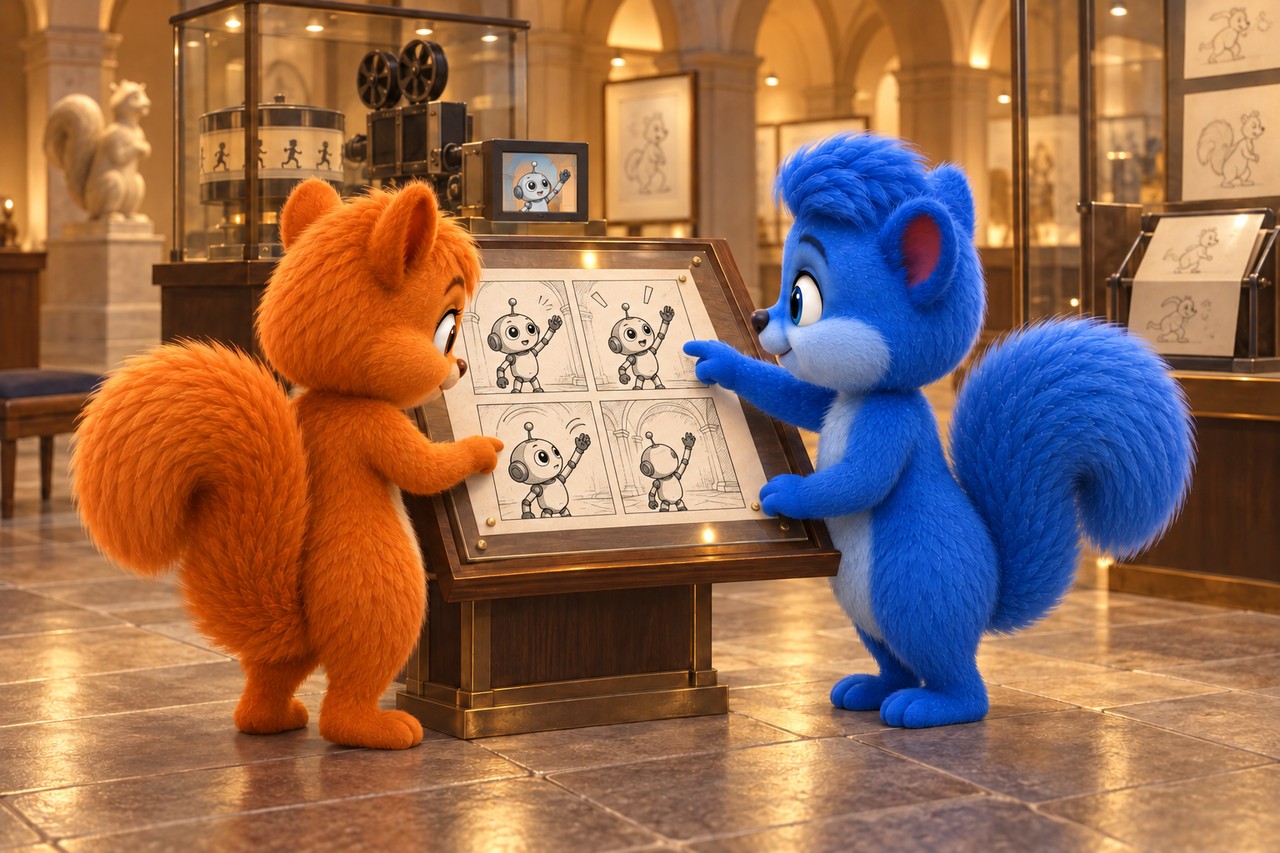
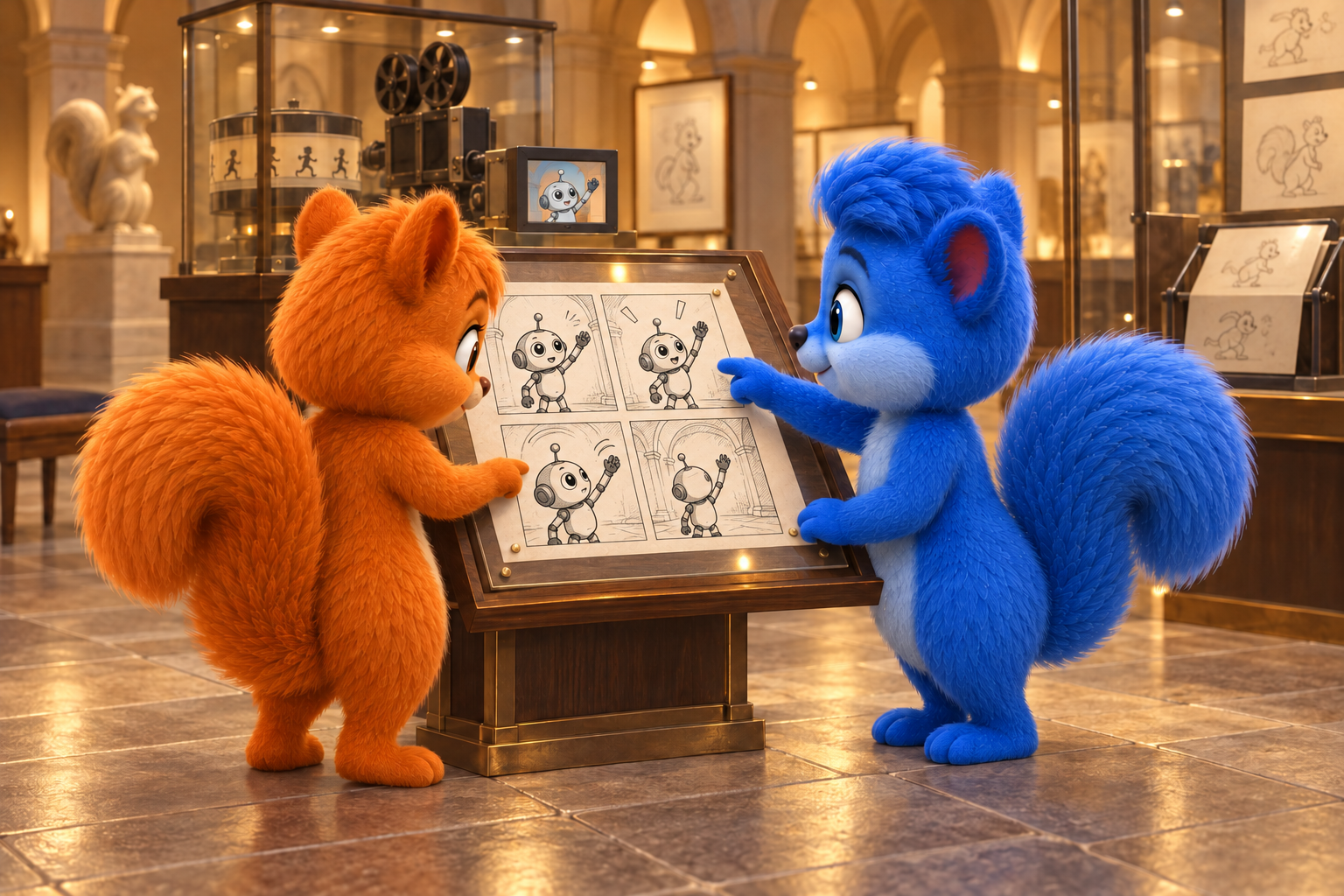
Puschel and Flauschi examine an original four-panel page and an animation screen in the museum. Original learning scene with invented robot pictures; no actual manga page or anime still. AI-created illustration, not a photograph of nature.
What the diagram shows
The diagram simplifies the process. First compare its shapes and arrows. You can read its labels in larger text below.
Read the picture labels
These are the words and sentences from the diagram above. The full explanation follows below.
- Same original character, different media
- Manga reading model
- Animation model
- 2
- 1
- 4
- 3
- Pictures stay still.
- Arm moves during playback.
- Reading order: 1 → 2 → 3 → 4
- Motion can be reduced.
- Original example: no actual manga page or Japanese production.
- The character demonstrates the media difference, not a fixed drawing style.
An imagined Wusel scene
Puschel and Flauschi investigate
Puschel sorts two stories only by their characters' large eyes. Flauschi points to the form: comic pages here, an animated film there. They sort by storytelling medium instead. Lumi also checks what is suitable for children.
Look closely
In the museum picture-story gallery, Puschel and Flauschi examine an original four-panel sequence on a sloping reading lectern. Puschel points at the top-right panel; Flauschi follows the sequence. A small screen shows the same original robot in colour as an animation example. Protected drawings and equipment stand behind glass.
An example to help you understand
Original four-panel activity: draw an invented little toy robot in four boxes. At top right its arm is down, at top left it raises the arm, at bottom right it keeps it raised, and at bottom left it lowers it again. Number the panels 1 to 4 in exactly this order. Decide the reading direction first and ask someone to explain the action from the pictures alone. This is our practice model, not a traced manga page.
Try explaining it
What distinguishes manga and anime as storytelling forms?
Choose a), b) or c), then explain your choice.
- a)Manga show moving film images; anime tell stories on printed comic pages.
- b)Manga and anime differ only in whether eyes are large or small.
- c)Manga use comic pages; anime use moving images.
Show the explanation
Correct: c): Manga use comic pages; anime use moving images.
Manga are Japanese comics and graphic narratives. Anime are Japanese animated films or series. Both vary greatly and are not all made for children. One drawing style does not define the difference.
Explore in more detail
Here you will find longer explanations and further details. You can explore them together.
1. Manga tells stories through pictures
Manga refers to Japanese comics and graphic narratives. Pictures, lines and characters carry the story; text may be added. There are many subjects and formats. Manga therefore does not mean just one kind of plot or a fixed recipe for one drawing style.
2. Check the reading direction
Traditional manga pages often lead right to left and top to bottom. Check the particular edition’s instructions and layout. Our simple four-panel example begins at top right, continues at top left, then bottom right and finally bottom left.
3. Anime is animation
Here, anime means Japanese animation. Animation shows many separate pictures in sequence to create the impression of movement. For example, a drawn arm is slightly higher in each following picture. When played, the figure appears to raise it. Instead of moving between panels yourself, you watch the sequence play. Tezuka Productions shows how manga and television animation can be connected. A manga story may become a source, but animation and a printed page remain different media.
4. A picture can suggest movement
Drawn lines or symbols in manga can express movement, mood or imagined sounds. A paper picture does not actually move. Ask what the lines in an original drawing communicate and compare interpretations. Different stories use different devices.
Checked against: [1]
An optional question for further exploration
You can use the longer explanation above. This is extra, not needed for the first quiz.
An extra question
Why is a manga page with movement lines not yet animation?
Discover the answer
Because the lines suggest movement while the printed pictures remain still. Animation plays over time. When reading a page, we instead follow the arranged panels ourselves.
Pictures and sources for adults
Sources for further reading
Facts checked against the specialist sources below on 12 October 2026. The Wusel scene is fictional; comparisons and simplified models are explicitly explained. Sources are in English.