Why can an airplane fly?
Air is invisible, but it can exert forces. Wings and engines have different jobs in flight.
The short answer
An aircraft wing changes the motion of air around it, producing an upward force called lift. At a suitable speed and angle, lift can support the aircraft's weight. Thrust helps it move against air resistance.
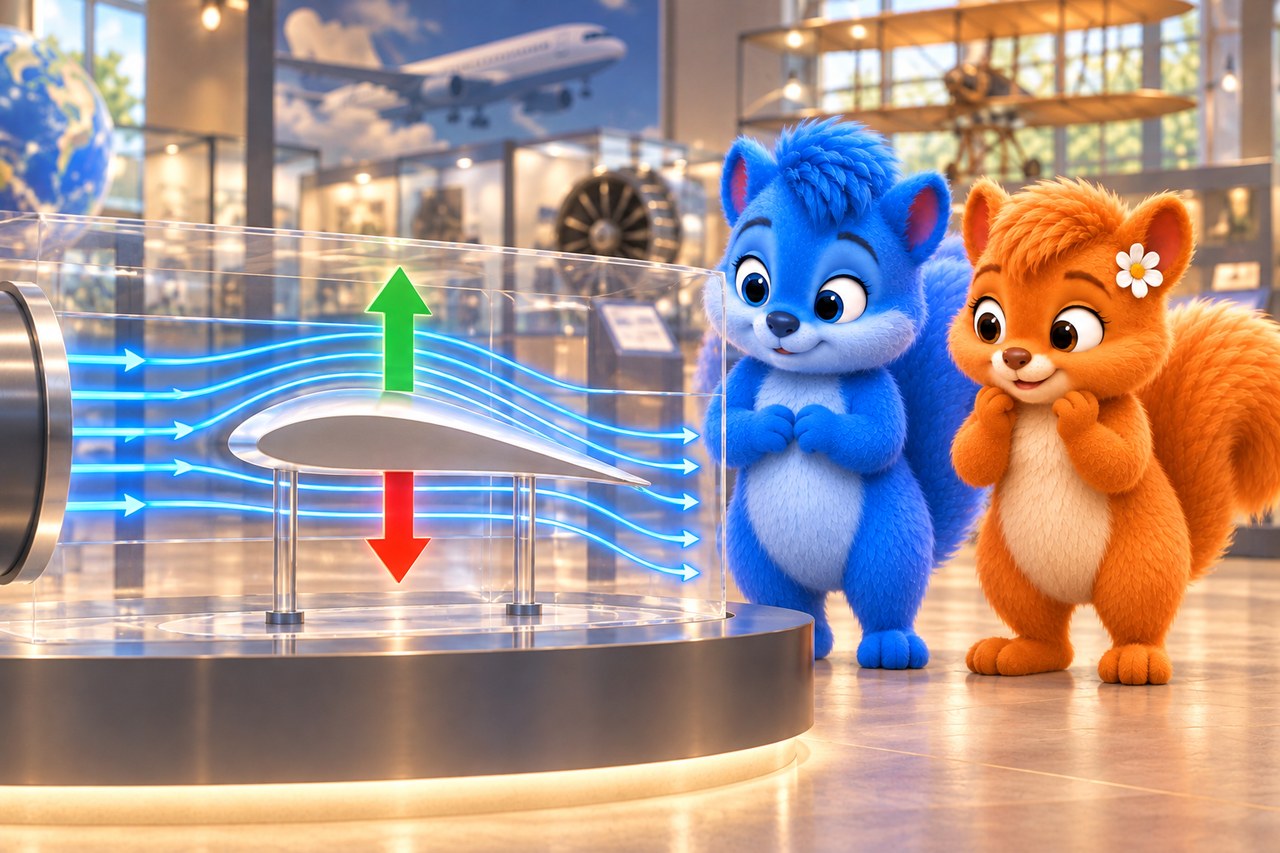
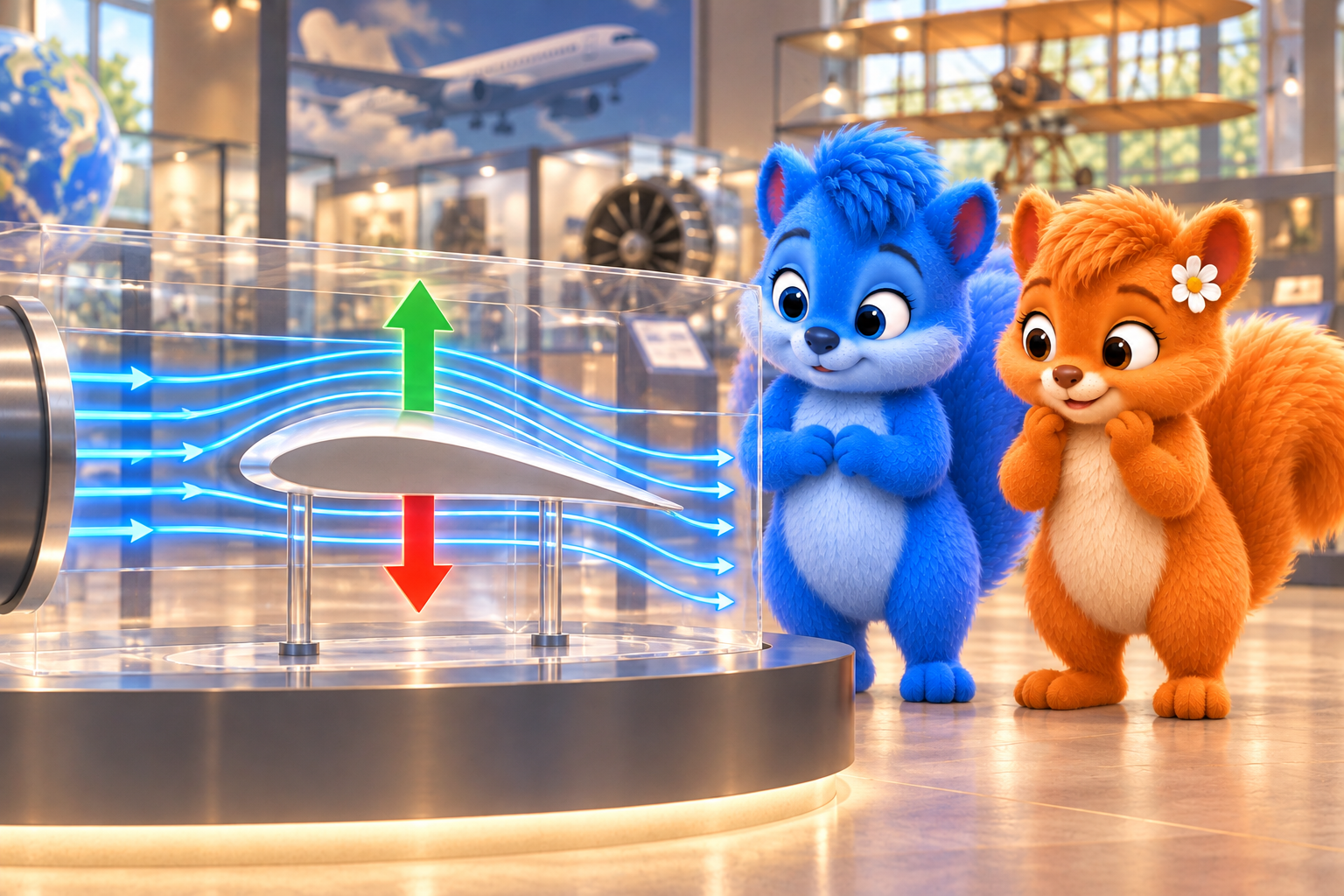
Puschel and Flauschi in the museum. Wing model: air is deflected down, lift acts up and weight acts down. Simplified inanimate museum model; arrows and colours help explain it. AI-created illustration, not a photograph of nature.
Explained in three pictures
1 Air flows past a wing
A moving wing changes the airflow.
2 Air is deflected
Overall, it deflects air downwards.
3 Force on the wing
Air exerts lift upwards. Weight acts downwards.
More about the picture
Lift arises from wing shape, angle and airflow working together. Pressure differences and air deflection belong together. Propulsion provides motion; lift is not thrust. Air taking different routes does not have to arrive at the same time.
An imagined Wusel scene
Puschel and Flauschi investigate
At the wing model, Puschel draws an upward arrow without knowing its cause. Flauschi helps trace the displayed airflow. He adds the air movement before the wing's force. His second drawing links cause and effect.
Look closely
Compare the museum model with the three picture steps. Overall, it deflects air downwards.
An example to help you understand
Draw a plane pointing right and label four arrows: lift upward, weight downward, thrust right and drag left. For steady straight level flight, make the two vertical arrows equally long and the two horizontal arrows equally long. Arrows represent forces; they are not airplane parts. Making your drawing larger does not tell you the actual force strengths. Experts calculate and test airflow, shape, weight and many other factors for real aircraft.
Try explaining it
Which force can balance weight upwards in flight?
Choose a), b) or c), then explain your choice.
- a)Weight pulling towards the ground.
- b)Lift from the wings.
- c)Drag acting along the direction of flight.
Show the explanation
Correct: b): Lift from the wings.
An aircraft wing changes the motion of air around it, producing an upward force called lift. At a suitable speed and angle, lift can support the aircraft's weight. Thrust helps it move against air resistance. Weight pulls downward.
Lift can oppose it upward; drag resists movement through air.
Word help
- lift
- An upward force generated by airflow around a wing.
Explore in more detail
Here you will find longer explanations and further details. You can explore them together.
1. Earth also pulls airplanes down
An airplane has weight: a force pulling it toward Earth. A force is a push or pull in a direction. Weight does not disappear during flight. Straight flight at a constant height requires an upward force balancing weight.
Checked against: [1]
2. Wings change the airflow
When a wing moves through air, air flows around its upper and lower surfaces. The wing’s shape and position change the flow. Air is deflected downward overall, while air exerts force on the wing. Air pressure describes how strongly air pushes on a surface. Different pressures around the wing belong to the same process. In straight level flight, the upward part is lift. Level here means parallel to an imagined flat ground.
3. The engine helps it move forward
The engine produces thrust, a forward force. Air resists motion; that resistance is drag. The engine counters drag. The large wings provide most lift on our passenger aircraft; engines provide thrust. A glider can even fly without its own engine while air continues flowing appropriately around its wings.
Checked against: [1]
4. Forces match the flight conditions
In straight flight at constant height and speed, forces balance: lift balances weight; thrust balances drag. Speed tells us how fast something moves. Our diagram shows this simplified case. Directions and strengths can differ during takeoff, turns and landing. Air particles above and below a wing do not have to meet behind it at the same time; that familiar story explains lift incorrectly.
An optional question for further exploration
You can use the longer explanation above. This is extra, not needed for the first quiz.
An extra question
Which two forces balance during straight flight at a constant height?
Discover the answer
Lift and weight. Weight acts downward; lift acts upward in this level flight. Constant speed also requires thrust and drag to balance.
Pictures and sources for adults
Sources for further reading
Facts checked against the specialist sources below on 12 October 2026. The Wusel scene is fictional; comparisons and simplified models are explicitly explained. Sources are in English.