Discovery 27 / 27
Puschel & Flauschi’s Forest Discoveries
Why Do the Woods Crack in the Frost?
The green explorer’s magnifying glass with a leaf-shaped handle
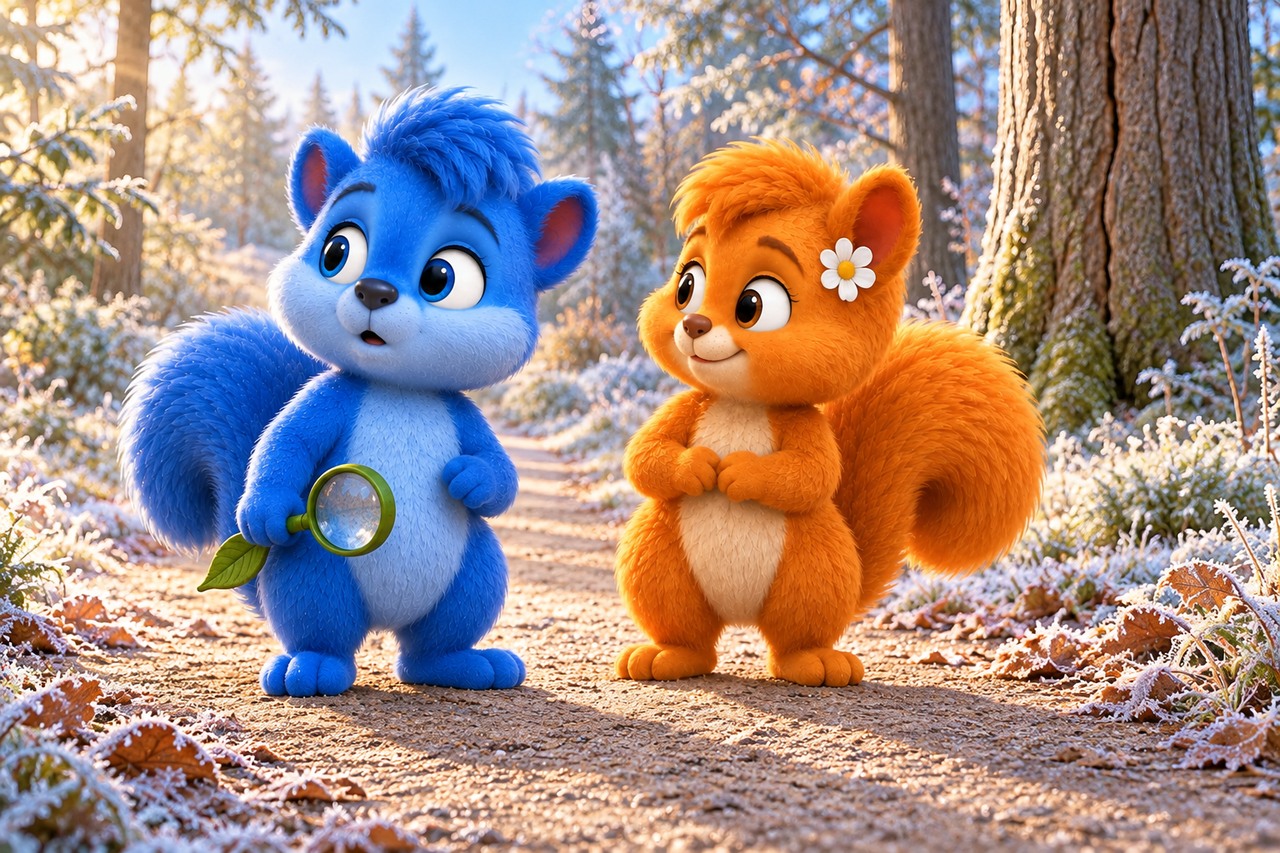
The morning was bright, and frost glittered along the path edges. Puschel and Flauschi followed the wide, open woodland path. Puschel had just decided to be especially quiet when a sharp crack sounded somewhere among the trees. He stopped. For a moment his tail looked particularly round behind him.
Puschel“Who has opened an enormous nut?”
Flauschi listened too. They heard a rustle, then everything was quiet again. Neither could see where the sound had come from. Puschel looked toward a thick trunk in the distance. He wanted to step closer but stayed beside Flauschi on the path.
Flauschi“We don't need to go beneath the trees to investigate. We can think from here too.”
Puschel“Good. I haven't got a nutcracker big enough anyway.”
A little farther on, the path led out of the dense trees toward the woodland edge. They paused there. A thin rim of frost lay on the signpost. Puschel studied it and asked whether the cold might have something to do with the sound.
Flauschi“It can play a part. When wood becomes very cold quickly, its different parts do not all change in the same way. That can create stress.”
Puschel“Stress? Like when I'm waiting for a story to start?”
Flauschi“Here it means parts of the wood pull differently. That can cause a split at a weak spot. Some splits like that are called frost cracks.”
Puschel imagined a sleeve pulled harder on one side than the other. It was not an exact model of a tree, but it helped him picture the pulling. Flauschi explained that a trunk could cool faster on the outside than deeper inside. The wood was not equally cold everywhere at once.
Puschel“So something is changing outside while something different is still happening inside.”
Flauschi nodded. But she did not point to the distant trunk and claim that a frost crack had just formed there. They had not seen that happen. It could have been a branch or another woodland sound. Not every crack was a frost crack, and not every old line in bark told them what had happened just now.
Puschel“Our puzzle still has a perhaps. We met one of those with the acorn.”
Flauschi“Yes. A possible explanation and a certain observation are not the same thing.”
Puschel looked at the firm path beneath his feet. When branches cracked or paths were closed because of danger, they should not search for a closer spot to investigate. They would keep their distance and continue along safe paths with an adult. They did not need to solve the whole puzzle today.
Puschel“I can be curious and still stay here. Both things fit in my head at the same time.”
As they headed home, another softer crack sounded behind them. Puschel turned his head but kept his feet on the path. Flauschi waited beside him for a moment. They listened without touching anything or walking beneath the branches.
Puschel“If the woods have opened a nut, they may keep it.”
Flauschi laughed quietly. Then they walked on. The sound remained a little mystery. They understood a bit more about what cold could do to wood—and the wide, safe path led them all the way home.
Look closely
What the two discovered
During rapid severe cooling, outer and inner parts of a trunk may shrink by different amounts.
This can create stress. Wood may split at weak spots; such splits are sometimes called frost cracks.
Not every woodland cracking sound is a frost crack. Without observing it, we cannot know the cause of a particular sound for certain.
An old split or bark line does not prove what just made a sound. Distance and safe paths matter more than a quick answer.
Little Wusel quiz
Choose one answer: a) or b).
Does every cracking sound prove that a frost crack is forming?
Show answer
The correct answer is a). We may know a possible explanation without knowing the cause of that particular sound for certain.
Explorer’s rule: Leave animals and plants in peace. Just watch and do not damage anything.
Sources for adults: Iowa State University: Frost cracks (English) · US Forest Service: Tree wounds and frost cracks (English)
Keep exploring
Where shall we wusel next?
Choose how to keep exploring: another story or a related activity.
The Pearls in the Spider Web
In the morning light, a mysterious string of pearls sparkles between two ferns. With their explorer’s magnifying glass, Puschel and Flauschi discover who it belongs to.
Read another discovery →Keep exploring together
Nature bingo and woodland games for curious explorers.
Explore woodland games →