Discovery 26 / 27
Puschel & Flauschi’s Forest Discoveries
The Woods under the White Blanket
The green explorer’s magnifying glass with a leaf-shaped handle
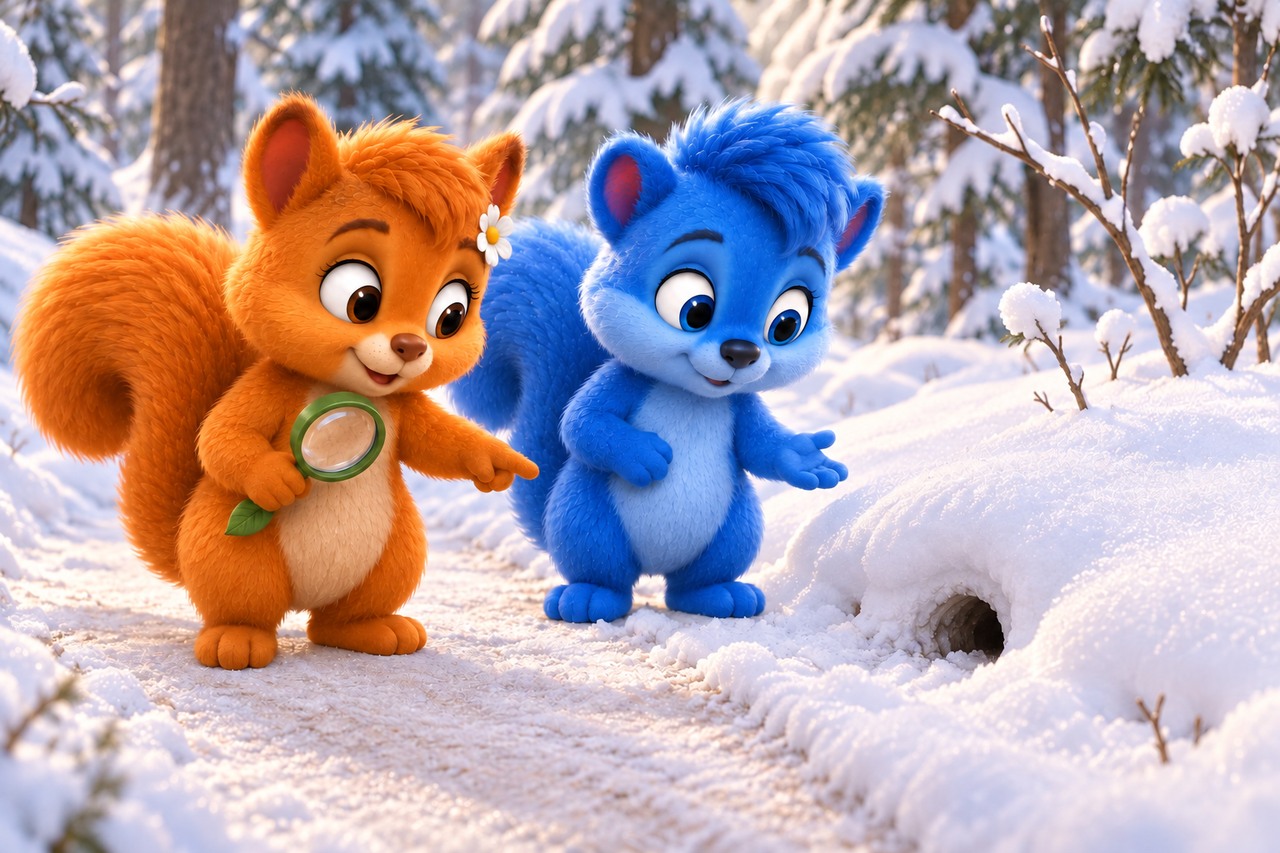
Overnight the woods had gained a white blanket. Puschel and Flauschi could walk safely on the cleared path. Beside them, smooth snow lay among the trees. Puschel looked over it and spread his paws as if measuring its size.
Puschel“The woods have tucked themselves in. But their feet aren't sticking out.”
Flauschi smiled. A low twig poked out of the snow. Beneath it, a little opening was already visible at the edge. The two had not made it. Puschel stayed on the path and looked from there instead of walking over.
Puschel“Is that the way in under the blanket?”
Flauschi“Perhaps it belongs to a little tunnel. We can't tell from here who uses it.”
They kept their distance. Beneath snow there could be spaces where little animals moved about. Puschel imagined a mouse passing a blade of grass while one snowflake settled on another overhead. He liked the thought. He wanted to see everything—and also realised that uncovering everything would not be a good way to watch.
Puschel“If I take the blanket away, it isn't a blanket any more.”
Flauschi“Exactly. We'll leave the snow in place and learn from what is already visible.”
Puschel looked at his own paw. Snow felt cold. Yet Flauschi had said that a deep enough snow layer could protect the ground and some animals beneath it from severe cold. At first that sounded puzzling.
Puschel“How can something cold be a blanket? My blanket at home is much cosier.”
Flauschi“Air sits between the snow crystals. A loose snow layer lets heat pass through slowly. It doesn't make new heat; it slows the loss of warmth that is already there.”
Puschel thought about the warm fur on his tummy. Beneath it things felt more comfortable than in the cold wind. Snow and fur were not the same, but the idea of holding warmth helped. Beneath the white surface, the temperature could be different from the air above. The amount of protection also depended on how deep and loose the snow was.
Puschel“So there isn't an oven beneath the woods. More like a brake on warmth that's already there.”
Flauschi nodded. Snow did not protect every animal from everything. Some had to work especially hard to find food now. Winter remained winter, even with a blanket. That was another reason not to enlarge openings or expose hiding places.
Puschel“Then the little entrance won't have visitors today. We wouldn't fit through it anyway.”
He held his paws beside his round tummy and looked at Flauschi. They both laughed. Then they listened quietly to the woods again. They saw no mouse, and did not need to see one to understand something new.
Flauschi“We can look from the same spot another day and see how the snow changes.”
Puschel remembered the twig and the bend in the path. The little opening remained untouched behind them. On the way back he glanced once more across the smooth snow. The woods looked quiet, but now he could imagine life continuing beneath the white blanket.
Look closely
What the two discovered
Air lies between snow crystals. A deep enough loose layer can slow heat loss from the ground.
Snow does not create heat. Temperatures beneath it may still vary less than in the air above.
Some small animals use spaces beneath snow. A visible opening alone does not identify its resident.
Protection depends partly on the depth and structure of snow. Snow can also make finding food harder for some animals.
Little Wusel quiz
Choose one answer: a) or b).
How can snow cover protect the ground?
Show answer
The correct answer is b). Air in a loose snow layer helps warmth escape more slowly. Snow itself creates no heat.
Explorer’s rule: Leave animals and plants in peace. Just watch and do not damage anything.
Sources for adults: NSIDC: Why snow matters – insulation and wildlife (Englisch / English) · National Park Service: SnowSchool – insulation (Englisch / English)
Keep exploring
Where shall we wusel next?
Choose how to keep exploring: another story or a related activity.
Why Do the Woods Crack in the Frost?
A sudden crack makes Puschel listen. The two discover how cold can affect wood—and why not every sound has a certain explanation.
Read another discovery →Keep exploring together
Nature bingo and woodland games for curious explorers.
Explore woodland games →