In brief
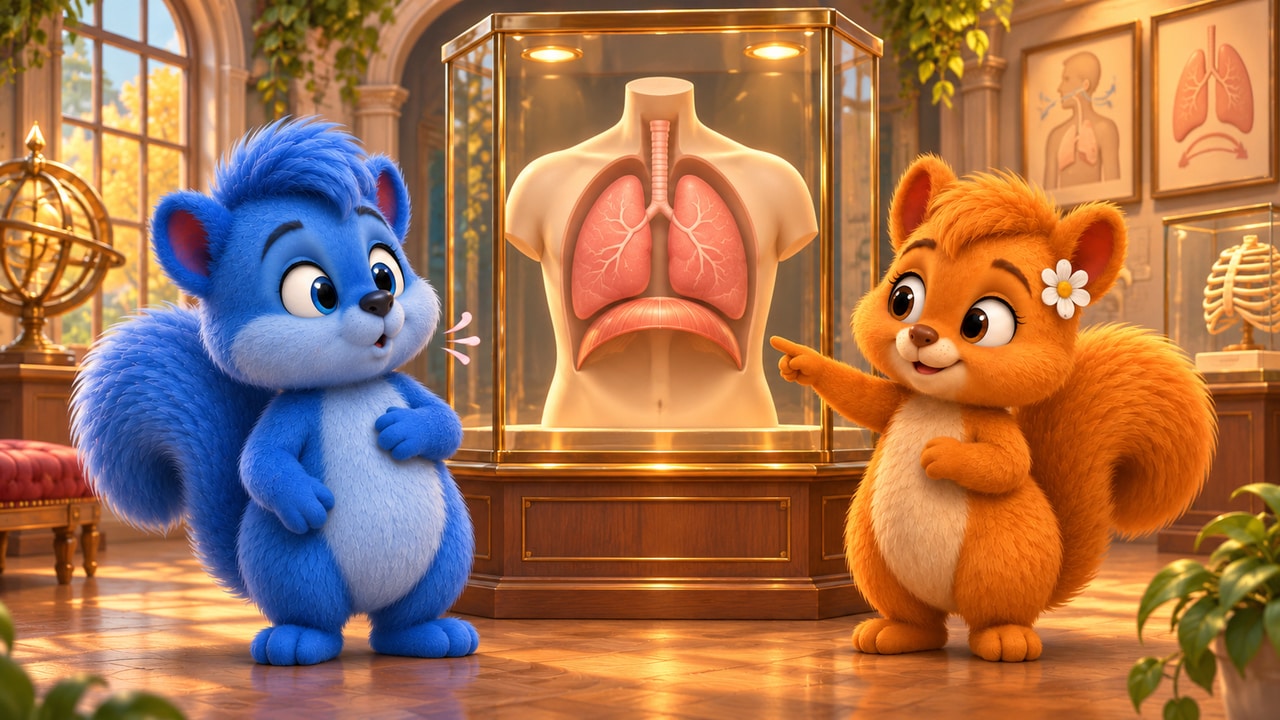
During a hiccup, the diaphragm, a large breathing muscle below the lungs, suddenly tightens without you choosing to do it. Two soft folds in the throat, the vocal folds, close quickly afterwards. This makes the hic sound.
Lumi’s rule
Never frighten someone or pressure them into breath-holding, gulping drinks or other tricks. Tell an adult about persistent or troubling hiccups; seek medical advice if they last longer than 48 hours.
Puschel and Flauschi investigate
Puschel is about to explain the breathing model. He gives a small sudden jolt in the middle of his sentence.
Puschel “I only wanted to speak! Now I have hiccups.”
Flauschi stays calmly beside him. She does not startle him or turn it into a contest.
Flauschi “It happens without you choosing it. The diaphragm, the large breathing muscle below the lungs, suddenly tightens.”
Puschel “But the sound comes from up in my throat, doesn’t it?”
Flauschi “The vocal folds close briefly just afterwards. They are two soft folds in the airway at the front of the throat. That makes the hic sound.”
They pause their exploring and wait. When Puschel wants to continue, he points below the lungs and then towards his throat. Two events work together.
Listen to the story
With the narrator, Puschel and Flauschi. This recording contains the story; the explanations and quiz follow below.
In three steps
1
Muscle contracts
The breathing muscle below the lungs suddenly tightens without you choosing it.
2
Vocal folds close
A brief rapid closure follows in the throat.
3
The hic is heard
The closure makes the characteristic sound.
Simplified explanatory models: colours distinguish parts, not real materials. Read the three steps in order. The text explains what each shape represents. Blue shapes: lungs. Pink arch: diaphragm. The throat is shown enlarged in the middle picture.
The explanation step by step
The diaphragm helps us breathe
The diaphragm is a large muscle below the lungs. As you breathe in normally, it tightens and flattens. This creates more room in the chest, allowing air into the lungs. During a hiccup it suddenly tightens with a jerk, without you choosing to do it. This is called involuntary.
Why the hic sound?
After the sudden contraction, the vocal folds close quickly. These are two soft folds in the larynx, or voice box, a part of the airway at the front of the throat. Their vibrations help make your voice when you speak. This rapid closure makes the characteristic sound. A hiccup is not simply an air bubble bursting in the belly.
There is not always an obvious trigger
Eating quickly or a lot, fizzy drinks and excitement can trigger hiccups. Often there is no obvious cause. They usually stop on their own. No home remedy works reliably for everyone. If hiccups last unusually long or interfere with eating, sleeping or breathing, tell an adult and seek medical advice where needed.
Word help
- diaphragm
- A large breathing muscle below the lungs. It flattens as you breathe in, making more room in your chest.
- vocal folds
- Two soft folds in the airway at the front of the throat. They help make your voice and close quickly in a hiccup.
- involuntary
- Happening without you choosing the movement.
- larynx
- The voice box: a part of the airway at the front of the throat containing the vocal folds.
- contraction
- A muscle tightening and changing shape.
Your explorer activity
Point to the first step in the diagram. Explain in your own words what changes by the final step. Use only the drawing; you do not need to open any appliance or recreate the process.
Remember this
In a hiccup the diaphragm contracts; the vocal folds closing quickly make the sound.
Quiz question 1
Which muscle contracts suddenly in a hiccup?
Choose a), b) or c), then explain your choice.
- a)The diaphragm.
- b)Only the tongue.
- c)Only the lips around the mouth.
Show the explanation
Correct: a): The diaphragm.
The diaphragm lies below the lungs.
Quiz question 2
What produces the hic sound?
Choose a), b) or c), then explain your choice.
- a)An air bubble bursting in the stomach.
- b)The vocal folds closing rapidly.
- c)The tongue touching the teeth.
Show the explanation
Correct: b): The vocal folds closing rapidly.
The sound comes from the voice box, where the vocal folds are.
Quiz question 3
What is true about triggers?
Choose a), b) or c), then explain your choice.
- a)Sometimes no trigger is obvious.
- b)You have always eaten too much.
- c)The movement is always deliberate.
Show the explanation
Correct: a): Sometimes no trigger is obvious.
Eating quickly can trigger hiccups, but we do not know the cause of every hiccup.
Sources and illustration note
Facts checked on 18 November 2026; language reviewed on 19 November 2026. The Wusel story is fictional. Simplified models show principles, not construction, repair or treatment instructions. Specialist references are for reading with an adult.