Earth & Space
Why do stars twinkle?
A star seems to flicker. The Wusels explore its light's journey through the air.
The short answer
Starlight passes through the air above us. Moving layers of air bend it in changing ways, making a distant star seem to twinkle. This twinkling happens on the last part of the light's journey through our atmosphere: Earth's blanket of air.
An imagined Wusel scene
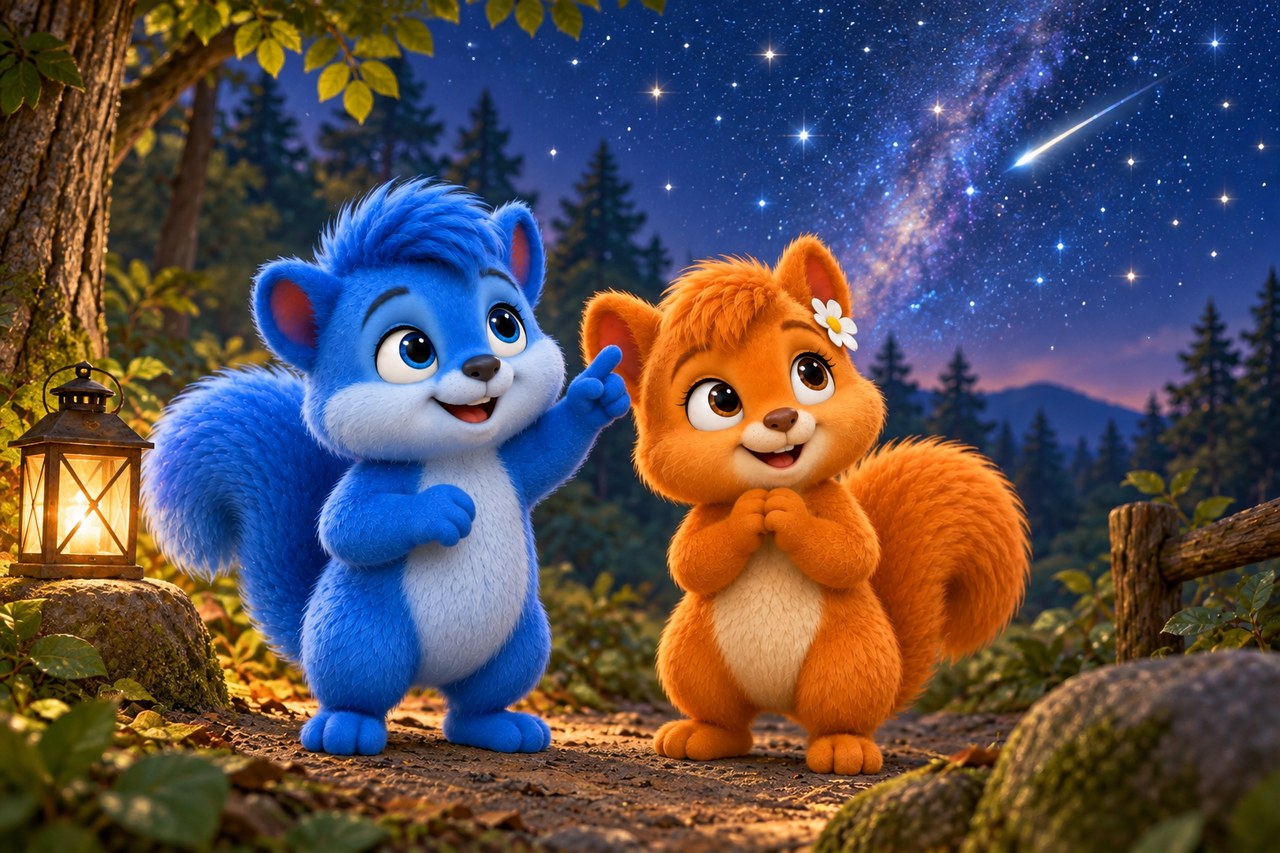
Puschel and Flauschi investigate
Puschel draws a star with a light switch. Flauschi places a picture of Earth beside it and points to its air. They add the long light path and moving air just before the eye.
He crosses out the switch: they do not need it to explain this twinkling.
Try explaining it
Where does the cause of this twinkling lie?
Choose a), b) or c), then explain your choice.
- a)In moving air above us.
- b)At the star, which changes brightness because of air movement on Earth.
- c)In the eye, because every star sends light only in pulses.
Show the explanation
Correct: a): In moving air above us.
Starlight passes through the air above us. Moving layers of air bend it in changing ways, making a distant star seem to twinkle. This twinkling happens on the last part of the light's journey through our atmosphere: Earth's blanket of air.
Word help
- atmosphere
- The gas layer around a world; on Earth it is the air above us.
Explore in more detail
Here you will find longer explanations and further details. You can explore them together.
Understand step by step
How it works – simply explained
Light travels to us
Starlight crosses a great distance and then Earth’s atmosphere before we see it.
Air is not uniform
Moving layers with different properties redirect the light variably. Slightly more or less light from the tiny apparent point reaches us.
Twinkling arises along the way
The star need not switch on and off. Outside Earth’s atmosphere this cause is absent, though real changes in stellar brightness still occur.
References for this explanation: [1]
The key points again
Discovery 1
Starlight passes through Earth’s atmosphere before reaching our eyes.
Source: [1]
Discovery 2
Moving layers of air bend it in changing ways. A distant star looks like a tiny point whose brightness flickers.
Source: [1]
Discovery 3
Space lacks this atmospheric cause of twinkling. Not every change in a star’s brightness has the same cause.
Source: [1]