Water, Waste & Recycling
Where does the rubbish collection truck go?
The short answer
Rubbish services take separately collected waste to suitable facilities. Paper can become new paper, organic waste compost or biogas, and packaging is sorted. In Germany, residual waste is usually burned with energy recovery. It does not all go onto one pile.
See how it works
These pictures show different routes, not one truck mixing every kind of waste.
1. Separate first
Paper, glass, organic waste, packaging and residual waste are collected differently. Local services explain which containers and colours apply. Not every type of packaging goes in the same bin.
2. Separate transport
Collection vehicles take different waste streams to suitable facilities. From outside, you cannot always tell whether a vehicle has separate compartments.
3. Sort and process
Sorting facilities separate materials such as metals and different packaging materials. Suitable materials can become resources for new products. Dirt and wrong items make this harder.
4. What remains
Not every material can usefully be recovered. German residual waste is usually used for energy: burning produces usable heat. This is different from recycling the material.
An imagined Wusel scene
Puschel and Flauschi investigate
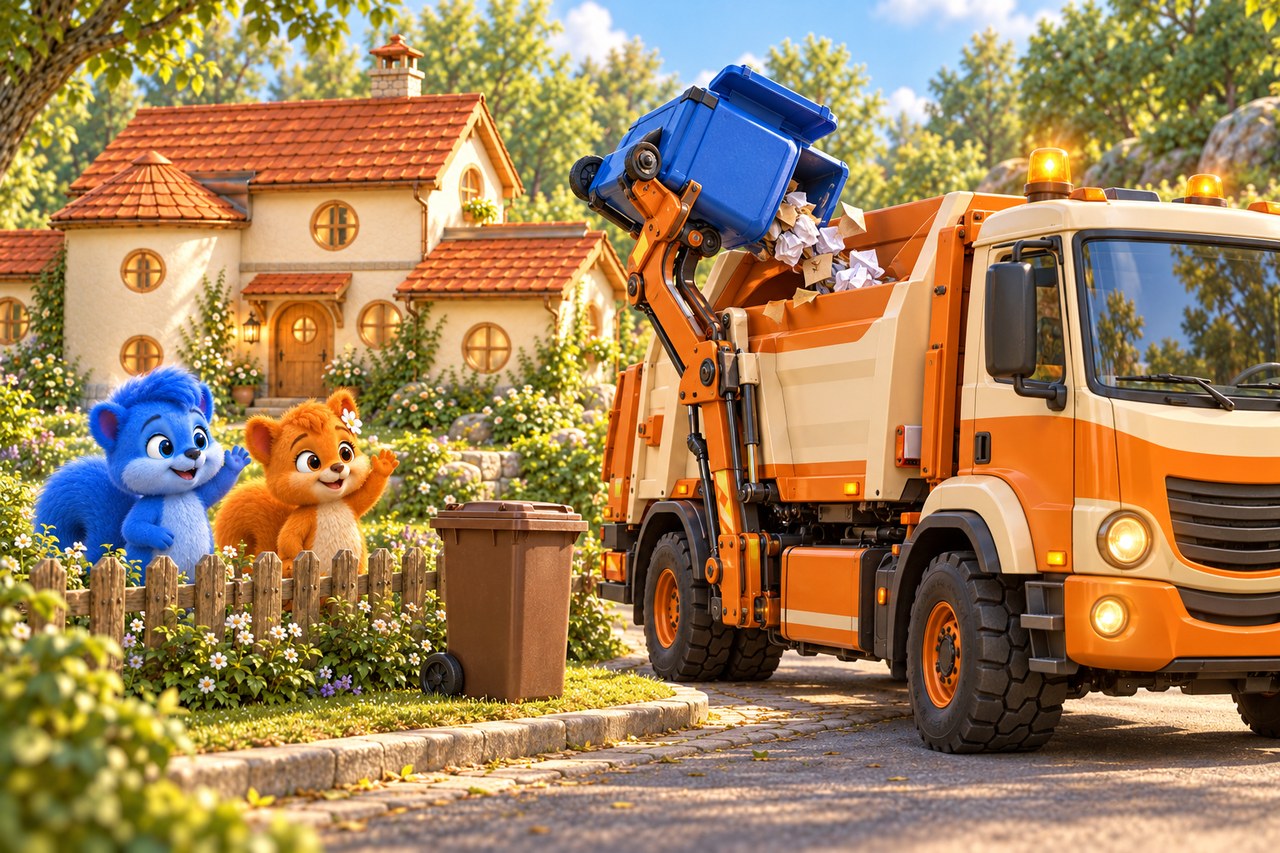
A rubbish collection truck rumbles up outside the Wusels’ home. Its round headlights and curved grille look like a cheerful face. Puschel and Flauschi wave from behind their garden fence. The lifting arm grips the paper bin and tips it up.
Rustle, rustle — the collected paper falls into the truck. “Will it take the other bin too?” asks Puschel. “Today is the paper collection,” says Flauschi.
“We will check the collection calendar for the other waste.” The arm puts the empty bin down again. The two keep their distance: they can watch from their safe spot.
Word help
- Resource
- A starting material used to make something.
- Recycling
- Processing waste material so it can be used as material again.
Your activity
Sort clean picture cards using your local rules. Add an “ask an adult” card for uncertain items. You do not need to handle or open real rubbish.
Quiz: understand the idea
Why collect paper separately from residual waste?
Choose a), b) or c), then explain your choice.
- a)Because separation replaces all further processing.
- b)So its fibres can be used more effectively as a resource.
- c)Because burning turns paper fibres back into paper.
Show the explanation
Correct: b): So its fibres can be used more effectively as a resource.
Suitable separated paper can be recycled. Burning residual waste does not recover its paper fibres.
Try a new example
Burning a material produces heat. Is that the same as recycling its material?
Choose a), b) or c), then explain your choice.
- a)Yes: burnt paper fibres can be pressed unchanged into paper.
- b)Yes: any recovered heat is already new material.
- c)No: it does not recover the substance as the same resource.
Show the explanation
Correct: c): No: it does not recover the substance as the same resource.
Recovering energy and recovering material are different forms of recovery.
Explore in more detail
Here you will find longer explanations and further details. You can explore them together.
More to discover
Avoid waste earlier
Using things longer, repairing and reusing can prevent waste. Recycling also needs work, water or energy. It is not a reason to use unlimited disposable products.
Pictures and sources for adults
Sources
Imagined Wusel scene with a realistic collection process: AI-generated illustration, checked separately from the factual diagram. The diagrams simplify the process. Editorial source check: 19 October 2026.