Access for Everyone
What makes a route accessible?
The short answer
An accessible route should be findable and usable by different people, generally without assistance. Step-free access, enough space, firm ground and clear orientation can help. Wheelchair users, people with sight loss and people with pushchairs do not always need the same solution.
A ramp alone therefore does not remove every barrier.
See how it works
Arrows show a direction or change. Sizes and distances are simplified. Read in order; each explanation belongs to the picture above it.
1. Reach places without steps
A suitable ramp or lift can bypass steps. Overly steep or blocked ramps do not reliably help. Real planning also checks length, surfaces and other requirements.
2. Space and surfaces
Wide clear routes and firm, fairly even ground help movement. An open door is little use if an obstacle blocks it.
3. Offer orientation
Contrasts, clear signs and well-planned tactile features can help orientation. Information given by colour alone is not enough for everyone. Several understandable ways to get information help.
4. Include people
Users know important obstacles from experience. Asking and checking together helps more than imposing unwanted assistance. Good intentions alone do not test usability.
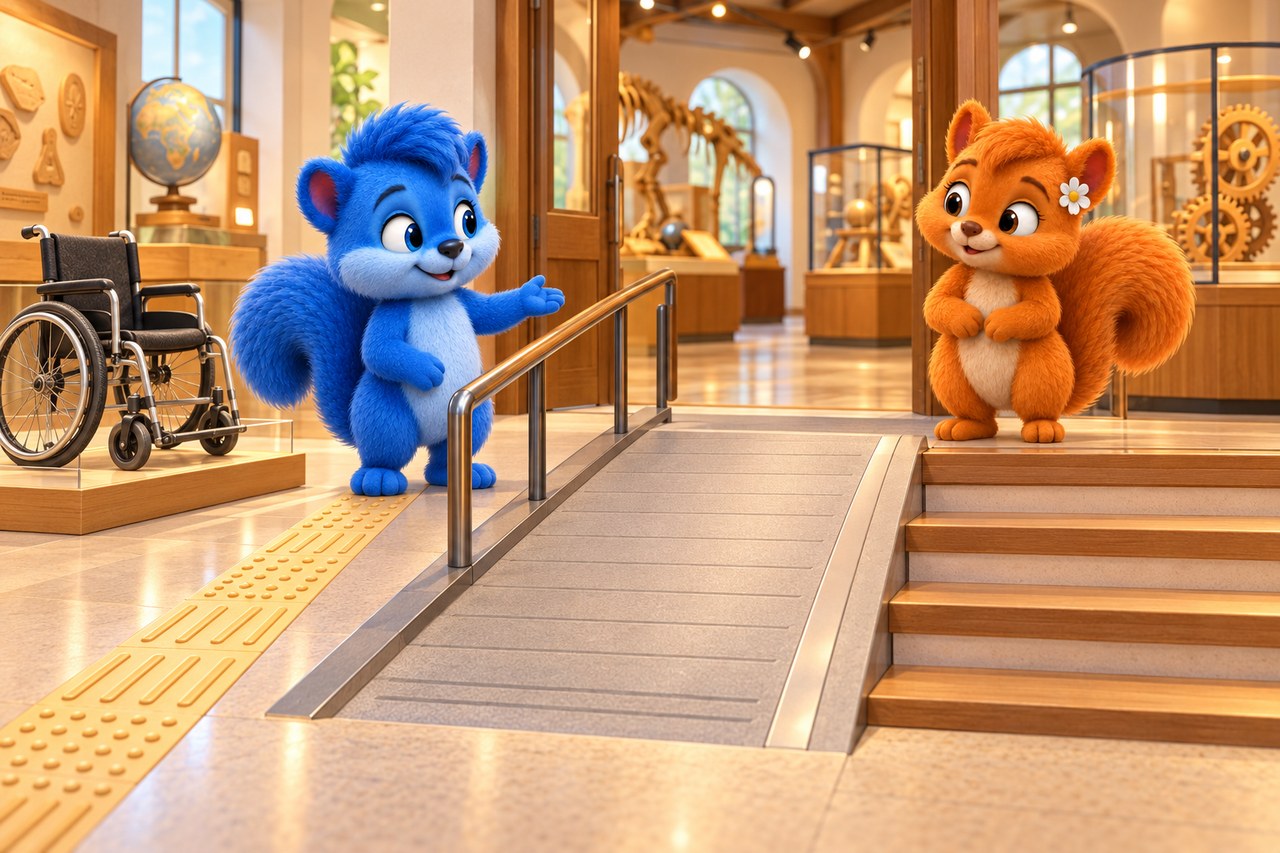
An imagined Wusel scene
Puschel and Flauschi investigate
Puschel builds a ramp from museum model blocks but leaves a basket in front of the door. Flauschi rolls a model wheelchair up to it. They clear the entire route, not just the first step.
Word help
- Barrier
- An obstacle making use or participation harder or impossible.
- Contrast
- A clearly noticeable difference, such as light next to dark.
Your activity
Draw a route from entrance to table. Look for steps, narrow points, loose objects and missing clues. This is an observation activity, not confirmation that a real building meets every requirement.
Quiz: understand the idea
A ramp ends at a doorway that is too narrow. Is the whole route usable now?
Choose a), b) or c), then explain your choice.
- a)No, the doorway and the remaining route must work too.
- b)Yes, only bypassing the steps matters.
- c)Yes, an extra-wide ramp makes up for the narrow doorway.
Show the explanation
Correct: a): No, the doorway and the remaining route must work too.
One good section is not enough if the route becomes blocked later.
Try a new example
You want to help someone using an aid. What makes sense?
Choose a), b) or c), then explain your choice.
- a)Take the aid immediately because help always looks the same.
- b)Ask whether help is wanted and what kind.
- c)Move them to a different route without asking.
Show the explanation
Correct: b): Ask whether help is wanted and what kind.
People decide what helps them. Their experiences and wishes are part of the solution.
Explore in more detail
Here you will find longer explanations and further details. You can explore them together.
More to discover
More than wheelchairs
Barriers can include hard-to-understand language, missing captions or an explanation available only as a picture. An offer therefore needs to consider more than one mobility aid. Our route model gives examples, not building regulations.
Pictures and sources for adults
Sources
Museum scene: AI-generated illustration, checked separately from the factual diagram. The diagrams simplify the process. Editorial source check: 19 October 2026.