Everyday Life & Technology
What changes when ice melts?
An ice cube becomes a puddle. The Wusels explore water and warmth.
The short answer
Ice takes in heat from its surroundings and becomes liquid. This is melting. It is still water: its state has changed from solid to liquid.
An imagined Wusel scene
Puschel and Flauschi investigate
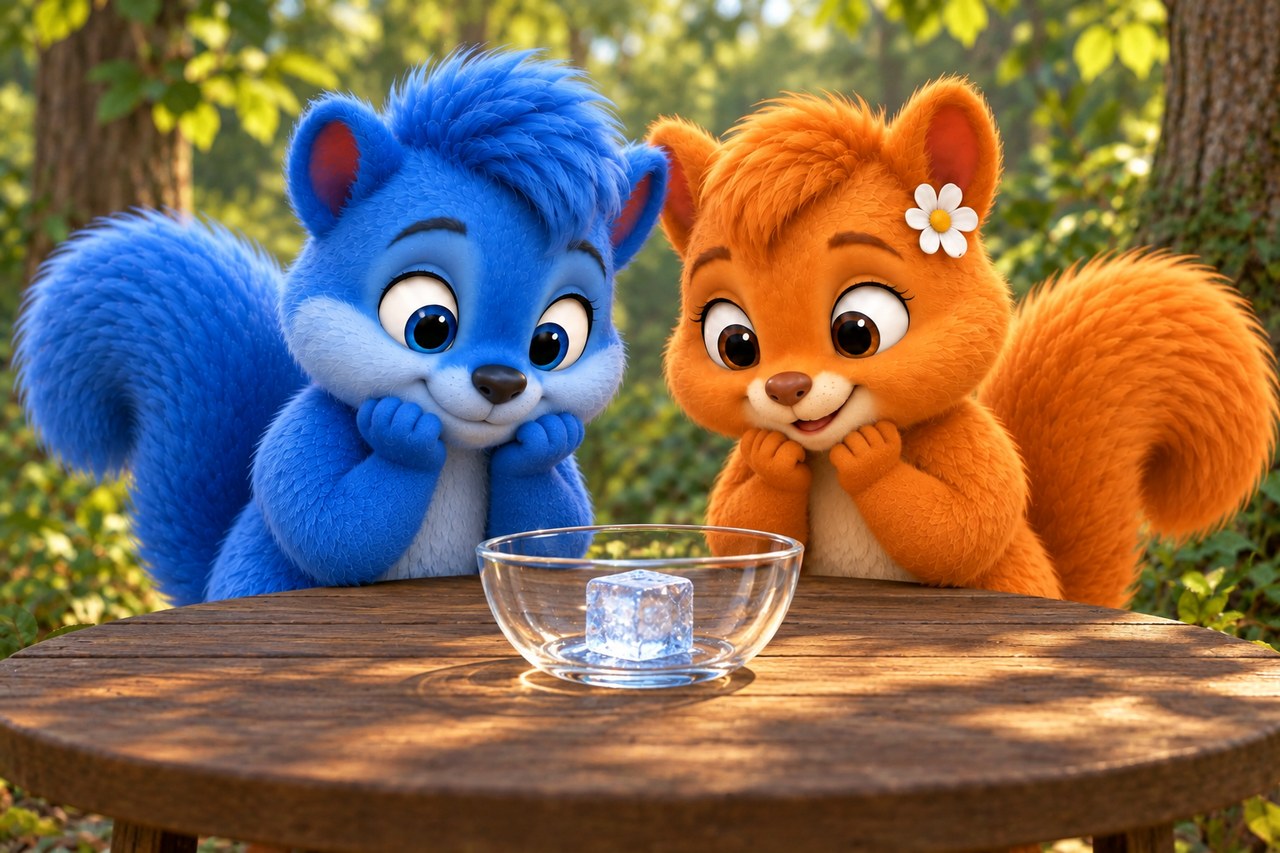
With Lumi, Puschel puts an ice cube in a bowl. Later he looks for the cube and sees a puddle. Flauschi points to the bowl: nothing was carried away.
He draws the same substance twice, once as a cube and once as liquid water.
Try explaining it
What stays the same when ice melts?
Choose a), b) or c), then explain your choice.
- a)The substance is still water.
- b)Its solid shape stays the same.
- c)It always stays equally cold.
Show the explanation
Correct: a): The substance is still water.
Ice takes in heat from its surroundings and becomes liquid. This is melting. It is still water: its state has changed from solid to liquid.
Explore in more detail
Here you will find longer explanations and further details. You can explore them together.
Understand step by step
How it works – simply explained
Same substance, different arrangement
Ice has water particles in a fixed arrangement. In liquid water they can change neighbours more easily.
Energy changes the state
Melting absorbs energy from warmer surroundings, breaking the solid arrangement into liquid water. No new substance is made.
Heat is needed
Pure ice melting at normal pressure stays around zero Celsius. Incoming energy is used for melting. Afterwards the liquid water can warm further.
References for this explanation: [1]
The key points again
Discovery 1
Ice is water in its solid state.
Source: [1]
Discovery 2
Melting ice takes in energy and becomes liquid. It remains the same substance.
Source: [1]
Discovery 3
Clean ice melts near zero degrees Celsius at ordinary air pressure; dissolved substances can change this.
Source: [1]