Water life · Rana temporaria
Discover the common frog
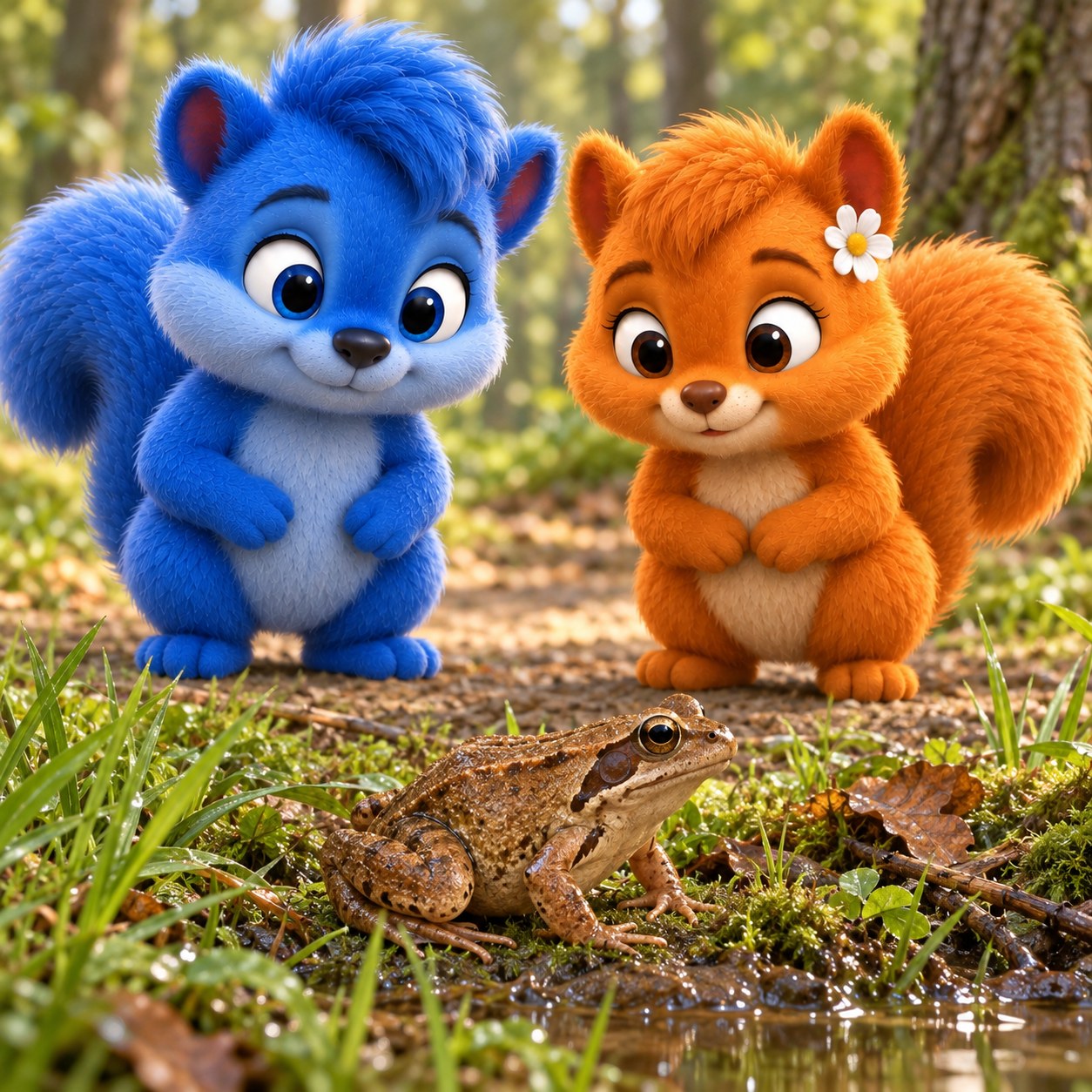
A brown jumper waits in damp grass. Puschel waits too.
The short answer
Common frogs are often brown with a dark patch behind the eye. They lay eggs in water but also live in damp places on land. They therefore need more than just a pond.
See the connection
Simplified drawings, not to scale. Not a guide for identifying species.
An imagined Wusel scene
Puschel and Flauschi investigate
Puschel has been looking for something green. Now a brown frog sits nearby. Puschel“Its German name sent me looking for the wrong colour!”
Flauschi“Names do not tell us everything,” Flauschi says. They stay on the path and give it room. Puschel puts his magnifier beside him instead of moving closer.
The frog hops into the grass. Puschel“Today I learned with my eyes,” says Puschel. Puschel“And my paws had a rest.”
Discover
Common frogs are not always green. Many are brown with a dark patch behind the eye.
Understand
They are amphibians. They visit water to breed; many spend the rest of the year in damp places on land.
Connections
Their eggs hatch into tadpoles. During metamorphosis, legs develop and the larval tail is absorbed.
Try explaining it
Why does a common frog need water and damp places on land?
Choose a), b) or c), then explain your choice.
- a)It lays eggs on land and takes them into water only as frogs.
- b)It develops in water and needs no place on land as an adult.
- c)It lays eggs in water and also lives on land.
Show the explanation
Correct: c): It lays eggs in water and also lives on land.
Eggs and tadpoles develop in water. Many adult common frogs also use damp habitats on land.
Word help
- metamorphosis
- A transformation of the body during a life cycle, such as from caterpillar through pupa to butterfly.
Explore in more detail
Here you will find longer explanations and further details. You can explore them together.
Understand step by step
How it works – simply explained
Eggs need water
Common frogs lay spawn, eggs in jelly-like coverings. Water matters for this stage.
A tadpole is not a finished miniature frog
A tadpole hatches from an egg. It has a tail, initially without four finished frog legs. During transformation, legs develop and the tail is absorbed.
Land matters later
Many adults use damp land places. Pond and sheltered surrounding land are needed together. A common frog can be brown; colour alone does not identify its species.
Why four different pictures can show one animal
Egg, tadpole, young frog and adult look very different. Metamorphosis, the name for this transformation, includes developing legs, absorbing the tail and changing breathing. This explains different habitats and lifestyles at different stages. Development time depends on conditions; there is no fixed day count for every frog.
References for this explanation: [1]
Explore animal sounds
Listen to common frog mating calls.
Common frog mating calls
Recording: Rabe19 · Original: Grasfrosch Paarungsrufe.OGG · Public domain · Wikimedia MP3 conversion; no trimming or content changes by us.
Listen quietly. Do not play animal recordings outdoors to attract animals.
An optional question for further exploration
You can use the longer explanation above. This is extra, not needed for the first quiz.
An extra question
Does a common frog have to be green?
Show answer
No. Colours vary and many common frogs are brown. A name does not fix an animal’s colour.