Trees and leaves · Silver Fir
Recognising a Silver Fir
The cones stand upright like little candles. Flauschi spots a silver fir, and Puschel looks for pale stripes beneath its needles.

The short answer
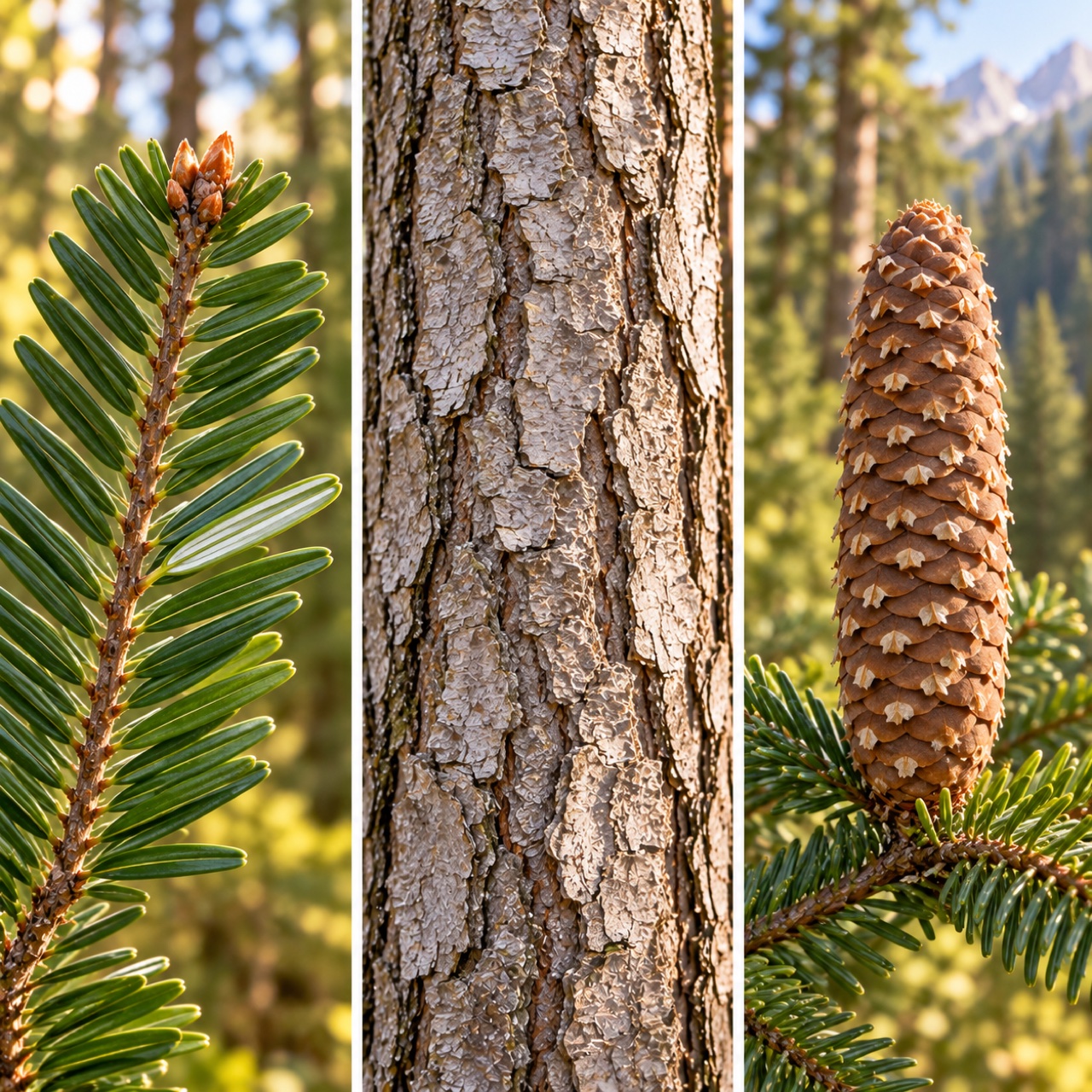
Fir needles are flat and usually blunt at the tip. Two pale stripes run along each needle’s underside. Silver fir bark is grey to silvery grey. On older trees it breaks into angular plates.
An imagined Wusel scene
Puschel and Flauschi investigate
From above, Puschel sees green needles like other conifers'. Flauschi also checks their undersides in the picture. He notices two pale bands. He draws both views and then looks for the upright cones.
The needles
Fir needles are flat and usually blunt at the tip. Two pale stripes run along each needle’s underside.
The bark
Silver fir bark is grey to silvery grey. On older trees it breaks into angular plates.
The cone
Fir cones stand upright like little candles. They break apart on the tree, leaving their central stems behind.
Mini quiz
What do you remember?
1. What can you see beneath a silver fir needle?
Choose one answer: a), b) or c).
- a)One pale stripe
- b)Two white stripes
- c)An evenly green surface
Show answer
Correct answer: b): Two white stripes Two white stripes
2. How do silver fir cones sit on a branch?
Choose one answer: a), b) or c).
- a)Upright
- b)Hanging far down
- c)Flat like leaves
Show answer
Correct answer: a): Upright Upright
3. What happens to a ripe silver fir cone?
Choose one answer: a), b) or c).
- a)It falls off whole
- b)It remains permanently closed
- c)It breaks apart on the tree
Show answer
Correct answer: c): It breaks apart on the tree It breaks apart on the tree
Word help
- axis
- An imaginary line around which something turns; in machines it may also be a physical part.
- pore
- A tiny opening. In pore-bearing fungi, these openings lie underneath the fruiting body.
Explore in more detail
Here you will find longer explanations and further details. You can explore them together.
Three tree clues
Why are whole fir cones hard to find?
A ripe silver fir cone breaks apart on the tree. Its scales and seeds come away while the central axis remains standing for a while. That is why whole fallen fir cones are unusual. A cone used as a Christmas decoration need not come from a fir.
Compare and understand
The two pale bands underneath a needle contain many tiny stomata. These pores allow gases to pass between leaf and air; water can also escape. Your eyes can see the bands, not every individual pore. Flat needles and upright cones provide complementary identification clues.