Trees and leaves · Scots Pine
Recognising a Scots Pine
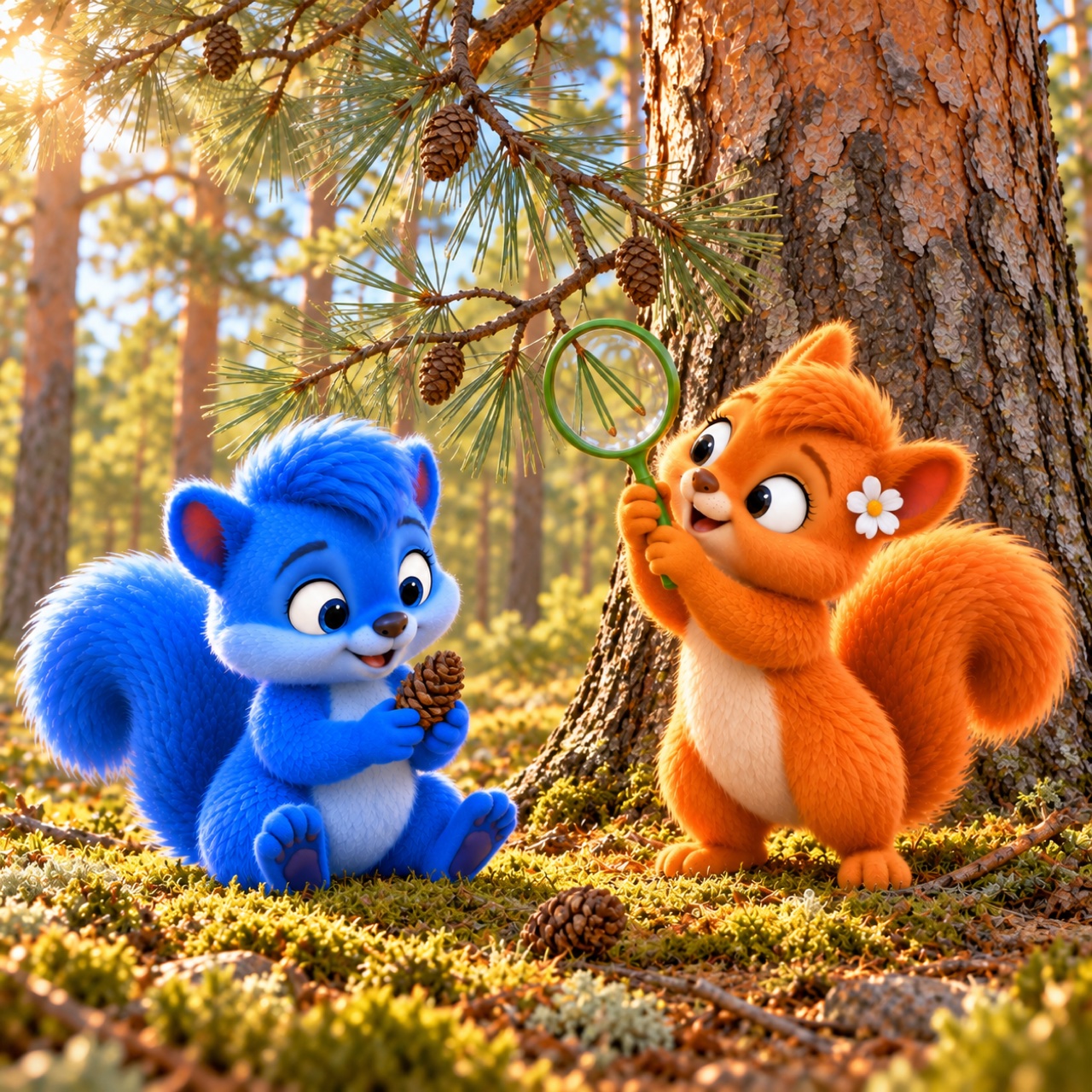
Needles in pairs! Flauschi shows Puschel the Scots pine. Can you also find its orange bark and little cones?
The short answer
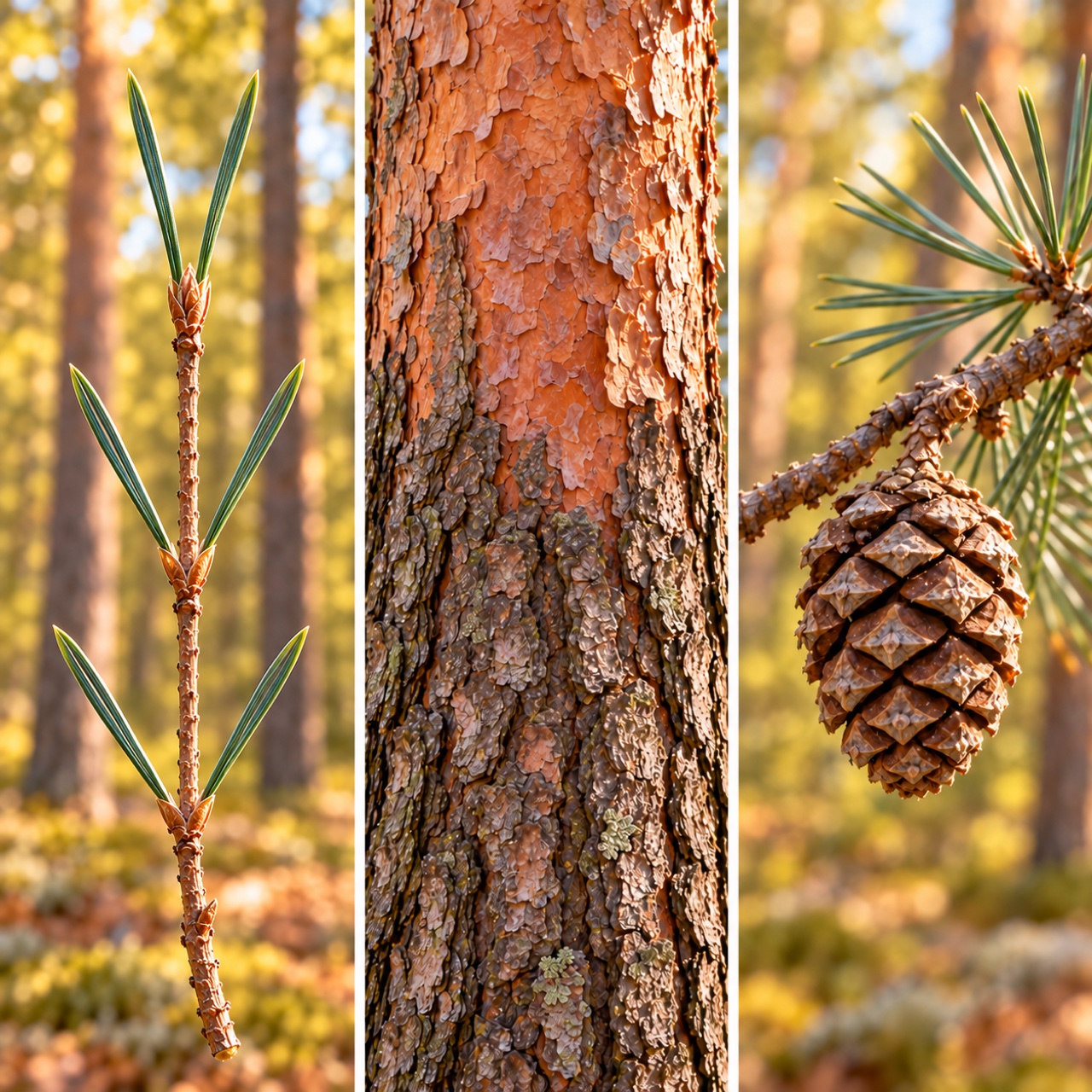
Scots pine needles usually grow in pairs from one small covering on the twig. It fits like a tiny sleeve around the bases of both needles. The lower trunk has deep grooves; higher up the bark is often orange-red.
See the connection
Simplified drawings, not to scale. Not a guide for identifying species.
An imagined Wusel scene
Puschel and Flauschi investigate
Puschel sees only separate loose needles below the tree. Flauschi points to a joined pair on a fallen twig. They compare the orange bark higher up. Several clues together make their guess stronger.
The needles
Scots pine needles are long and grow in pairs from one tiny shared sheath on the twig.
The bark
Low down, the trunk is dark and deeply fissured. Higher up, its thin bark is often orange-red.
The cone
Pine cones are fairly small and oval. Winged seeds ripen between their woody scales.
Mini quiz
What do you remember?
1. How do Scots pine needles grow together?
Choose one answer: a), b) or c).
- a)In pairs
- b)In large soft tufts
- c)All separately
Show answer
Correct answer: a): In pairs In pairs
2. What colour is the bark often higher up the trunk?
Choose one answer: a), b) or c).
- a)Orange-red
- b)Silvery grey
- c)Dark brown
Show answer
Correct answer: a): Orange-red Orange-red
3. What does a typical Scots pine cone look like?
Choose one answer: a), b) or c).
- a)Fairly small and oval
- b)Very long and hanging
- c)Like an acorn
Show answer
Correct answer: a): Fairly small and oval Fairly small and oval
Word help
- photosynthesis
- Green plants use light to make sugar from water and carbon dioxide. They release oxygen in the process.
Explore in more detail
Here you will find longer explanations and further details. You can explore them together.
Three tree clues
Are needles leaves too?
Yes. Green needles are narrow leaves. The pine uses light to make sugar in them, a process called photosynthesis. It carries several years of needles at once, but still sheds old ones. Evergreen does not mean that an individual needle stays on the tree forever.
Compare and understand
A ripe, dry cone can open its scales and release winged seeds. Many pine cones close again when damp. Moisture changes the material; no animal is opening its mouth. The seeds are not the same thing as the entire woody cone.