Trees and leaves · Douglas Fir
Recognising a Douglas Fir
What peeks out between the cone scales? Puschel spots little three-pointed tips. Flauschi knows the tree: a Douglas fir.

The short answer
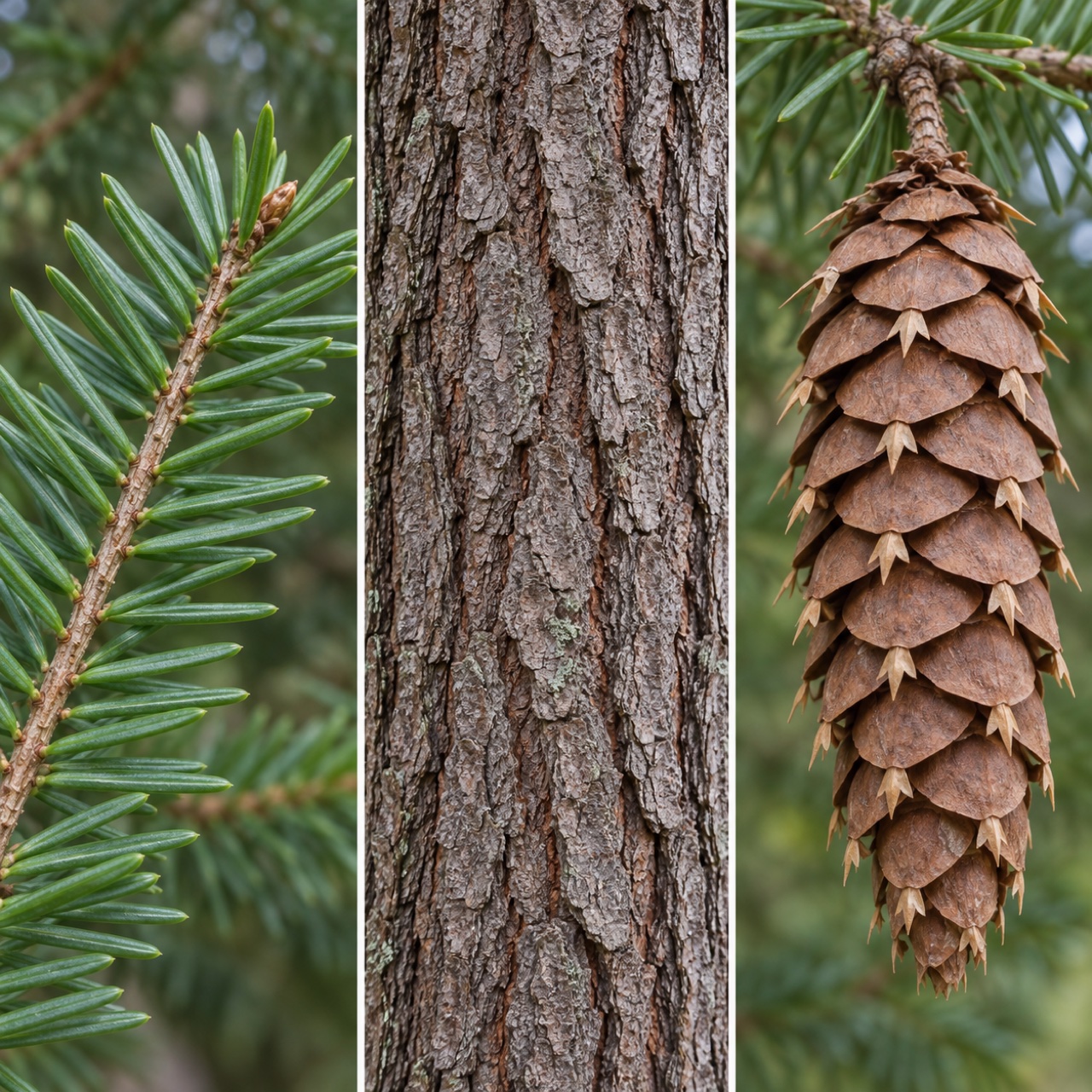
Flat Douglas fir needles grow singly on the twig. Its cones hang down. Small three-pointed tabs stick out between the broad cone scales. These tabs are called bracts. Compare several clues without breaking anything off.
See the connection
Simplified drawings, not to scale. Not a guide for identifying species.
An imagined Wusel scene
Puschel and Flauschi investigate
On a fallen cone, Flauschi spots little projecting parts. Puschel first draws them round, looks again and sees three points. They also compare the needles. The unusual cone detail helps them investigate.
Soft needles
The flat needles grow separately on the twig and feel soft.
Fissured bark
On older Douglas firs, the grey-brown bark is thick and deeply fissured.
Cones with three points
The cones hang down. Small three-pointed bracts protrude between their scales.
Mini quiz
What do you remember?
1. What projects between the Douglas fir cone scales?
Choose one answer: a), b) or c).
- a)Three-pointed bracts
- b)Smooth round scales without points
- c)Four-pointed bracts
Show answer
Correct answer: a): Three-pointed bracts Three-pointed bracts
2. Which needles match Douglas fir?
Choose one answer: a), b) or c).
- a)Long needles in pairs
- b)Many needles in dense tufts
- c)Soft needles
Show answer
Correct answer: c): Soft needles Soft needles
Explore in more detail
Here you will find longer explanations and further details. You can explore them together.
Three tree clues
What are the cone’s three-pointed tabs?
A Douglas fir cone has many scales. Three-pointed bracts project between the broad seed scales. These are plant parts, not animal feet or seed wings. They are sometimes compared to tiny mice with two hind legs and a tail. That image helps memory, but is not an explanation of how they formed.
Compare and understand
Douglas fir comes from western North America and is also planted in Europe. Its name does not make it a silver fir. Compare its hanging cones with fir cones, which stand upright and break apart on the tree. Use several features rather than relying on the name.