Trees and leaves · Black Alder
Recognising a Black Alder
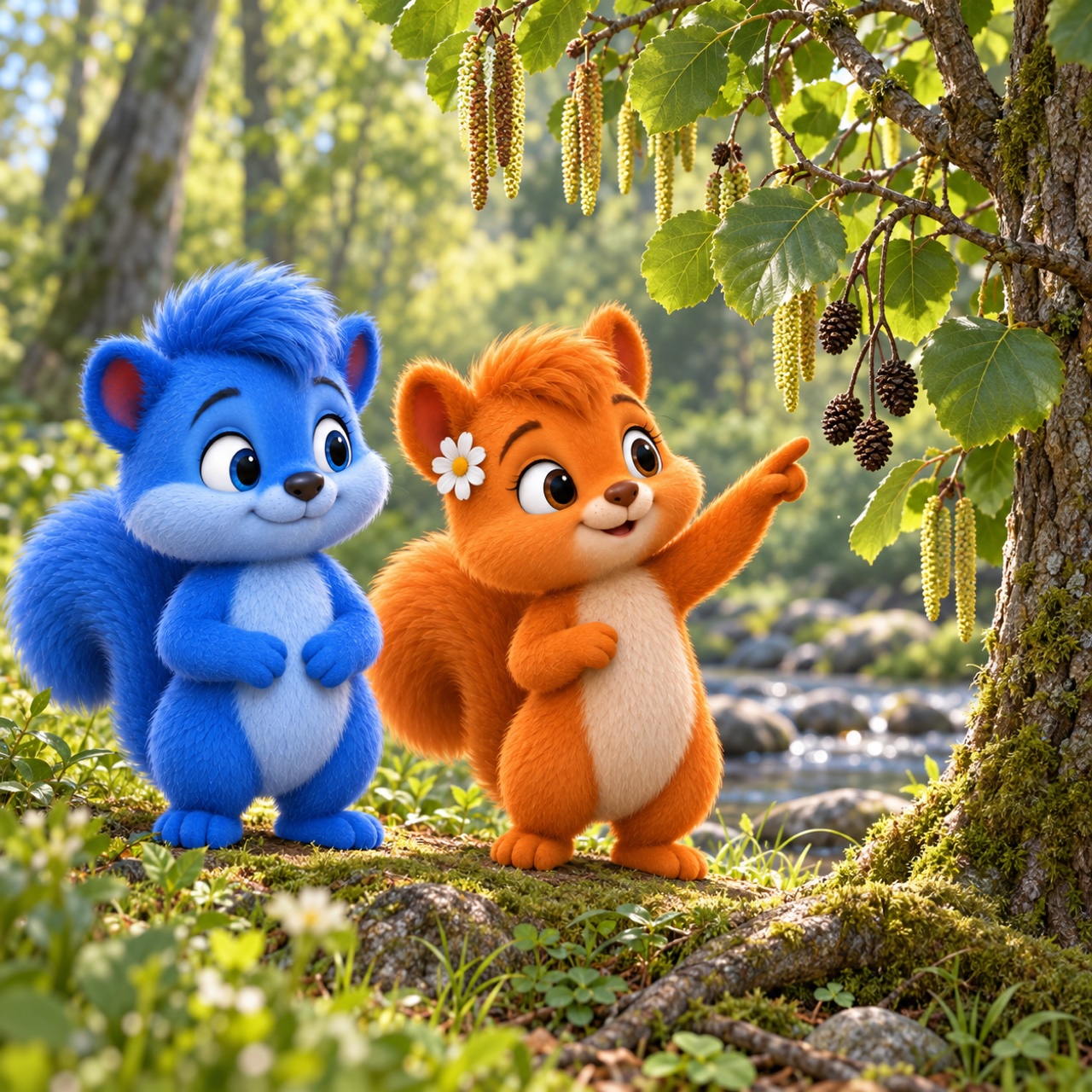
Cone-like fruiting heads beside the stream: is this a little fir? Puschel wonders. Flauschi spots rounded leaves: it is a black alder.
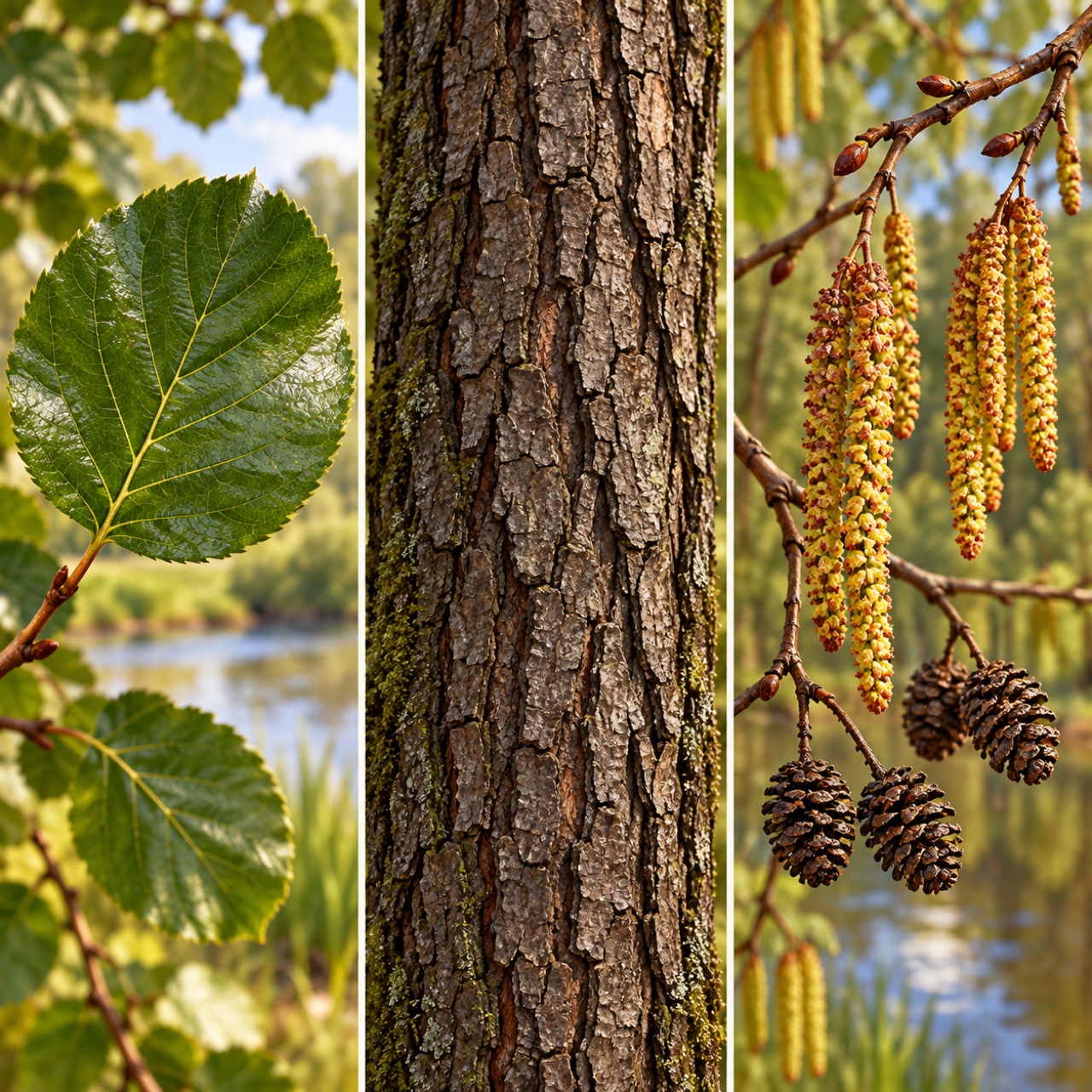
The short answer
Rounded leaves, dark older bark and small woody fruit clusters help identify black alder. The clusters look like tiny cones, but are not conifer cones. Black alders often grow in wet places.
An imagined Wusel scene
Puschel and Flauschi investigate
Puschel thinks the small woody fruit clusters prove it is a conifer. Flauschi shows him the rounded leaves on the same branch. They compare the alder picture. He notes that cone-like does not always mean a conifer cone.
Rounded leaves
The leaves are rounded and often have a small notch at the tip.
Dark bark
Older black alders have dark, rough and fissured bark.
Cone-like fruiting heads
The woody fruiting heads look like tiny cones and often stay on the tree. They are not conifer cones; small nutlets sit between their scales.
Mini quiz
What do you remember?
1. Which fruit clusters match black alder?
Choose one answer: a), b) or c).
- a)Acorns in small cups
- b)Cone-like fruiting heads
- c)Long hanging conifer cones
Show answer
Correct answer: b): Cone-like fruiting heads Cone-like fruiting heads
2. Which leaf shape matches black alder?
Choose one answer: a), b) or c).
- a)Rounded leaves
- b)Long, narrow, pointed leaves
- c)Pinnate leaves
Show answer
Correct answer: a): Rounded leaves Rounded leaves
Word help
- fruit cluster
- Several fruits attached together on one part of a plant.
Explore in more detail
Here you will find longer explanations and further details. You can explore them together.
Three tree clues
Cones on a broadleaved tree?
The small woody structures are fruit clusters. Each carries several tiny nut-like fruits containing seeds. The woody parts often remain long after the seeds have been released. They resemble cones, but that does not make alder a conifer.
Compare and understand
Alders often grow beside streams or on wet ground. Their small fruits can be carried by water. Habitat helps you know where to look, but does not identify a tree by itself. Stay on a safe path; compare leaves and fruit clusters without approaching steep or slippery banks.