Water, Waste & Recycling
How does used paper become new paper?
The short answer
Used paper contains many fibres. Water separates them into a watery pulp. Unwanted materials are removed. A thin layer of fibres forms on a mesh; water drains away. Pressing and drying turn the layer into paper again.
See how it works
Arrows show a direction or change. Sizes and distances are simplified. Read in order; each explanation belongs to the picture above it.
1. Collect suitable paper
Newspapers and cardboard contain useful fibres. Very dirty or specially coated papers are not equally suitable. Local sorting rules help choose the right materials.
2. Separate fibres
Water and movement release many fibres from the old sheet. This makes pulp. The paper has not simply vanished into water: the fibres remain as material.
3. Clean and form a sheet
Factories remove unwanted pieces and, depending on the process, printing inks. Pulp flows onto a mesh, where a thin fibre layer forms.
4. Press and dry
Water is removed and the fibre layer pressed and dried. As they dry, the fibres bond together to make a new sheet. Repeated processing loses or wears out some fibres; the cycle is not endless.
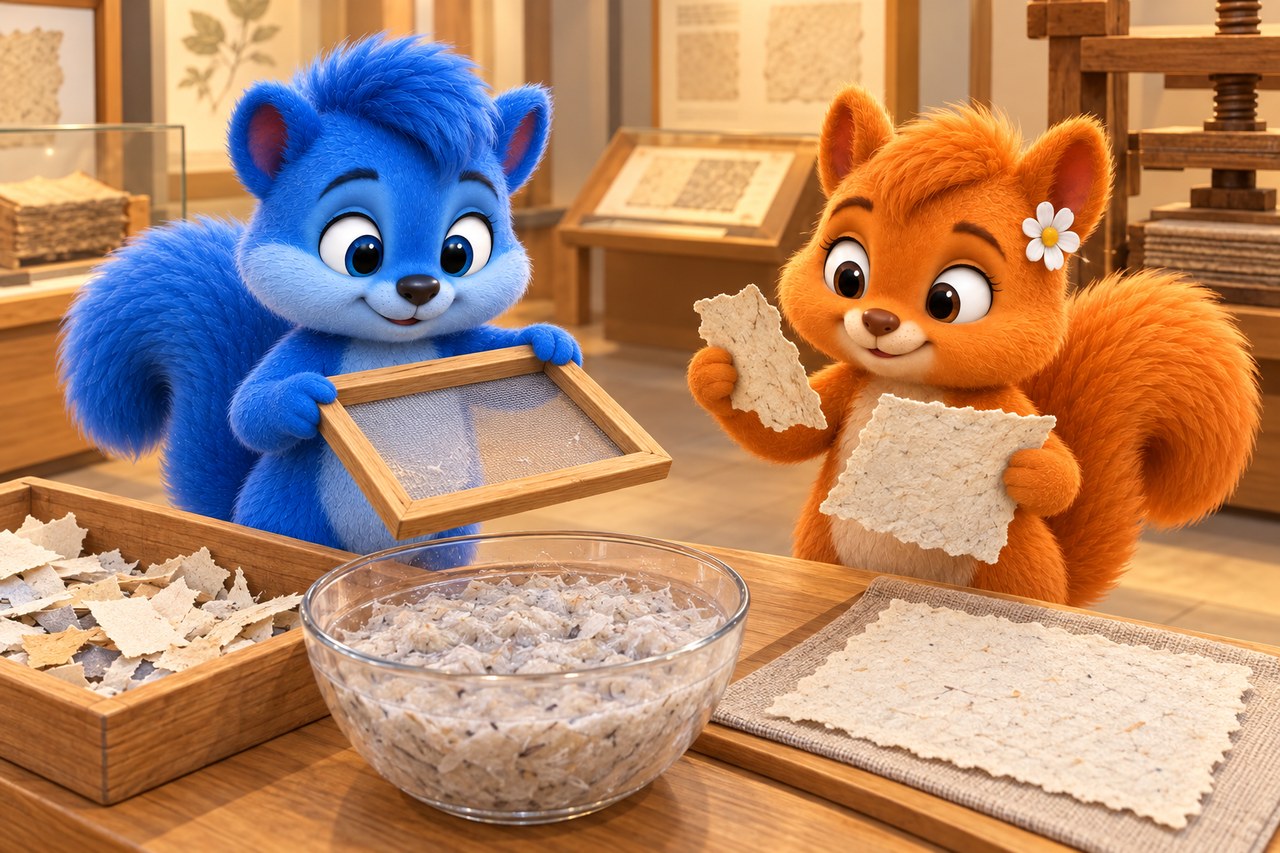
An imagined Wusel scene
Puschel and Flauschi investigate
Puschel sees the museum’s pulp and thinks the paper has gone. Flauschi shows the sheet on the papermaking mesh. As water drains away, he discovers what remains in the new paper.
Word help
- Fibre
- A very thin, long piece of material; many form a sheet.
- Pulp
- Water containing separated paper fibres.
Your activity
Compare an old paper scrap with a handmade sheet. Look for fibres with a magnifying glass. In a supervised papermaking activity use suitable paper, water and a safe mesh; do not taste anything.
Quiz: understand the idea
What is reused when paper is recycled?
Choose a), b) or c), then explain your choice.
- a)The finished old sheet shape without further processing.
- b)Fibres from the old paper.
- c)Only the water, while all fibres disappear.
Show the explanation
Correct: b): Fibres from the old paper.
The old sheet loses its shape; useful fibres can form a new layer.
Try a new example
Why must the fibre layer on the mesh be dried afterwards?
Choose a), b) or c), then explain your choice.
- a)Paper holds together only underwater.
- b)Dry fibres are newly made from water during drying.
- c)The pulp still contains a lot of water.
Show the explanation
Correct: c): The pulp still contains a lot of water.
Much of the water must leave. The remaining fibre layer becomes a sheet.
Explore in more detail
Here you will find longer explanations and further details. You can explore them together.
More to discover
Not an endless cycle
Processing saves new resources, but not every fibre remains useful each time. The overall paper cycle therefore also needs new fibres. Some paper products are not collected again either.
Pictures and sources for adults
Sources
Museum scene: AI-generated illustration, checked separately from the factual diagram. The diagrams simplify the process. Editorial source check: 19 October 2026.