Water, Waste & Recycling
How does a treatment plant make dirty water cleaner?
The short answer
A wastewater treatment plant uses several steps. It catches large objects, lets materials settle and uses tiny living organisms to break down pollutants. Other processes remove additional substances. Treated wastewater looks cleaner but is not automatically safe to drink.
See how it works
Arrows show a direction or change. Sizes and distances are simplified. Read in order; each explanation belongs to the picture above it.
1. Catch large objects
A screen has bars that catch larger objects. Sand can settle in a slow-flowing tank. These steps do not remove everything dissolved in the water.
2. Let solids settle
In another quiet tank, separable suspended solids settle to the bottom and form sludge. Dissolved substances can still travel onward with the water.
3. Tiny helpers
In biological treatment, microorganisms break down many organic pollutants. They receive oxygen in aerated areas. They do not work like a kitchen sieve or remove every substance.
4. Separate sludge and water
Sludge containing microorganisms settles in a final settling tank. Some is returned to treatment. Chemical steps may remove phosphorus, and some plants have additional stages.
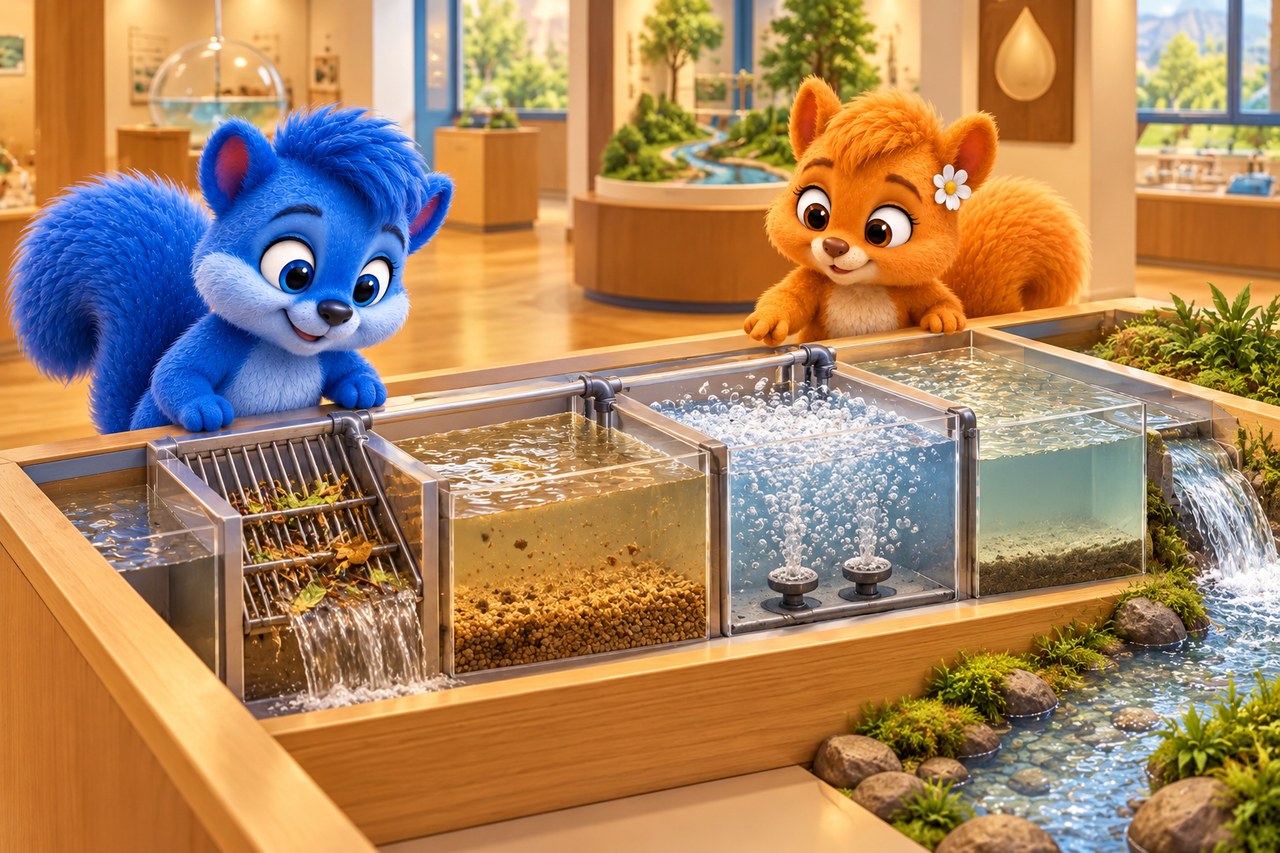
An imagined Wusel scene
Puschel and Flauschi investigate
Puschel points at the first screen in the museum model: “Finished?” Flauschi compares the later tanks. They realise that different kinds of pollution need different treatment steps.
Word help
- Microorganisms
- Very small living things, such as bacteria, imagined greatly enlarged here.
- Dissolved
- When a substance dissolves, its particles spread individually among water particles instead of remaining solid grains.
- Phosphorus
- A nutrient living things need. Too much in water can encourage excessive algal growth.
Your activity
Order picture cards: catch a large object, settle sand, tiny helpers, settle sludge. Explain what each step can do. Also say that this simplified model is not a drinking-water filter.
Quiz: understand the idea
Why is one coarse screen not enough?
Choose a), b) or c), then explain your choice.
- a)Biological treatment needs only large paper scraps.
- b)Dissolved pollutants can pass through with the water.
- c)A coarse screen automatically turns dissolved substances solid.
Show the explanation
Correct: b): Dissolved pollutants can pass through with the water.
A screen catches suitable solid pieces. Many other substances require further treatment.
Try a new example
Water looks clear after treatment. What does that tell us?
Choose a), b) or c), then explain your choice.
- a)Clear wastewater can go straight to the drinking-water tap.
- b)Clear water proves every germ has been removed.
- c)That alone does not make it drinking water.
Show the explanation
Correct: c): That alone does not make it drinking water.
Not all substances and germs are visible. Drinking water must meet particular standards and be checked.
Explore in more detail
Here you will find longer explanations and further details. You can explore them together.
More to discover
Why plants look different
Equipment and sequence can vary. Some processes share areas or happen at the same time. Our diagram shows a common principle. Returning some sludge is described in the text but is not drawn as a complete loop.
Pictures and sources for adults
Sources
Museum scene: AI-generated illustration, checked separately from the factual diagram. The diagrams simplify the process. Editorial source check: 19 October 2026.