Earth & Space
How does a robot explore Mars?
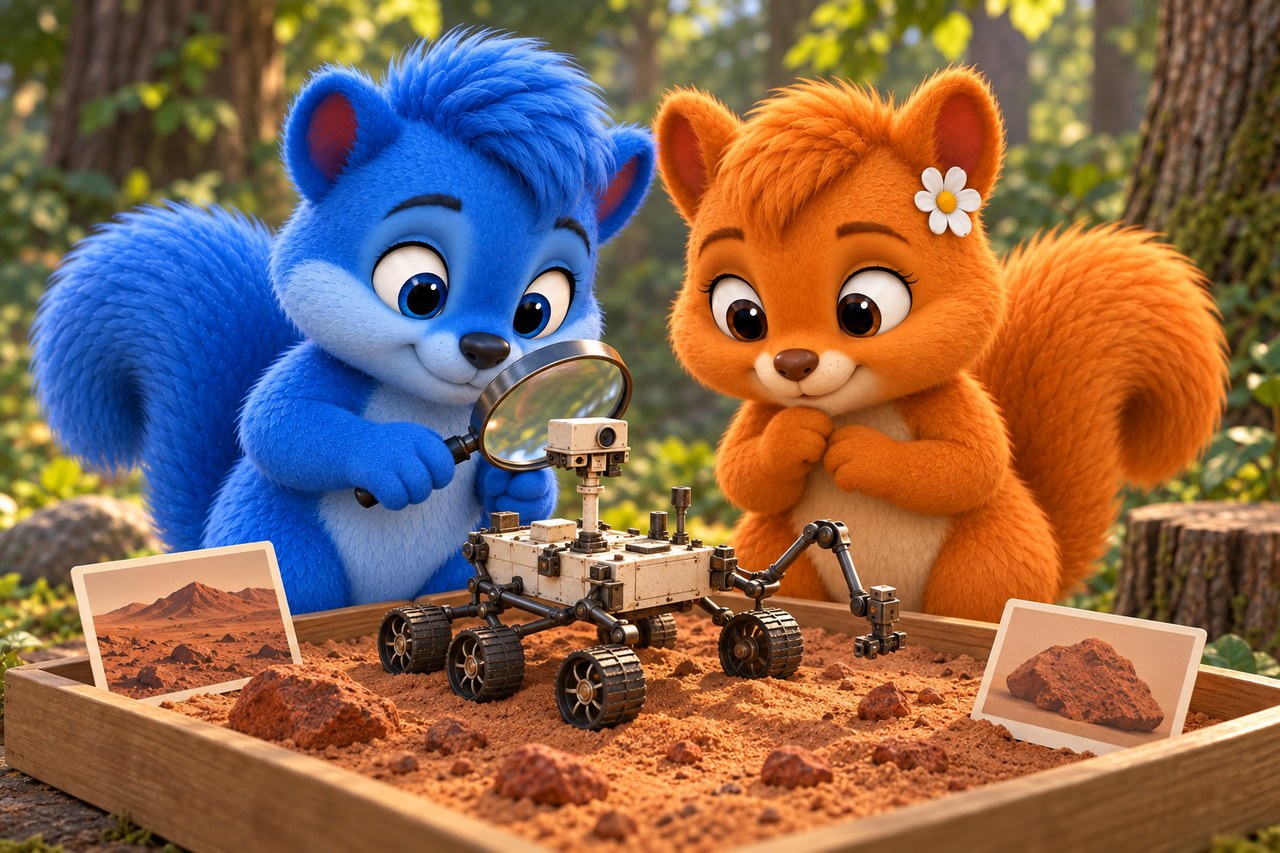
A robot travels across Mars. Puschel explores its tools for discovery.
The short answer
A Mars rover is a mobile research robot. Cameras and instruments examine rocks and ground. Its messages take time to reach Earth across the huge distance. People therefore plan its journeys, while the rover handles some tasks itself.
An imagined Wusel scene
Puschel and Flauschi investigate
Puschel expects a new Mars picture instantly after each button press. Flauschi lays a long string between Earth and Mars on the distance chart. They arrange cards as instruction, signal journey, investigation, reply. Now he plans the next safe step ahead.
Try explaining it
Why is a rover journey carefully planned ahead?
Choose a), b) or c), then explain your choice.
- a)Radio signals do not arrive instantly.
- b)Planning is needed because radio signals arrive only in sunlight.
- c)The camera cannot send images, so every route is chosen blindly.
Show the explanation
Correct: a): Radio signals do not arrive instantly.
A Mars rover is a mobile research robot. Cameras and instruments examine rocks and ground. Its messages take time to reach Earth across the huge distance. People therefore plan its journeys, while the rover handles some tasks itself.
Word help
- rover
- A mobile research robot on another world.
Explore in more detail
Here you will find longer explanations and further details. You can explore them together.
Understand step by step
How it works – simply explained
Instruments explore
A wheeled rover carries cameras and measuring tools. Equipment determines which terrain, rocks or other properties it can investigate.
Radio links worlds
Information travels by radio across a great distance, taking time. Steering it like a nearby toy car is therefore impossible.
Planning and autonomy help
Teams send planned tasks. A rover can execute certain steps itself. It is not alive but a machine with programmed abilities and limits.
Why a team cannot instantly say turn left
Radio signals need several minutes between Earth and Mars, varying with distance. Teams cannot see every movement instantly. They plan and send commands, while a rover performs suitable programmed steps independently. This means not needing an immediate command for every tiny action, not unlimited intelligence or freedom from rules.
The key points again
Discovery 1
A Mars rover carries cameras and instruments to investigate selected places.
Source: [1]
Discovery 2
Commands and data travel as radio signals. Distance means they do not arrive instantly.
Source: [2]
Discovery 3
Teams therefore plan carefully, and rovers can perform some tasks autonomously. They are not living animals.