Feelings & Togetherness
How can we share something that does not divide evenly?
Not everything splits neatly in half. The Wusels talk about what may be fair.
The short answer
Sharing fairly means finding an understandable agreement. If something is left over, taking turns may help. Fair does not always mean the same number of pieces. You do not always have to give away your favourite belongings.
An imagined Wusel scene
Puschel and Flauschi investigate
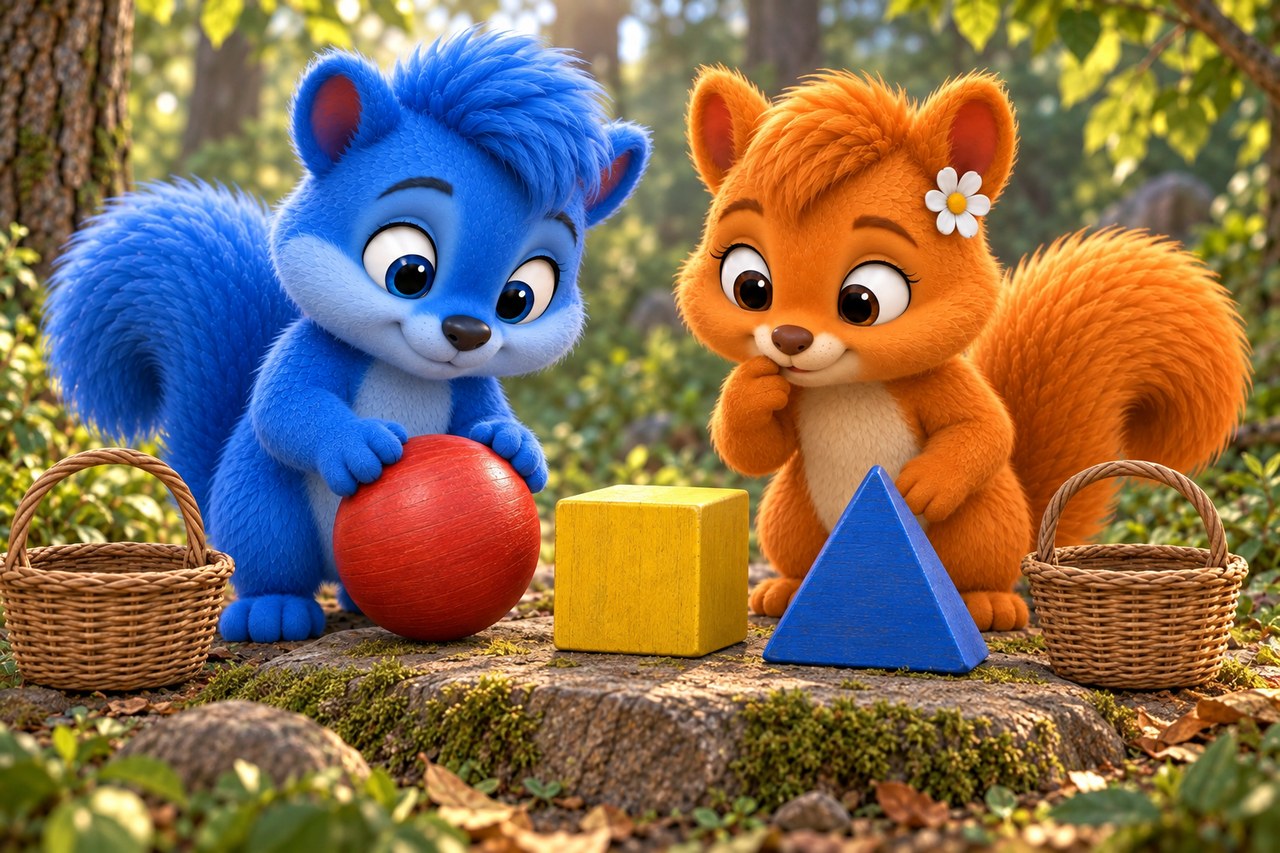
There are three large play blocks for two Wusels. Puschel gives each one; one is left. Flauschi suggests using the third for the bridge first and the tower afterwards. They check that both agree to this order.
Try explaining it
This question is about a fictional situation and considerate actions, not about which feelings you should have.
Two characters want the same indivisible toy. What agreement is possible?
Choose a), b) or c), then explain your choice.
- a)Have to give away every favourite belonging every time.
- b)A shared, understood order for taking turns.
- c)Let only the stronger character decide without agreement.
Show the explanation
Correct: b): A shared, understood order for taking turns.
Sharing fairly means finding an understandable agreement. If something is left over, taking turns may help. Fair does not always mean the same number of pieces. You do not always have to give away your favourite belongings.
Think about it, if you like
You can use the fictional situation; you do not have to share personal experiences.
Two children want to use the same indivisible toy. What agreement is possible?
One possible idea
They could agree to take turns. Both should understand the rule and be able to state their boundaries.
Explore in more detail
Here you will find longer explanations and further details. You can explore them together.
Understand step by step
What does this mean in everyday life?
Examples are possible situations. You need not feel a particular emotion or share a personal story.
A remainder reveals the issue
Two children have three shared pieces. One each leaves one over. Equal counts do not solve everything.
Several fair ideas may work
Share the remaining piece in play or alternate later. Adults may divide suitable food.
Agreement matters
Discuss ownership and needs. Personal favourites need not always be shared. Fairness is more than giving everything away quickly.
References for this explanation: [1]
The key points again
Discovery 1
Equal numbers are not the only possible fair solution.
Source: [1]
Discovery 2
People can take turns with an indivisible object; an adult may sometimes divide something suitably.
Source: [1]
Discovery 3
Clear agreements should consider needs. Nobody must always hand over favourite belongings.
Source: [1]