Woodland plants · Urtica dioica
Discover stinging nettle
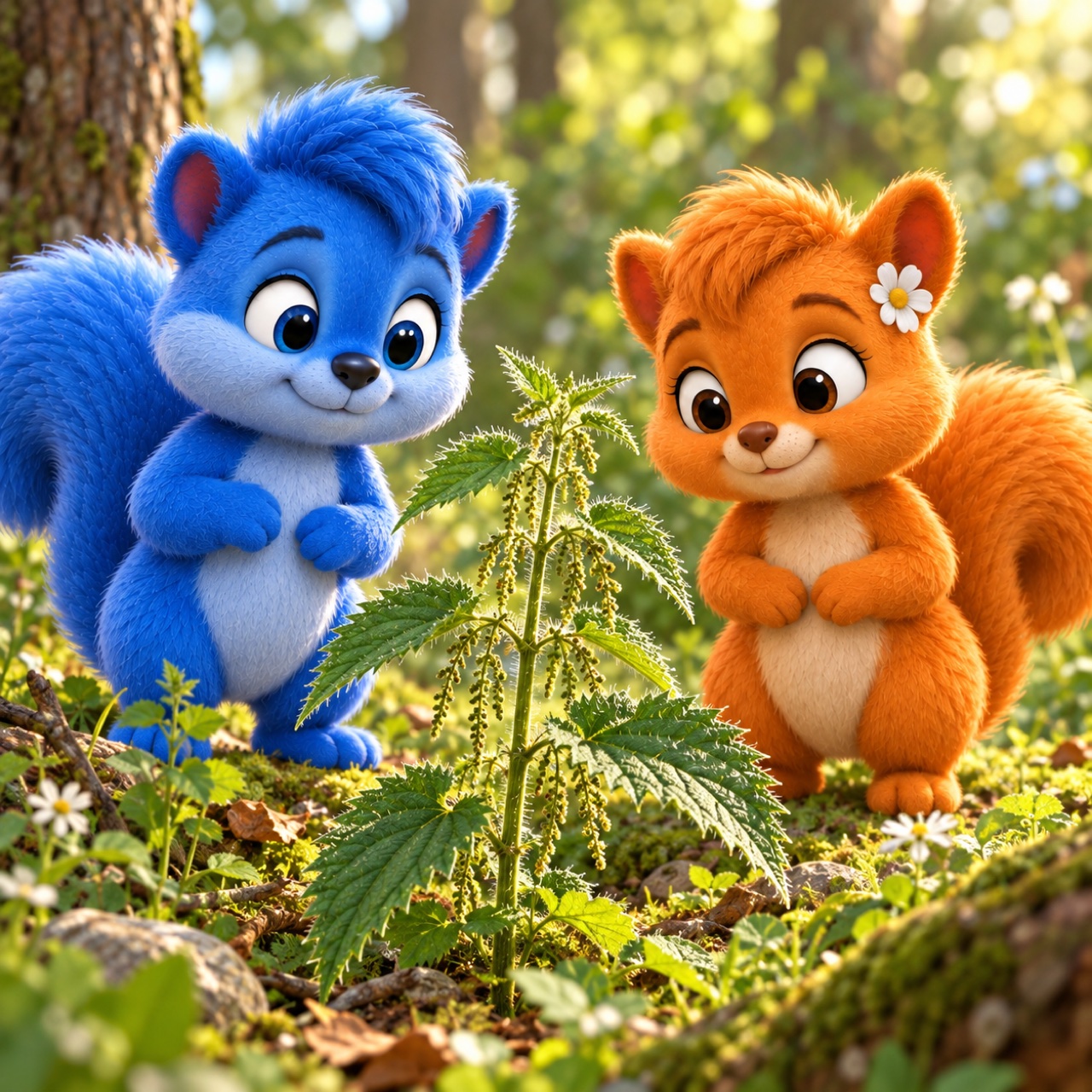
Toothed leaves to count, but without touching! Flauschi stops Puschel’s curious paws. Why can a nettle sting your skin?
The short answer
Common nettle has pointed leaves with coarsely toothed edges. Leaves grow in opposite pairs. Stinging hairs can irritate skin. Look without touching to test them.
An imagined Wusel scene
Puschel and Flauschi investigate
Puschel wants to count the jagged leaves. Flauschi gently stops him: Flauschi“Count with your eyes – this plant can sting.”
Now Puschel looks for leaves facing one another across the stem. Puschel“Two neighbours together.” Flauschi looks too, without touching them. Puschel does not need a stinging paw to remember the leaf pattern.
Plant clues
Three things to notice
Toothed leaves
The green leaves taper to a point and have coarsely toothed edges.
Opposite pairs
Two leaves grow opposite each other on the stem.
Stinging hairs
Fine hairs on leaves and stems can sting skin.
Mini quiz
What do you remember?
1. What does a nettle leaf edge look like?
Choose one answer: a), b) or c).
- a)Needle-shaped leaves
- b)Toothed leaves
- c)Smooth leaf edges
Show answer
Correct answer: b): Toothed leaves Toothed leaves
2. What can sting the skin on a nettle?
Choose one answer: a), b) or c).
- a)The small teeth along the leaf edge
- b)The stinging hairs
- c)Pollen on the leaves
Show answer
Correct answer: b): The stinging hairs The stinging hairs
Word help
- toothed
- The edge has little points like tiny teeth. A leaf has no real teeth.
Explore in more detail
Here you will find longer explanations and further details. You can explore them together.
How can a hair make skin sting?
Stinging hairs are specialised tiny hairs. On contact, a tip can break off, leaving a sharp point that can puncture skin and introduce irritating fluid. Irritation may cause stinging or a raised bump. There is no flame and the hair is not hot.
Compare and understand
Nettles feed some butterfly caterpillars, including peacocks. A plant uncomfortable for us to touch can therefore be an important habitat for another animal. Look for feeding marks or caterpillars from a distance. You do not need to sting yourself to understand the explanation.