Earth & Space
What is a solar eclipse?
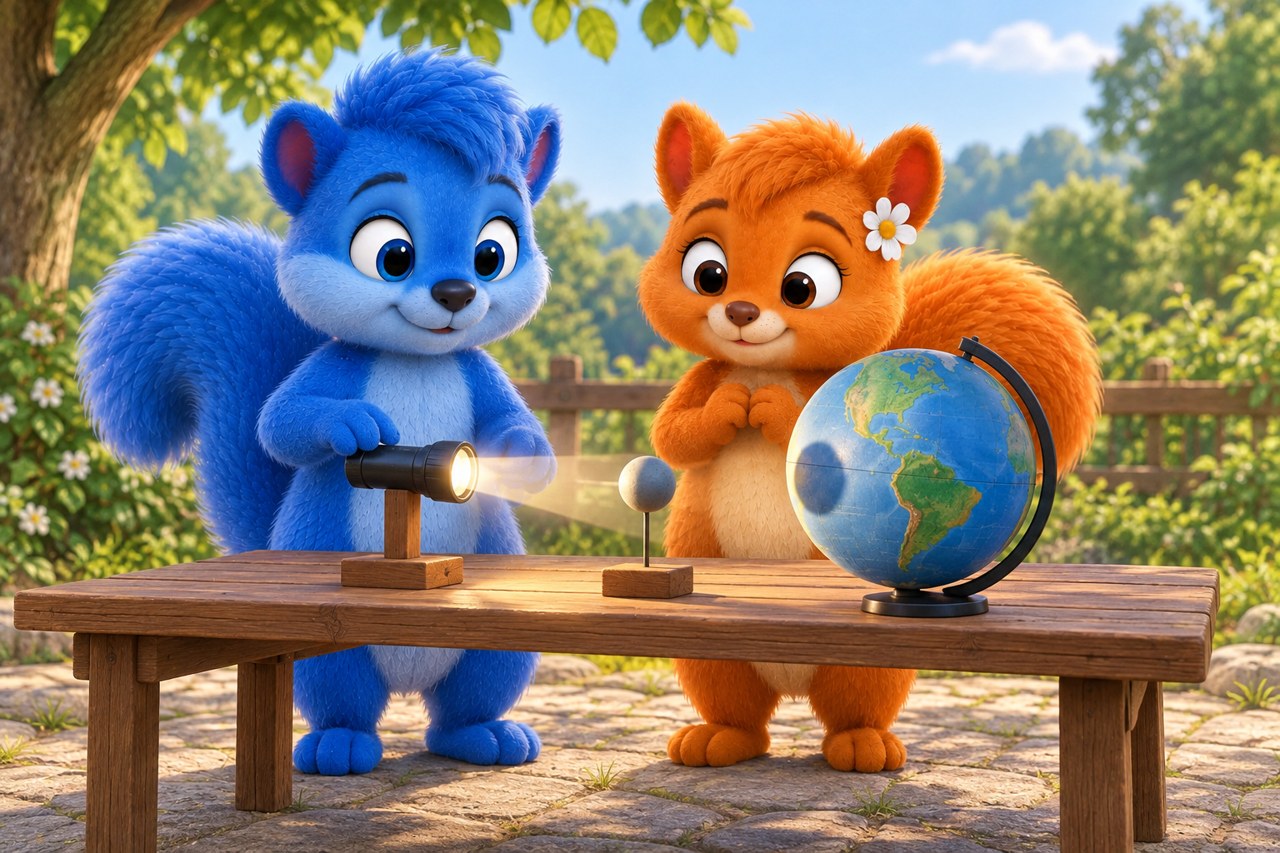
A little ball casts a shadow on the model Earth.
The short answer
During a solar eclipse, the Moon stands between Sun and Earth. Its shadow reaches part of Earth. From there it hides some or all of the Sun. The Sun keeps shining. We use safe models and never look directly at the Sun.
An imagined Wusel scene
Puschel and Flauschi investigate
A little lamp, a ball and a globe stand on the shady garden table. Puschel“A Sun with a switch?”
Flauschi“Only in the model. The lamp represents the Sun, the small ball the Moon and the globe Earth.”
A shadow falls on the globe. Puschel“The ball blocks some light.” Flauschi“In a similar way the Moon can cover the Sun during a solar eclipse.”
Puschel looks only at the globe. Puschel“The real Sun does not need to demonstrate this for us.”
Flauschi switches off the model lamp. They tidy up. The ball stays a ball and their eyes stay protected from sunlight.
Little Wusel quiz
What is between Sun and Earth during a solar eclipse?
Choose one answer: a), b).
- a)Earth.
- b)The Moon.
Show answer
Correct answer: b): The Moon. The Moon is between Sun and Earth.
Does the Sun switch off during an eclipse?
Choose one answer: a), b).
- a)No, the Moon covers it from our viewpoint.
- b)Yes.
Show answer
Correct answer: a): No, the Moon covers it from our viewpoint. No. The Sun keeps shining.
Word help
- orbit
- The path of one body around another.
Explore in more detail
Here you will find longer explanations and further details. You can explore them together.
Understand step by step
How it works – simply explained
Three bodies align
During a solar eclipse the Moon is between Sun and Earth, passing in front of the Sun from our viewpoint.
The Moon blocks light
Its shadow reaches part of Earth, where the Sun appears partly or fully covered. The Sun keeps shining.
Not every new Moon works
The tilted lunar orbit often makes the shadow miss Earth. A model explains shadows, not true distances. Observe only with approved protection and adults; never look directly at the Sun.
Why not every new Moon causes an eclipse
At new Moon the Moon lies roughly towards the Sun from us, but its orbit is tilted relative to Earth’s orbit. Its shadow usually misses Earth. Only suitable alignment lets it reach part of Earth. New Moon and solar eclipse are not the same. The imagined model explains this and is no invitation to look at the Sun.
The key points again
Discovery 1
During a solar eclipse, the Moon is between the Sun and Earth. Its shadow can reach part of Earth.
Source: [1]
Discovery 2
From suitable places, the Moon appears to cover some or all of the Sun. At new moon, the Moon’s unlit side faces us. Not every new moon causes an eclipse because the Moon’s orbit is tilted slightly.
Source: [1]
Discovery 3
The Sun does not switch off. A lamp-and-ball model shows the shadow idea but not the real sizes and distances in space.
Source: [1]