Everyday Life & Technology
How does pedalling move a bicycle forward?
The two follow the route from the pedals to the rear wheel.
The short answer
Pedalling turns the front chainring. The chain carries the movement to drive the rear wheel. The tyre pushes against the ground and the bicycle moves forwards.
An imagined Wusel scene
Puschel and Flauschi investigate
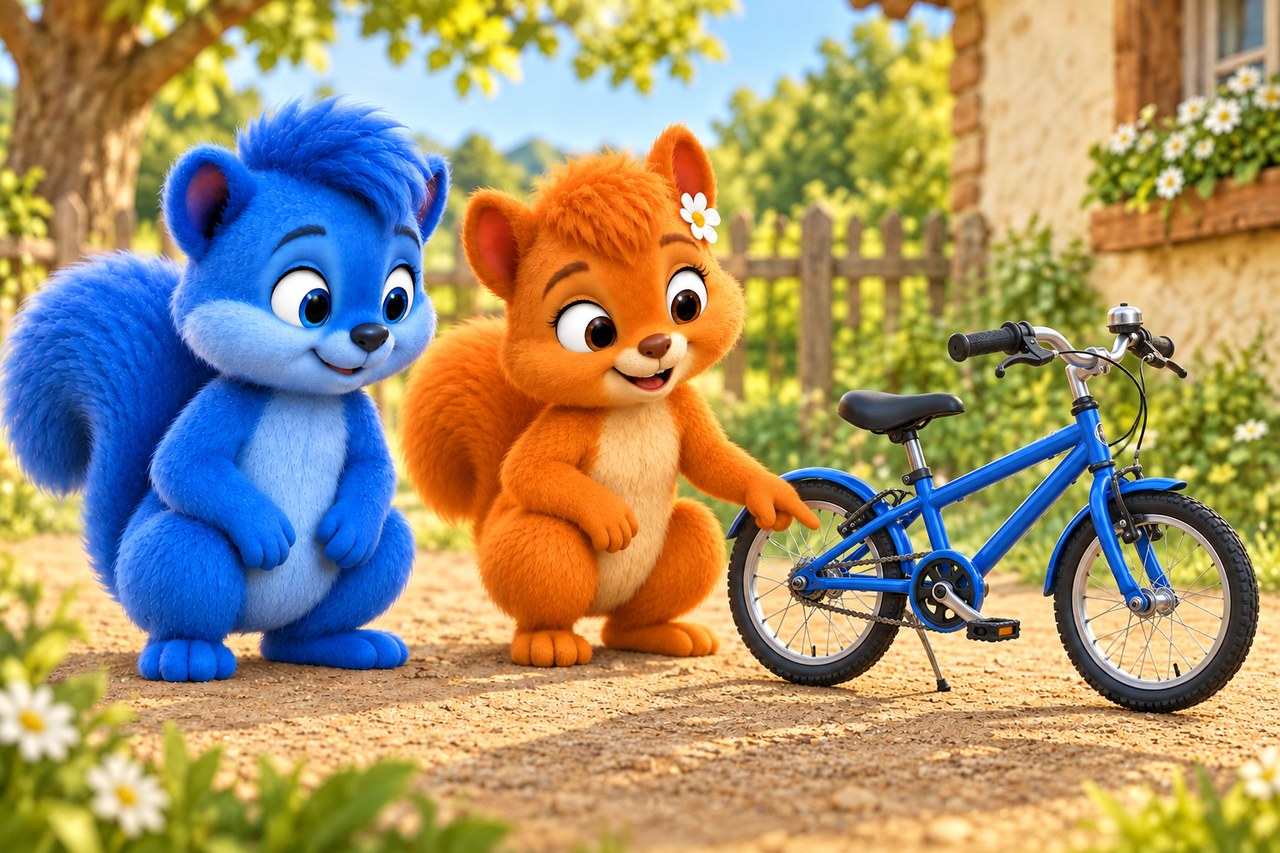
A small bicycle stands safely on the path. Puschel“The pedals are in front and the rear wheel is behind. How do they talk?”
Flauschi points towards the chain. Flauschi“That is the transmission route on this bicycle.”
They follow it with their eyes from the large chainring to the rear sprocket. Puschel“A loop made of lots of little links!”
Flauschi“When you pedal, the chain drives the sprocket and rear wheel. Some bicycles have other kinds of drive.”
Puschel keeps his paws back. Puschel“Today we only look. The chain does not need paws as passengers.”
Little Wusel quiz
Which wheel does pedalling drive on a usual chain bicycle?
Choose one answer: a), b).
- a)The rear wheel.
- b)The front wheel.
Show answer
Correct answer: a): The rear wheel. The chain and rear sprocket drive the rear wheel.
Does absolutely every bicycle have a chain?
Choose one answer: a), b).
- a)No.
- b)Yes.
Show answer
Correct answer: a): No. No. Some bicycles use a belt drive, for example.
Word help
- rotation
- Turning around one's own axis.
Explore in more detail
Here you will find longer explanations and further details. You can explore them together.
Understand step by step
How it works – simply explained
Pedalling becomes rotation
Your feet move pedals and cranks, rotating the front chainring. Its teeth engage the chain.
The chain transfers movement
The moving chain turns a rear sprocket and drives the rear wheel. The front wheel needs no second chain.
The ground helps movement
The driven tyre pushes backwards against the ground. The ground exerts a forward force on it. Without enough grip, the wheel may spin without moving forward properly.
Why the front wheel needs no chain
On a usual chain-driven bicycle, pedals, cranks, chainring, chain and rear sprocket drive the rear wheel. Contact with the ground moves the bicycle forwards. The front wheel rolls as the bicycle carries it along, so it needs no second chain. Compare how your force passes through the drive with how the whole bicycle moves. Observe a stationary bicycle and keep fingers away from the chain and gears.
The key points again
Discovery 1
On a typical chain-driven bicycle, the pedals are attached to two rigid arms called cranks. Pedalling turns the front toothed wheel, called the chainring. The chain runs over its teeth.
Source: [1]
Discovery 2
The chain carries this movement to a toothed wheel at the rear wheel. Pedalling therefore drives the rear wheel. Some bicycles use a belt instead of a chain: a strong band with teeth. This is called a belt drive.
Source: [1]
Discovery 3
At the driven rear wheel, the tyre pushes backwards on the ground; the ground exerts a forwards force on that wheel. This can move the bicycle forwards.
Source: [2]