Discovery 22 / 27
Puschel & Flauschi’s Forest Discoveries
The Acorn with the Tiny Hole
The green explorer’s magnifying glass with a leaf-shaped handle
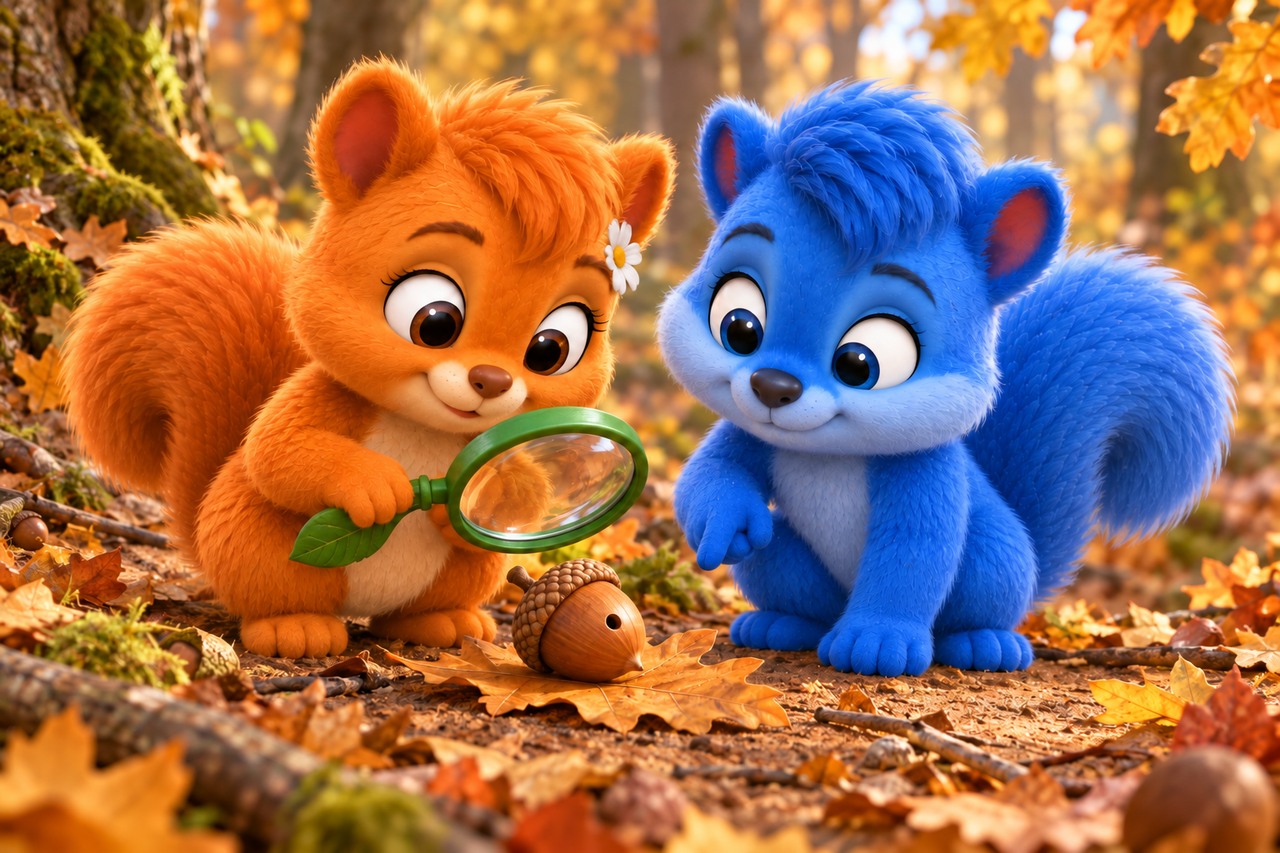
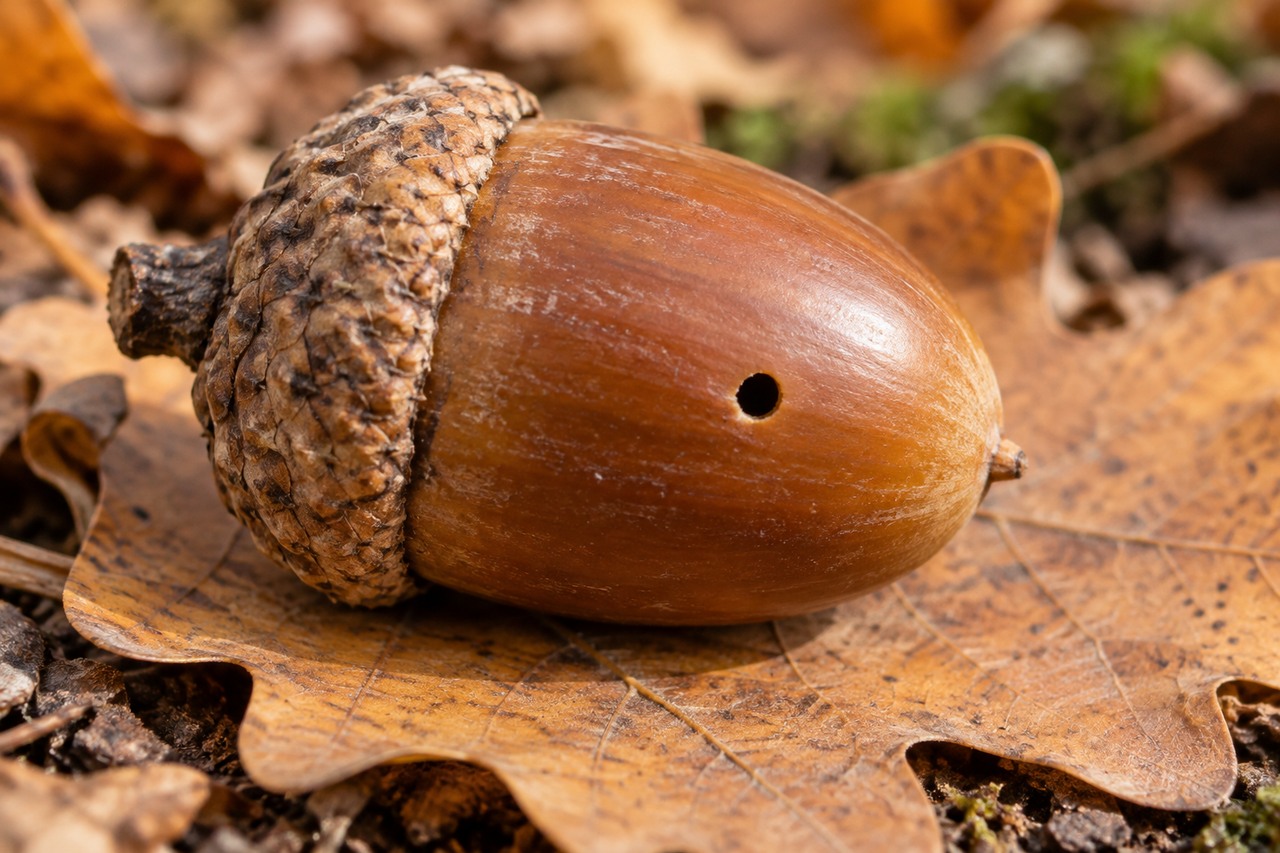
Yellow leaves, brown acorns and a little twig lay beneath the old oak. The twig bobbed whenever the wind passed. Puschel stopped at the edge of the dry path. On a leaf lay an acorn with a small round hole in its side. He bent down and opened his eyes wide.
Puschel“Flauschi, this acorn has a front door! But somebody forgot the handle.”
Flauschi knelt beside him. She held her green magnifying glass with its leaf-shaped handle above the acorn so both could see the hole. Puschel moved his tail out of her view. The opening was small but easy to see. The shell around it was still whole.
Flauschi“Perhaps someone came out through it.”
Puschel“That must have been a very little home. With a built-in food cupboard.”
He rested a paw beside the leaf without touching the acorn. The hole looked different from the ragged bite on another acorn nearby. A little front door was a lovely idea for a story. For a real explanation, they wanted to look more closely.
Flauschi“There are beetles called acorn weevils. Their young grow inside acorns. A young one is called a larva.”
Puschel“Is a larva a beetle that isn't finished yet?”
Flauschi“Yes. It looks different from the adult beetle. Later it can chew an exit through the shell.”
Puschel studied the hole again. Now he imagined a tiny larva squeezing through and disappearing into the soil. This was no door with hinges. The acorn had provided food, and eventually the little animal needed a way out.
Puschel“Perhaps it's a moving-out door. The home got too small.”
Flauschi smiled. She explained that they had not seen the animal that had lived in this particular acorn. A hole alone could not tell them exactly which beetle species it had been. It was a useful clue, but not complete proof. Puschel nodded very seriously and raised the magnifying glass a little.
Puschel“I'll write Perhaps an acorn weevil inside my head. Perhaps gets a place of its own.”
For a moment he wondered whether they should open the acorn. Then he looked at all the whole acorns beneath the tree. Even if no animal remained inside, they did not need to break it to solve the puzzle. They left it on its leaf.
Flauschi“We can look at the hole without looking inside. Some discoveries stay a little unfinished.”
Puschel“Just like this acorn. Only in a different way.”
A leaf drifted slowly down between them. Puschel waited while Flauschi put the magnifying glass away. On their way home he noticed three more acorns without any holes at all. He greeted each with a little nod. Beside the last one he paused.
Puschel“If anyone lives here: we won't ring the bell today.”
Flauschi laughed. They walked on, leaving the little brown acorn beneath the big oak. Its tiny hole was still there. To Puschel it now looked like a clue left by a journey.
Look closely
What the two discovered
Acorn weevils are small beetles with long snouts. Females lay eggs in developing acorns.
An egg hatches into a larva. It feeds and grows inside the acorn.
Later the larva chews an exit hole and enters the soil. It becomes an adult beetle later.
A round hole can be a clue to a beetle larva. The hole alone does not identify the exact species.

Little Wusel quiz
Choose one answer: a) or b).
What can the two tell for certain from the hole?
Show answer
The correct answer is b). A hole may be an exit hole. It proves neither the exact beetle species nor that an animal remains inside today.
Explorer’s rule: Leave animals and plants in peace. Just watch and do not damage anything.
Sources for adults: Wildlife Trust: Acorn weevil (Englisch / English)
Keep exploring
Where shall we wusel next?
Choose how to keep exploring: another story or a related activity.
Why Does the Fir Stay Green?
Most trees have lost their leaves. Puschel thinks the fir must have forgotten autumn.
Read another discovery →Keep exploring together
Nature bingo and woodland games for curious explorers.
Explore woodland games →